What Are You Afraid Of?

The Question
Tell me.
What are you afraid of?
What is your biggest fear?
And is it still the same?
I’ll tell you mine.
Except I am not sure it still meets the misery threshold required to be granted the titillating title of fear.
And that may be one of the more perverse little penchants of penance that belongs to cirrhosis and liver disease.
Because once your own body becomes the thing you cannot fully turn the lights on inside, fear changes shape.
It is not clean anymore.
It is not a red button with a reasonable escape plan.
It is not a dark corner you can walk away from, a noise down the hall, or some easy little monster with a costume and rules.
Fear is supposed to protect us.
That is the old arrangement.
It is ancient.
Biological.
Useful.
One of those primal little survival tools stitched into the human operating system so we do not pet the wolf, eat the wrong berry, wander too close to the cliff, or stand too close to the microwave while holding our cell phone because someone’s aunt swears that is how you become soup.
Fear is not weakness.
Fear is an ally.
Fear is your body saying:
Pay attention.
But cirrhosis makes a mockery of the old archioalogical arrangement.
Because what happens when the thing setting off the alarm is not outside of you?
And once that happens, fear stops being a clean little cue from a red button and an emergency escape hatch.
Because what do you do when the hair standing up on your arm is taking orders from the anemia antagonist?
What do you do when the thing you were built to fear becomes the thing you need to survive long enough to say good morning one more time?
Cirrhosis Steals
I talk about cirrhosis as a thief all the time.
It is probably my favorite insult to cast at this disease, which is literally rotting away the piece of my body that draws its name from live.
Live.
Liver.
Alive.
Me.
There is something almost too pathetically poetic about that.
Cirrhosis steals.
That is what it does.
It steals your energy. It rips the coal out of the engine and still expects the train to make it through the mountain.
It steals your physical appearance.
Your skin.
Your eyes.
Your abdomen.
Your face.
The casual luxury of recognizing yourself without conducting a forensic investigation.
It steals your mind.
It steals spontaneity.
It steals appetite.
It steals privacy.
It steals confidence.
It steals the casual assumption that your body is on your side, that it is not two timing you .
It steals, steals, steals.
It forces you into some penitentiary-esque sentence that is half insane asylum, half solitary confinement, and half maximum-security life in prison.
And yes, I know that is too many halves.
So is liver disease.
Nothing about it divides divinely.
The Fear It Stole
But one of the most insulting things cirrhosis stole from me was not something I expected to lose.
It stole my greatest fear.
No.
That sounds too clean.
It did not commit larceny it like a jewel thief in velvet gloves.
It took my greatest fear, chewed it into a wet little pulp, smacked it around like old bubble gum, dragged it across the underside of a hospital waiting-room chair, and spit it back in my face with a lab order attached.
Vile.
Vagrant.
Deeply grotesque.
And somehow devastatingly on point.
Because cirrhosis did not simply take my fear away.
It made my fear useful.
That is the obscene part.
The thing that once protected me became the thing I had to walk toward.
The black-winged sentinel became the threshold.
The monster became the gate.
The very thing my body had spent a lifetime screaming about became one of the only tools available to keep me alive.
Needles
The thing cirrhosis stole from me was needles.
I know.
Wild.
Maybe anticlimactic, depending on your personal ranking of horrors.
But I was terrified of needles.
Not my cup of titanium.
Terrified.
I was the kind of scared of needles where annual bloodwork influenced my lifestyle.
I ate healthy, in part, because I was scared of more needles.
And for the record, no, I was not out here cosplaying as a triathlete with a macro spreadsheet and a personalized hydration vest.
Let us not rewrite history into propaganda recovered from the first Athens Olympics.
I just tried.
I ate the vegetables.
I moved my body.
I drank the water.
I attempted to be the responsible little citizen of my own bloodstream.
That was the deal I thought I had made with the universe.
Or, at the very least, with a stubborn little thing called surgical steel.
We would keep our distance and meet once a year for the duel my health insurance and former outlook on life demanded.
Behave yourself, and maybe the silver medieval vampire sword stays away.
Needles were not just scary to me.
They were behavior modification.
My fear of needles was practically preventive medicine.
It was protecting me from liver failure.
Except, of course, it did not.
Because my immune system is an asshole.
But that is a separate issue.
Fangs
And if you know me, you may be thinking:
Needles?
Really?
You are also scared of snakes.
Yes.
And do you know why I am scared of snakes?
Fangs.
And what is a fang?
A needle that works the other way.
So let us not pretend this is inconsistent.
My brand has always been clear.
Sharp things that enter the body?
No, thank you.
The Cursed Tarot Card
Then cirrhosis came along like a cursed tarot card read beside a blistered bingo sheet in a cigarette-smoked hole-in-the-wall bar where the ceiling tiles have seen too much and the fortune-teller coughs before she ruins your life.
The biggest fear of my life became one of the most normalized requirements of my existence.
Blood draws.
IVs.
Labs.
Procedures.
Repeat checks.
Needles in rooms.
Needles in arms.
Needles as calendar events.
Needles as data collection.
Needles as the price of knowing whether I was stable, worsening, improving, qualifying, declining, surviving.
The thing I feared became the thing I had to use to stay alive.
And I know this is where the story usually turns empowering.
Where I am supposed to say I conquered it.
That I became brave.
That I learned something beautiful about myself.
That somewhere inside the fluorescent terror of lab chairs and alcohol wipes, I found my inner warrior goddess with good veins and excellent hydration.
No.
Not exactly.
The truth is more disturbing than that.
What happens when the thing you spent your entire life flinching from becomes unavoidable?
Not once.
Not for a dramatic scene.
Repeatedly.
Clinically.
Routinely.
Casually.
As if the universe looked at the one thing your nervous system had built an entire alarm system around and said:
Perfect.
We will make that the entrance.
The First Time Alone
I will never forget the first time I actually had to go get something done by myself.
And I know how that sounds.
Silly.
Adult woman afraid of needle.
Fine.
But imagine your future depends on this.
Imagine your life depends on this.
Imagine the price of knowing anything about your own survival is walking into a sterile room, sitting under horrible hospital luminescence, and surrendering your body to the very thing your nervous system has spent decades declaring as danger.
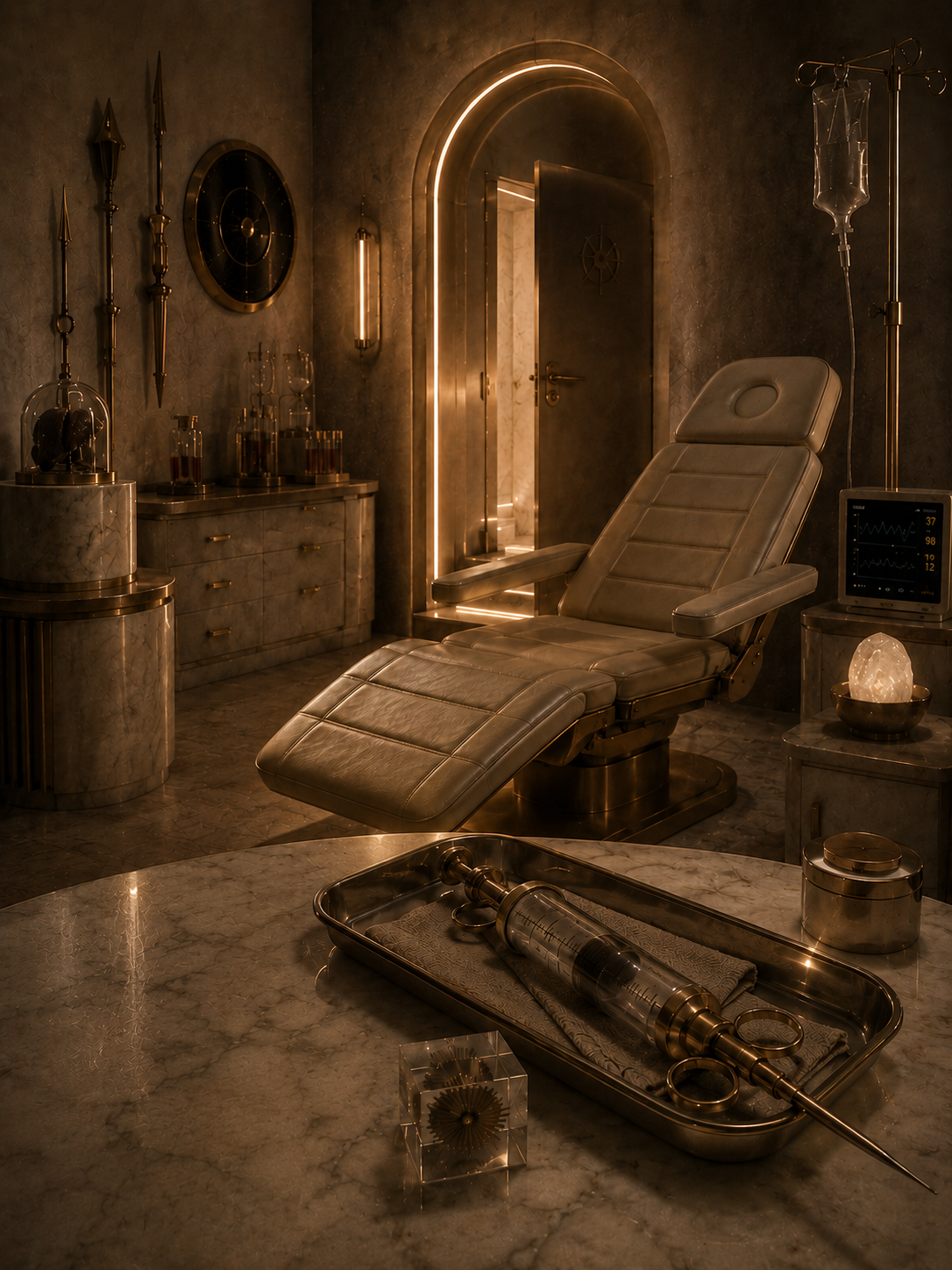
And then make it worse.
Because the first time it was:
We are going to take this very large needle.
You will be awake the entire time.
We are going to put it into your abdomen.
And we are going to suck the fluid wooshing around out of you.
A paracentesis.
Which is, objectively, one of the most barbaric arrangements modern medicine has managed to rebrand as routine.
Stephen King does not even write about paracentesis.
Someone give that man a ring. Give him the inspiration. Send me the check.
Because if you want horror, there it is.
Not a clown in a sewer.
A bright room.
A clean tray.
A nurse who feels so visibly sorry for you that the kindness becomes its own kind of terror.
The smell of antiseptic so sharp you can practically see it.
A needle large enough to make your ancestors scream through the layers of rot and fertilizer.
Your abdomen, swollen with fluid, about to be turned into a faucet.
And the most insulting part?
If you have had edema too, you know there is a deranged little fantasy that starts living in your mind.
You do not only dream of them draining your abdomen.
You start imagining them sticking that paracentesis needle into your legs and pulling the fluid out there too.
That is how deep it runs.
That is how desperate fluid makes you.
The fear becomes complicated because the thing that terrifies you also begins to sound like relief.
What kind of corrupted, cryptic construct says:
Here is the thing you fear most.
Now it is also the thing that may help you breathe.
That is not empowerment.
That is ransom.
The Vaccine Line
And before all of that, before liver disease turned needles into survival equipment, I had evidence.
Let us revisit COVID.
Picture it.
We pull up to the vaccine line, and I am dressed like I am preparing for a transatlantic flight through the underworld.
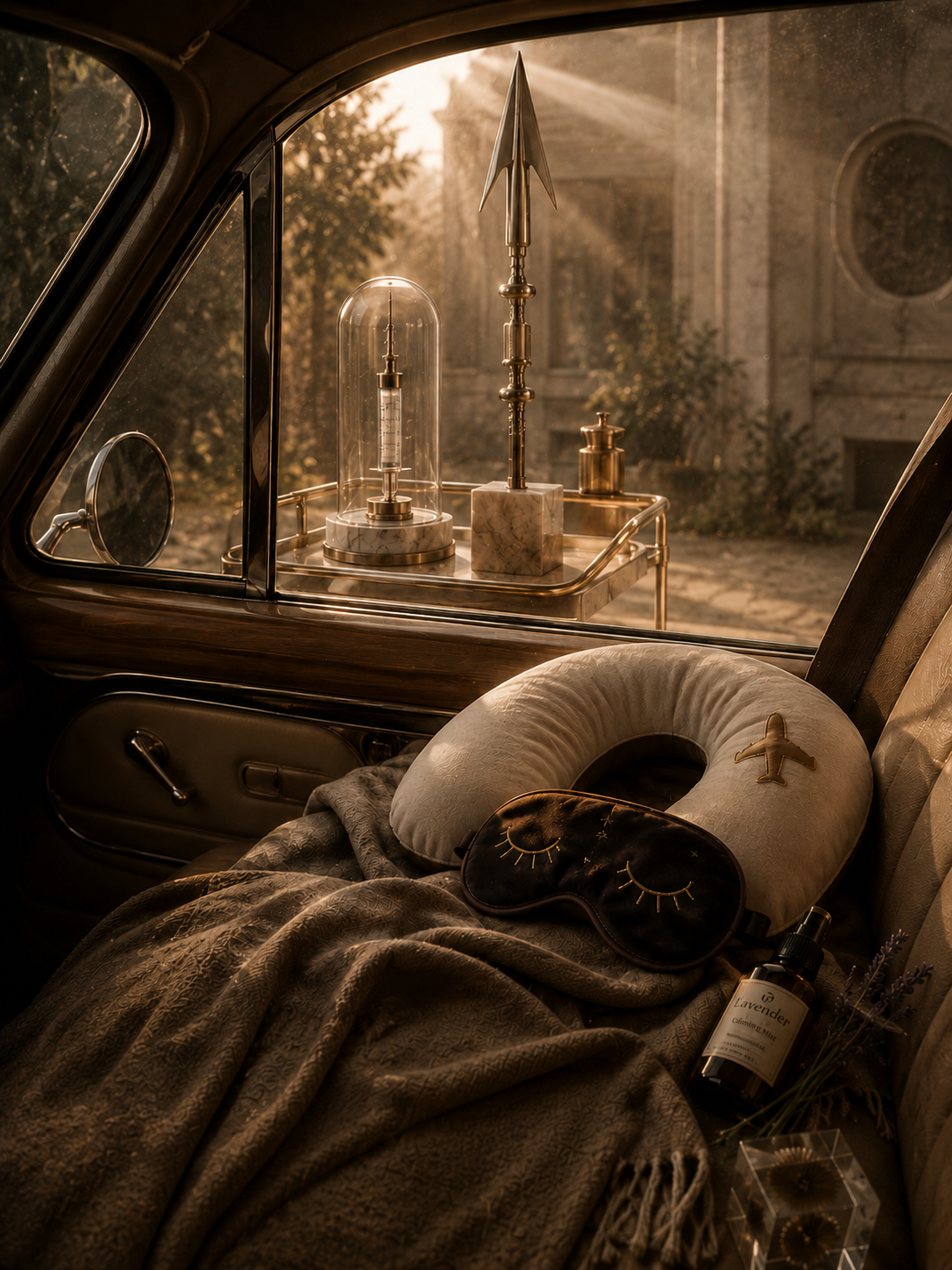
Eye mask.
Airplane pillow.
Blanket.
Doused in enough lavender to ward off whatever 1600s warlock was lurking in the AC vents.
I was shaking.
Crying.
No wits about me.
Absolutely none.
I had arrived at a high school parking lot for one vaccine and somehow staged a full theatrical meltdown in the passenger seat.
The person giving the shot looked into the car and became immediately concerned.
“Ma’am, are you here of your own volition?”
Which, to be fair, was a reasonable question.
I was limp, blindfolded, swaddled, lavender-marinated, and weeping.
My husband, meanwhile, was one sentence away from being detained.
Legal panic.
“Tell them I did not kidnap you,” he said.
And I, with the full authority of a woman being asked to authorize a microscopic harpoon, said something like:
“Yeah. Fine. Just do it.”
Apparently, that was not sufficient.
“No, ma’am. We need a verbal yes. We need authorization. We need consent.”
Can you picture the blasphemy of this?
The theater?
My husband pleading with me to verbally confirm that I was not being trafficked through the Pfizer line.]
Me, sobbing under an eye mask, trying to consent to a vaccine while spiritually leaving my body.
The nurse hovering with the syringe.
The parking lot sun.
The rolled-down window.
The entire scene screaming:
This woman is not built for needles.
And then cirrhosis laughed.
Not gently.
Not in a “life works in mysterious ways” kind of way.
It laughed like mockery from something that had already decided how this story was going to go.
Because that version of me — the vaccine-line hostage, the flailing purple-fumed flight risk, the person who could barely survive a tiny needle in a car window — was about to become someone who had to sit for blood draws, IVs, scans, procedures, and the occasional abdominal drainage event like it was just another item on the calendar.
The Snake
And that is the part people misunderstand.
I did not become less afraid because I became stronger in some clean, marketable way.
I became less afraid because there were bigger things in the room.
Needles did not stop being scary.
They became smaller because cirrhosis became enormous.

That is scale.
That is what happens when the ceiling caves in and suddenly you are no longer worried about the wallpaper.
And then, of course, there was the snake.
Because remember:
Fangs.
Needles that work the other way.
For most of my life, snakes lived in the same general category as needles.
Sharp entry points.
Unwanted puncture.
Hard pass.
Then one day, I was at a friend’s house in the exact kind of suburbia that makes you question what civilization even means.
Pedicures. At home.
A woman comes over and saws and shapes our toenails while we eat little finger sandwiches like emotionally unstable duchesses.
It is disgusting.
It is exactly what privilege and convenience provide.
But anyway, this friend had a snake.
A real one.
Slithering around with its little fang-based agenda.
And something in me went:
Fuck it.
Let that little bitch slither all over me.
If it bites me, what is the worst that happens?
Another needle?
Do you understand how deranged that is?
Do you understand how complete the usurping has to be for snakes to lose their ranking because medical needles have become routine?
The Oar
That is what cirrhosis did.

It did not cure my fear.
It humiliated it.
It took my carefully curated hierarchy of terror and kicked the ladder over.
The thing I had feared my whole life was no longer the monster.
It became the oar.
The thing you fear becomes your oar in a storm.
Try that on for size.
It does not fit very well.
Because fear is supposed to protect you.
That is the original contract.
Fear says:
Do not go there.
Do not touch that.
Do not let that near you.
Do not allow the sharp thing into your skin.
But serious illness is a contract written by a drunk notary in a basement with no witnesses.
Suddenly fear says:
Go there.
Sit down.
Hold still.
Give them your arm.
Let them place the IV.
Let them drain the fluid.
Let them measure the numbers.
Let them take the thing you were guarding because the only way out is through the puncture.
That is gutting.
Not inspirational.
Gutting.
Because the thing that once protected you becomes the protectant.
The thing that signaled danger becomes the thing standing between you and a larger danger.
The puncture becomes the passage.
The procedure becomes the relief.
Your old fear, the one that used to feel so large, is forced to stand in the corner holding its little hat.
The Transfer of Power
That is what happens when illness raises the roof on terror.
Cirrhosis does not simply scare you.
It escalates fear beyond its original jurisdiction.
It takes the fear you had, the fear that made sense, the fear that had edges and a name and a predictable little script, and swallows it whole.
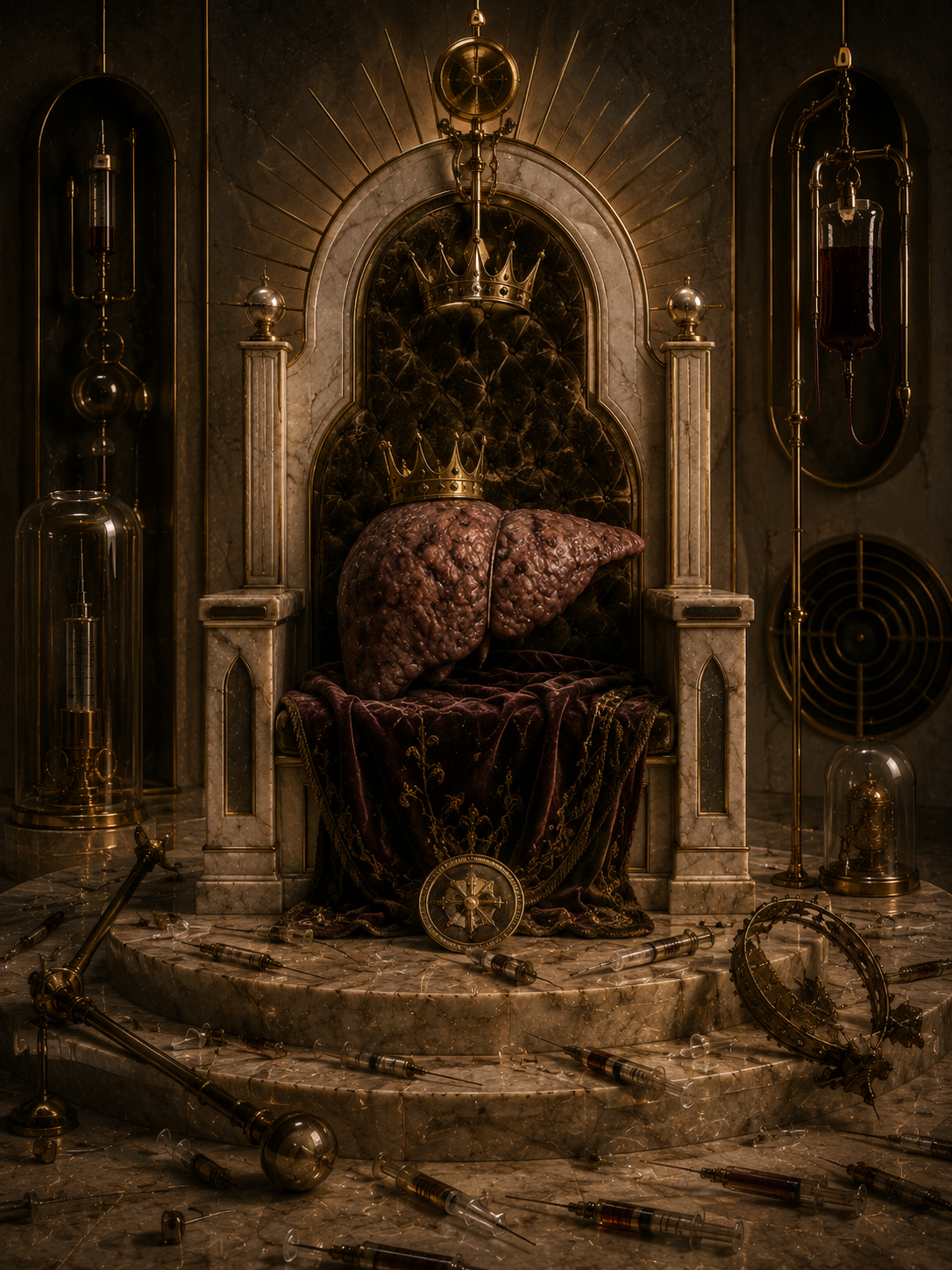
Then it replaces it with something bigger.
Something less cinematic.
Something harder to explain.
Because the thing you feared most is no longer optional.
It becomes part of the machinery.
It becomes part of the ritual.
It becomes part of the way you stay.
And maybe that is the real theft.
Cirrhosis did not cure my fear of needles.
It outranked it.
It impeached it.
It took my tidy little monarchy of terror and staged a hostile transfer of power.
Because what is one needle when the question is liver function?
What is one blood draw when the question is MELD?
What is one IV when the question is infection, kidney strain, albumin, bilirubin, sodium, INR, transplant evaluation, fluid, pressure, survival?
The fear did not disappear.
It was conscripted.
It conspired.
It was drafted into service.
It became part of the militia.
Sorry.
Medicine.
But also, unfortunately, the machinery.
The Sickest Twist…
So tell me again:
What are you afraid of?
And is it still the same?
Because mine changed.
Or maybe it did not change.
Maybe it was swallowed.
Maybe cirrhosis opened its mouth, took the one thing I had spent my life fearing, chewed it down to the bone, and handed it back as equipment.
A tool.
An oar.
A way through.
And I hate that.
I hate that something so awful can force an usurping so complete that the old terror has to bow to the new regime.
But that is the honest shape of it.
Sometimes this disease does not just take your comfort.
It takes your fear.
And then it makes you use it.
And you want to know the sickest twist of all?
I love getting my blood work done now.
Don’t you?