

Treatments
There is usually no one medication, supplement, diet, or lifestyle change that fixes everything. Cirrhosis management is more like maintaining a complicated house: checking the pressure, watching for leaks, fixing small problems before they become big ones,and protecting whatever still works.
What treatment looks like depends on what your liver is doing, what complications have shown up, and what your healthcare team is trying to prevent. Some people spend years focused on monitoring and portal hypertension. Others are managing ascites, hepatic encephalopathy, varices, malnutrition, jaundice, or several complications at once.
The goal is not simply to “treat the liver.” The goal is to preserve liver function, prevent emergencies, manage symptoms, and keep the rest of the body from getting dragged into the mess. Cirrhosis is serious, but it is often more manageable than it feels at the beginning.
There’s No Get Fixed Quick Scheme
There is usually no one medication, supplement, diet, or lifestyle change that fixes everything. Cirrhosis management is more like maintaining a complicated house: checking the pressure, watching for leaks, fixing small problems before they become big ones, and protecting whatever still works.

What treatment looks like depends on what your liver is doing, what complications have shown up, and what your healthcare team is trying to prevent. Some people spend years focused on monitoring and portal hypertension. Others are managing ascites, hepatic encephalopathy, varices, malnutrition, jaundice, or several complications at once.
The goal is not simply to “treat the liver.” The goal is to preserve liver function, prevent emergencies, manage symptoms, and keep the rest of the body from getting dragged into the mess. Cirrhosis is serious, but it is often more manageable than it feels at the beginning.
Understanding the Options for Advanced Liver Disease
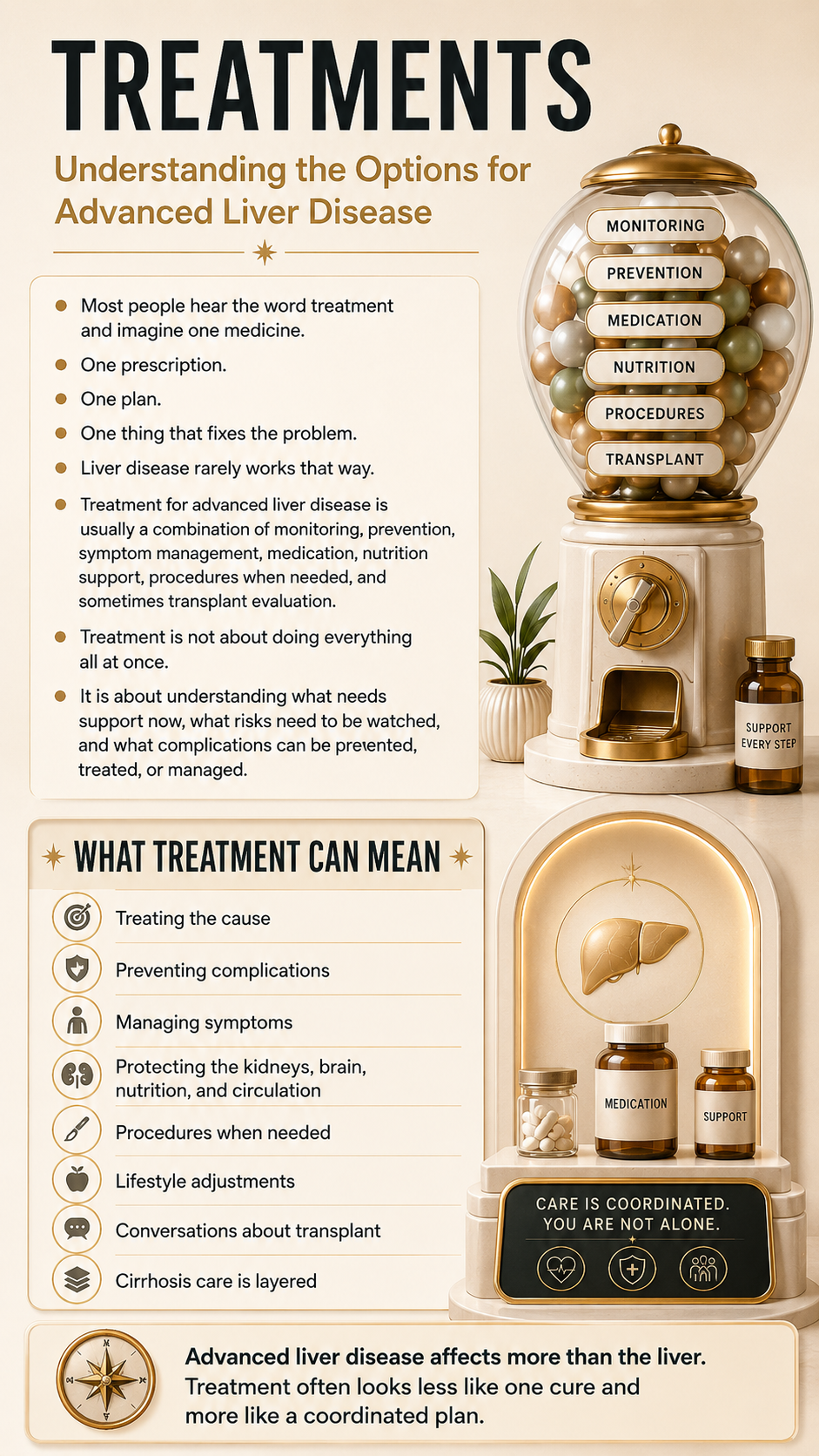
Most people hear the word treatment and imagine one medicine.
One prescription.
One plan.
One thing that fixes the problem.
Liver disease rarely works that way.
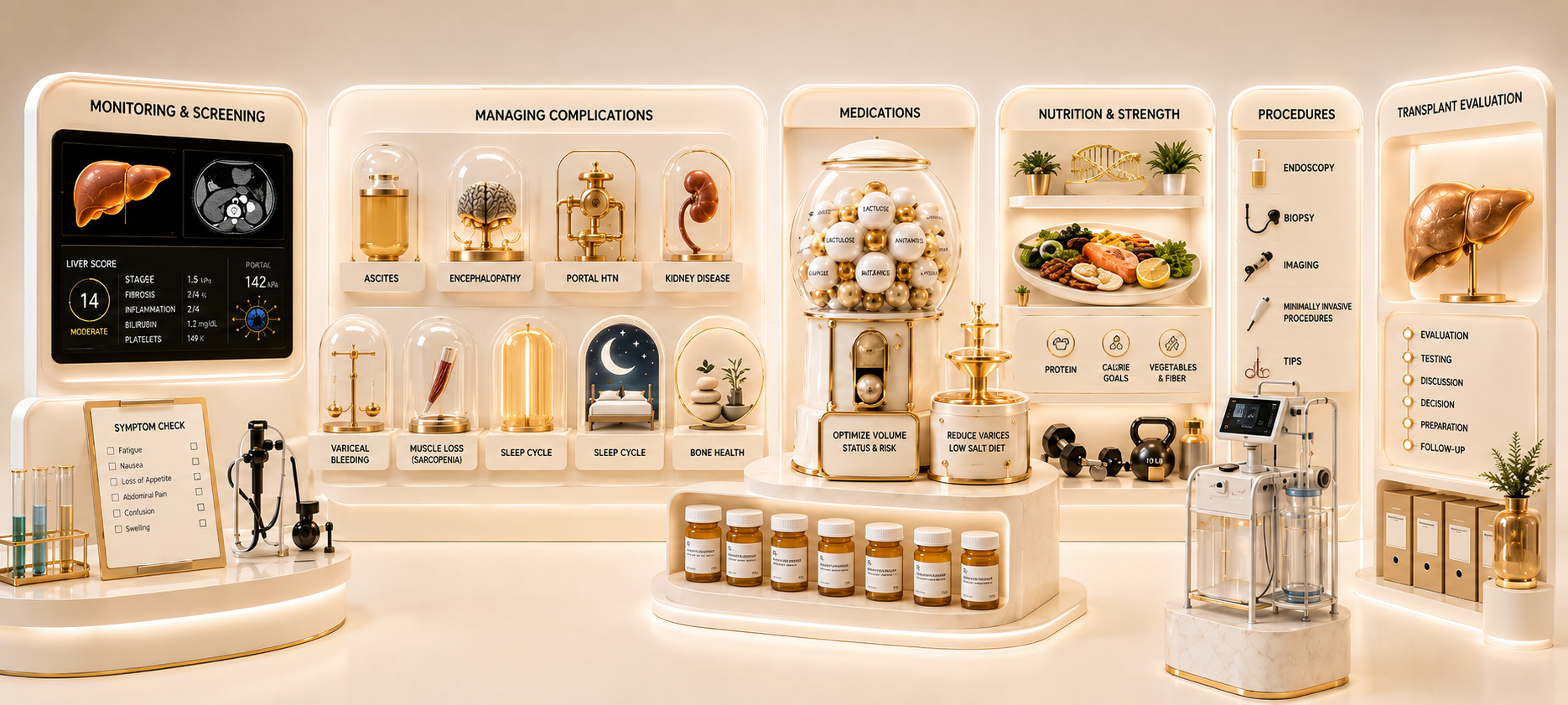
Treatment for advanced liver disease is usually not one single answer. It is a combination of monitoring, prevention, symptom management, medication, nutrition support, procedures when needed, and sometimes transplant evaluation.
That can sound overwhelming at first.
But treatment is not about doing everything all at once.
It is about understanding which parts of the system need support now, which risks need to be watched, and which complications can be prevented, treated, or managed.
Advanced liver disease affects more than the liver.
It can affect fluid balance, brain function, bleeding risk, kidney function, nutrition, strength, sleep, mood, hormones, and daily life.
That is why treatment often looks less like one cure and more like a coordinated plan.
Explore below to learn more & my experiences

What Treatment Can Mean
Treatment may include different kinds of support depending on the person, the cause of their liver disease, and whether complications are present.
Some treatments focus on thecause of liver disease.
Some focus on preventing complications.
Some manage symptoms.
Some protect the kidneys, brain, nutrition, or circulation.
Some are procedures.
Some are lifestyle adjustments.
Some are conversations about transplant.
The point is not that every person needs every treatment.
The point is that cirrhosis care is layered.
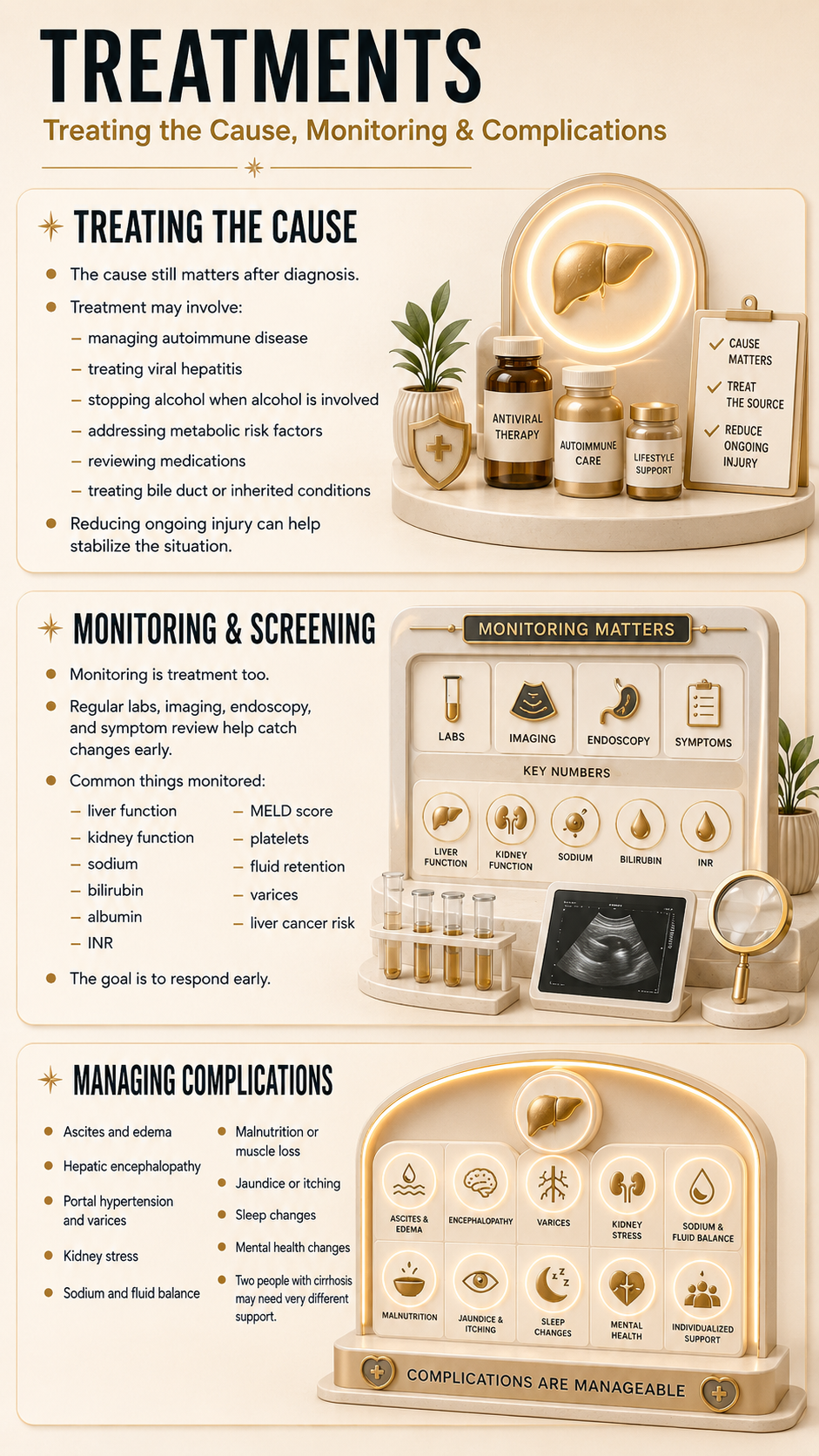
Treating the Cause
One of the first questions is:
What is driving the liver disease?
Depending on the cause, treatment may involve managing autoimmune disease, treating viral hepatitis, stopping alcohol when alcohol is involved, addressing metabolic risk factors, reviewing medications, or treating bile duct or inherited conditions.
The cause still matters after diagnosis.
Even when scarring is already present, reducing ongoing injury can help stabilize the situation and lower the risk of further damage.
What Treatment Is Really Trying To Do
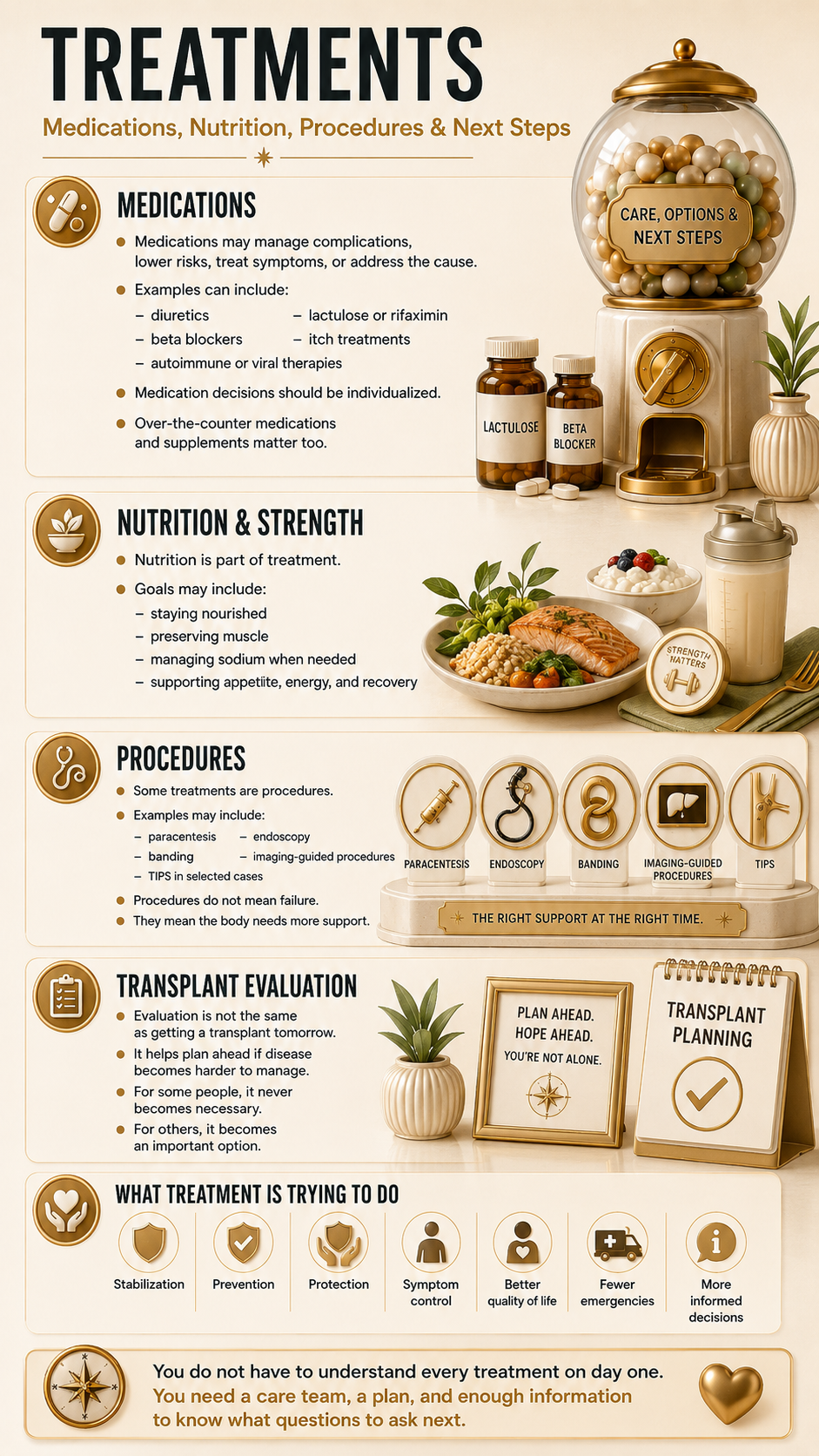
The goal of treatment is not perfection.
It is stabilization.
Prevention.
Protection.
Symptom control.
Better quality of life.
Fewer emergencies.
More informed decisions.
Treatment is not always dramatic.
Sometimes it is a medication doing its job quietly.
Sometimes it is a screening test catching something early.
Sometimes it is sodium discipline keeping fluid from building.
Sometimes it is nutrition protecting muscle.
Sometimes it is knowing which symptoms cannot wait.
All of the time it i having a care team watching the right things.
The Bottom Line
Treatment for advanced liver disease is not one thing.
It is a plan for managing a complex system.
Some parts treat the liver directly.
Some parts treat the complications.
Some parts prevent emergencies.
Some parts protect strength, nutrition, brain function, kidneys, and quality of life.
The goal is not to do everything at once.
The goal is to understand what your body needs now, what needs to be watched, and what options exist if things change.
Read More
What It Feels Like
Hepatic encephalopathy can feel different for everyone.
Common experiences include:
🧠 Brain fog
🧠 Forgetfulness
🧠 Difficulty concentrating
🧠 Slower thinking
🧠 Word-finding problems
🧠 Mental fatigue
🧠 Mood changes
🧠 Feeling "off"
Sleep-related symptoms often include:
🌙 Wide awake at 2:00 AM
☀️ Exhausted during the day
😴 Unplanned naps
⏰ Sleep-wake reversal
📅 Feeling disconnected from normal schedules
The Crossover Point
Think of your brain like a switchboard.
At first, a few signals arrive late.
A connection flickers.
A message gets rerouted.
Everything still works.
Then more signals begin crossing wires.
Some messages arrive slowly.
Others never arrive at all.
The switchboard becomes increasingly difficult to manage.
Hepatic encephalopathy is what happens when the brain is forced to work through static.
Things Nobody Explains
1. It Isn't Just Confusion
Many people expect hepatic encephalopathy to look dramatic.
Often it begins with subtle changes that are easy to dismiss.
2. Sleep Problems Can Be an Early Clue
For some patients, a reversed sleep schedule appears long before obvious cognitive symptoms.
3. You May Notice It Last
Friends and family sometimes recognize changes before the patient does.
4. It Can Fluctuate
A person may feel completely normal one day and noticeably foggy the next.
Infections, dehydration, constipation, medications, and other stressors can all contribute.
What Helps
✅ Lactulose when prescribed
✅ Rifaximin when prescribed
✅ Preventing constipation
✅ Staying hydrated when appropriate
✅ Managing infections quickly
✅ Maintaining nutrition and muscle mass
✅ Regular follow-up with your healthcare team
The Bottom Line
Hepatic encephalopathy is not a character flaw, a lack of effort, or a failure to pay attention.
It's a complication of liver disease that affects the brain's ability to process information efficiently.
Sometimes it looks like confusion.
Sometimes it looks like forgetfulness.
And sometimes it looks like lying awake at 3:00 AM wondering why a disease built around fatigue won't let you sleep.
Monitoring and Screening
Monitoring is one of the most important parts of liver disease care.
It may not feel like treatment because it is not always a pill or procedure.
But regular labs, imaging, endoscopy, and symptom review help your healthcare team understand what is changing and what needs attention.
This can include monitoring liver function, kidney function, sodium, bilirubin, albumin, INR, MELD score, platelets, fluid retention, varices, and liver cancer risk.
The goal is to catch problems early enough to respond.
Managing Complications
Many treatments in advanced liver disease are aimed at complications.
That may include treatment for:
💧 Ascites and edema
🧠 Hepatic encephalopathy
🩸 Portal hypertension and varices
🫘 Kidney stress
🧂 Sodium and fluid balance
🥚 Malnutrition or muscle loss
🟡 Jaundice or itching
😴 Sleep changes
🧠 Mental health changes
This is why treatment plans can look different from person to person.
Two people can both have cirrhosis and need very different support.
Medications
Medications may be used to manage complications, lower risks, treat symptoms, or address the underlying cause of liver disease.
Examples may include diuretics for fluid retention, lactulose or rifaximin for hepatic encephalopathy, beta blockers for portal hypertension or variceal bleeding risk, medications for itching, treatments for autoimmune or viral liver disease, and other therapies based on the person’s situation.
Medication decisions should always be individualized.
In cirrhosis, even common over-the-counter medications and supplements can matter, so medication review is part of treatment.
Nutrition and Strength
Nutrition is not just background advice.
It is part of treatment.
Advanced liver disease can affect appetite, protein needs, sodium balance, muscle mass, blood sugar, energy, and recovery.
The goal is not simply eating “healthy.”
The goal is staying nourished, preserving muscle, managing sodium when needed, and supporting the body through a disease that can make eating harder at the exact moment nutrition matters more.
Procedures
Some treatments are procedures.
These may include paracentesis for ascites, endoscopy for varices, banding if needed, imaging-guided procedures, TIPS in selected cases, or other interventions depending on the complication.
Procedures do not mean someone failed.
They usually mean the body needs a type of support that medication alone may not provide.
Transplant Evaluation
Transplant evaluation is not the same thing as getting a transplant tomorrow.
It is a process used to determine whether transplant may become appropriate if liver disease becomes severe enough or complications become difficult to manage.
For some people, transplant never becomes necessary.
For others, evaluation becomes an important part of planning ahead.
It is not giving up. It is not the easy way out. It’s not always Plan A.
It is understanding the full range of options.