


Late Nights à la Liver
What It Feels Like
Hepatic encephalopathy can feel different for everyone.
Common experiences include:
🧠 Brain fog
🧠 Forgetfulness
🧠 Difficulty concentrating
🧠 Slower thinking
🧠 Word-finding problems
🧠 Mental fatigue
🧠 Mood changes
🧠 Feeling "off"
Sleep-related symptoms often include:
🌙 Wide awake at 2:00 AM
☀️ Exhausted during the day
😴 Unplanned naps
⏰ Sleep-wake reversal
📅 Feeling disconnected from normal schedules
The Crossover Point
Think of your brain like a switchboard.
At first, a few signals arrive late.
A connection flickers.
A message gets rerouted.
Everything still works.
Then more signals begin crossing wires.
Some messages arrive slowly.
Others never arrive at all.
The switchboard becomes increasingly difficult to manage.
Hepatic encephalopathy is what happens when the brain is forced to work through static.
Things Nobody Explains
1. It Isn't Just Confusion
Many people expect hepatic encephalopathy to look dramatic.
Often it begins with subtle changes that are easy to dismiss.
2. Sleep Problems Can Be an Early Clue
For some patients, a reversed sleep schedule appears long before obvious cognitive symptoms.
3. You May Notice It Last
Friends and family sometimes recognize changes before the patient does.
4. It Can Fluctuate
A person may feel completely normal one day and noticeably foggy the next.
Infections, dehydration, constipation, medications, and other stressors can all contribute.
What Helps
✅ Lactulose when prescribed
✅ Rifaximin when prescribed
✅ Preventing constipation
✅ Staying hydrated when appropriate
✅ Managing infections quickly
✅ Maintaining nutrition and muscle mass
✅ Regular follow-up with your healthcare team
The Bottom Line
Hepatic encephalopathy is not a character flaw, a lack of effort, or a failure to pay attention.
It's a complication of liver disease that affects the brain's ability to process information efficiently.
Sometimes it looks like confusion.
Sometimes it looks like forgetfulness.
And sometimes it looks like lying awake at 3:00 AM wondering why a disease built around fatigue won't let you sleep.
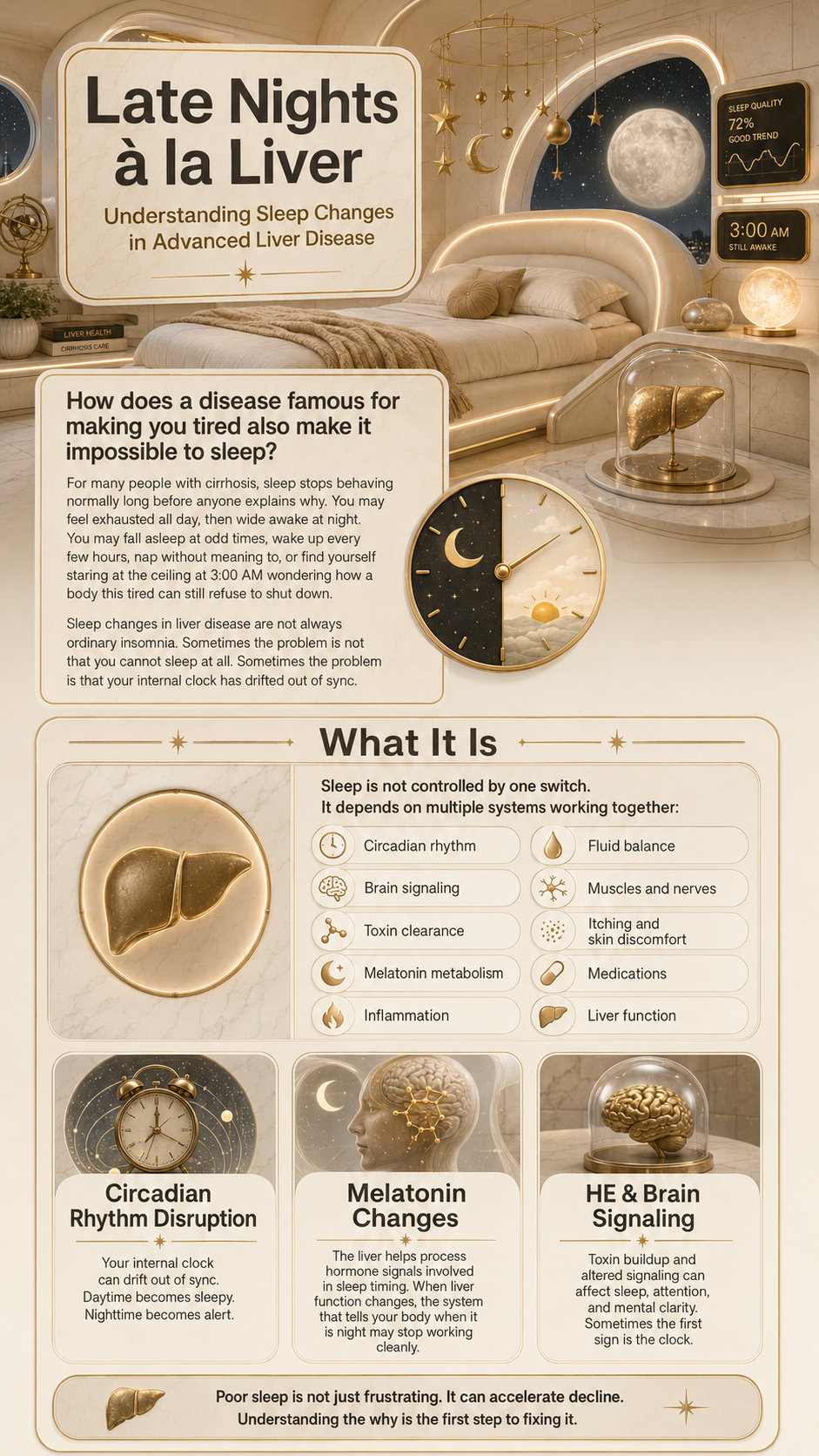
Understanding Sleep Changes in Advanced Liver Disease
How does a disease famous for making you tired also make it impossible to sleep?
For many people with cirrhosis, sleep stops behaving normally long before anyone explains why. You may feel exhausted all day, then wide awake at night. You may fall asleep at odd times, wake up every few hours, nap without meaning to, or find yourself staring at the ceiling at 3:00 AM wondering how a body this tired can still refuse to shut down.
Sleep changes in liver disease are not always ordinary insomnia. Sometimes the problem is not that you cannot sleep at all. Sometimes the problem is that your internal clock has drifted out of sync. Daytime becomes sleepy. Nighttime becomes alert. Rest becomes fragmented. Recovery starts feeling unreliable.
The frustrating part is that sleep problems are often treated like a separate issue, when in reality they can be deeply connected to liver function, brain signaling, inflammation, itching, fluid shifts, cramps, medications, hormones, stress, and the body’s ability to regulate its own rhythms.
What It Is
Sleep is not controlled by one switch.
It depends on multiple systems working together:
🌙 circadian rhythm
🧠 brain signaling
🧪 toxin clearance
🕯️ melatonin metabolism
🔥 inflammation
💧 fluid balance
🦵 muscles and nerves
🧴 itching and skin discomfort
💊 medications
🫀 overall liver function
When cirrhosis affects several of those systems at once, sleep can become unpredictable.
You may be tired without feeling sleepy.
You may sleep without feeling rested.
You may spend all day fighting exhaustion and all night fighting wakefulness.
Circadian Rhythm Disruption
Your circadian rhythm is your body’s internal timing system.
It helps regulate when you feel awake, when you feel sleepy, and how your body moves between day and night.
In advanced liver disease, that rhythm can become disrupted. The body may stop sending sleep signals at the right time, or those signals may become weaker, delayed, or inconsistent.
That is why some people with cirrhosis describe feeling like their schedule has flipped.
Awake at night.
Exhausted during the day.
Not fully present at either time.
Melatonin Changes
Melatonin is one of the hormones involved in sleep timing.
The liver helps metabolize and clear many hormones and chemical signals, including melatonin. When liver function changes, melatonin handling may also become altered.
That does not mean melatonin supplements are automatically the answer.
It means the system that helps tell your body when it is night may not be working as cleanly as it used to.
This can contribute to:
🌙 trouble falling asleep at night
☀️ daytime sleepiness
😴 unplanned naps
⏰ sleep-wake reversal
🌀 feeling disconnected from normal schedules
Sometimes the clock on the wall says bedtime.
Your body disagrees.
Hepatic Encephalopathy & Brain Signaling
Sleep disruption can also overlap with hepatic encephalopathy.
HE happens when liver disease allows toxins such as ammonia and other gut-derived substances to affect the brain. This can interfere with attention, memory, alertness, reaction time, mood, and sleep.
Sometimes HE looks like confusion.
Sometimes it looks like brain fog.
And sometimes it looks like being awake at 2:00 AM, exhausted at 2:00 PM, and unable to explain why your brain no longer follows the schedule everyone else seems to live by.
Sleep changes can be an early clue that the brain is under stress.
Itching
Liver-related itching can make sleep nearly impossible.
Unlike ordinary itching, it may happen without a rash. It may move around the body. It may feel deeper than the skin. For many people, it becomes worse at night.
That means bedtime can become the exact moment your body becomes hardest to ignore.
You are tired.
You want to sleep.
But your skin will not be quiet.
Muscle Cramps & Restless Legs
Cirrhosis can be associated with cramps, nerve changes, restless legs, and muscle discomfort.
These symptoms may show up most aggressively when the body finally gets still.
A calf locks up.
Feet tingle.
Legs feel restless.
A muscle cramp wakes you from sleep and leaves you sore, startled, and wide awake afterward.
Sometimes the problem is not falling asleep.
It is staying asleep once your body starts interrupting itself.
Ascites, Edema & Position Changes
Fluid retention can also interfere with sleep.
Ascites may make it hard to get comfortable. Abdominal pressure can worsen when lying flat. Some people feel short of breath, overly full, or physically restricted.
Edema can make legs feel heavy, tight, or uncomfortable.
Even finding a sleep position can start to feel like negotiation.
You turn one way.
Pressure builds.
You turn another.
Your body still feels crowded.
Nocturia
Many people with cirrhosis wake up repeatedly to urinate, especially if they are taking diuretics or shifting fluid overnight.
Fluid that collects in the legs during the day can move back into circulation when lying down. The kidneys may then produce more urine at night.
So sleep gets interrupted again.
Not because you are doing something wrong.
Because fluid is moving when your body position changes.
Medications
Some medications may affect sleep directly or indirectly.
Diuretics can increase nighttime bathroom trips depending on timing.
Steroids, some antidepressants, sedatives, antihistamines, pain medications, and other drugs may affect alertness, sleep quality, dreams, confusion risk, or daytime fatigue.
Medications used for liver disease may help one problem while complicating another.
This is why medication timing and review matter.
Do not stop medications on your own.
But do tell your healthcare team when sleep changes begin affecting daily life.
Anxiety, Grief & Hypervigilance
Not every sleep problem is chemical.
Some of it is emotional.
Living with advanced liver disease can make nighttime feel louder. Fewer distractions. More body awareness. More fear. More thinking. More waiting.
You may be worrying about labs, appointments, symptoms, transplant evaluation, family, work, finances, or what happens next.
The body may be tired, but the mind stays on watch.
That is not weakness.
That is what uncertainty can do to a nervous system.
Read More
What It Feels Like
People describe sleep changes differently.
Some experience:
🌙 Wide awake at night
☀️ Exhausted during the day
😴 Unplanned naps
⏰ Sleep-wake reversal
🛏️ Fragmented sleep
🚽 Waking up to urinate
🔥 Itching that worsens at night
🦵 Cramps or restless legs
💭 Racing thoughts
😵 Waking up tired
🧠 Brain fog after poor sleep
📅 Feeling disconnected from normal schedules
Others describe it more simply:
“I am exhausted all day and somehow still awake all night.”
The Crossover Point
Think of sleep like an orchestra.
Every section has to come in at the right time.
The brain.
The liver.
The hormones.
The nerves.
The muscles.
The skin.
The kidneys.
The emotions.
At first, one instrument comes in late.
You still recognize the song.
Then another section drifts.
The rhythm changes.
The timing slips.
Everyone is technically still playing, but nothing feels synchronized anymore.
That is what sleep changes in liver disease can feel like.
Not just insomnia.
A whole body trying to keep time with instruments that no longer agree.
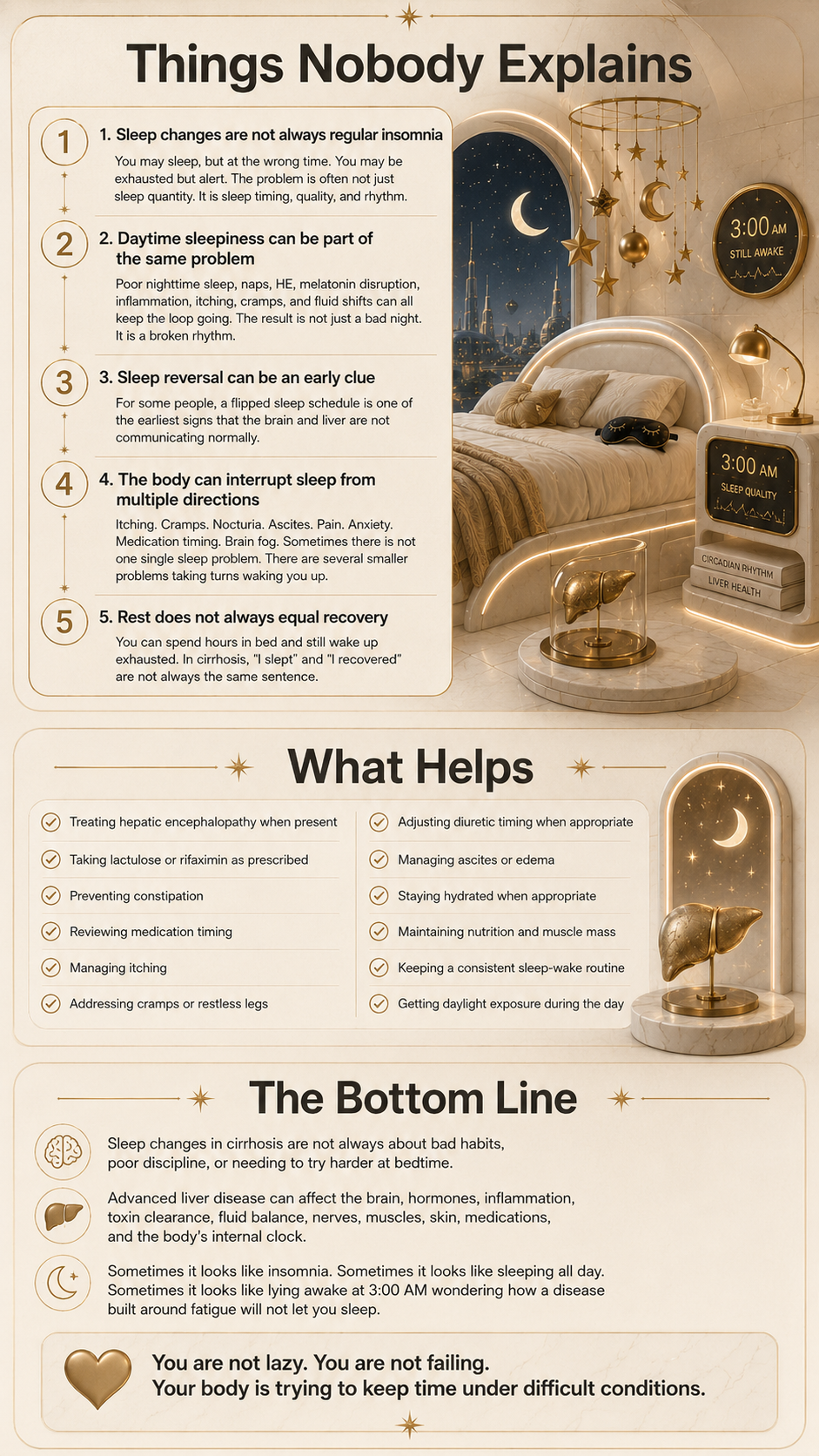
Things Nobody Explains
1. Sleep Changes Are Not Always Regular Insomnia
Insomnia usually means trouble falling asleep or staying asleep.
Cirrhosis-related sleep changes can be stranger than that.
You may sleep, but at the wrong time.
You may be exhausted but alert.
You may nap during the day and then feel wired at night.
The issue is often not just sleep quantity.
It is sleep timing, quality, and rhythm.
2. Daytime Sleepiness Can Be Part of the Same Problem
Many people separate nighttime insomnia from daytime fatigue.
In liver disease, they may be connected.
Poor nighttime sleep can worsen daytime exhaustion. Daytime naps can make nighttime sleep harder. HE, melatonin disruption, inflammation, itching, cramps, and fluid shifts can all keep the loop going.
The result is not a bad night.
It is a broken rhythm.
3. Sleep Reversal Can Be an Early Clue
A flipped sleep schedule can appear before dramatic confusion.
For some people, sleep-wake reversal is one of the earliest signs that the brain and liver are not communicating normally.
That does not mean every bad night is HE.
But repeated sleep reversal deserves attention.
4. The Body Can Interrupt Sleep From Multiple Directions
Itching.
Cramps.
Nocturia.
Ascites.
Pain.
Anxiety.
Medication timing.
Brain fog.
Fluid shifts.
Sometimes there is not one single sleep problem. There are five smaller problems taking turns waking you up.
5. Rest Does Not Always Equal Recovery
You can spend eight hours in bed and still wake up exhausted.
That does not mean you failed at sleep.
It may mean the sleep was fragmented, poorly timed, uncomfortable, or not restorative.
In cirrhosis, “I slept” and “I recovered” are not always the same sentence.
What Helps
Lactulose when prescribed
Sleep problems in cirrhosis should be discussed with your healthcare team, especially if they are new, worsening, or paired with confusion, severe daytime sleepiness, or other changes.
Helpful strategies may include:
✔️ Treating hepatic encephalopathy when present
✔️ Taking lactulose or rifaximin as prescribed
✔️ Preventing constipation
✔️ Reviewing medication timing
✔️ Managing itching
✔️ Addressing cramps or restless legs
✔️ Adjusting diuretic timing when appropriate
✔️ Managing ascites or edema
✔️ Staying hydrated when appropriate
✔️ Maintaining nutrition and muscle mass
✔️ Keeping a consistent sleep-wake routine
✔️ Getting daylight exposure during the day
✔️ Limiting long or late naps
✔️ Reducing nighttime screen exposure
✔️ Tracking sleep patterns and symptoms
✔️ Involving family when sleep changes seem unusual
Seek urgent medical care for sudden confusion, extreme sleepiness, inability to stay awake, personality changes, fever, severe dehydration, vomiting blood, black stools, or symptoms that feel rapidly worse than usual.
The Bottom Line
Sleep changes in cirrhosis are not always about bad habits, poor discipline, or needing to “try harder” at bedtime.
Advanced liver disease can affect the brain, hormones, inflammation, toxin clearance, fluid balance, nerves, muscles, skin, medications, and the body’s internal clock.
Sometimes it looks like insomnia.
Sometimes it looks like sleeping all day.
Sometimes it looks like itching, cramping, peeing, thinking, drifting, waking, and waiting for morning.
And sometimes it looks like lying awake at 3:00 AM wondering how a disease built around fatigue will not let you sleep.
You are not lazy.
You are not failing.
Your body is trying to keep time under difficult conditions.
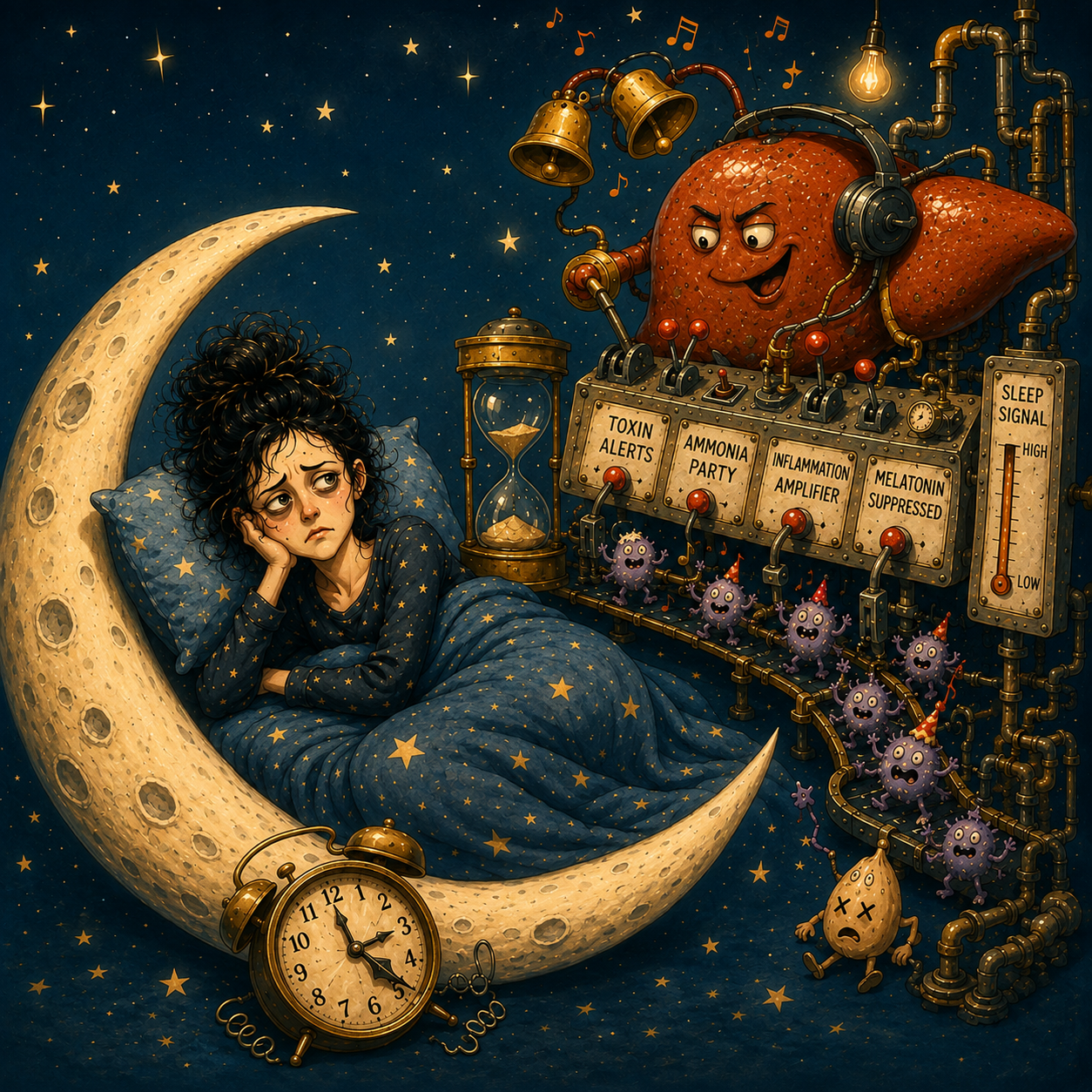
Toxins like ammonia can build up in the bloodstream and reach the brain. This causes a neurological complication called Hepatic Encephalopathy (HE). It doesn't always look medical at first—it often looks like extreme brain fog, mood swings, or "laziness." But it is a real physical condition that patients cannot control. Read to understand the symptoms, hidden triggers, and treatments that help keep the mind clear.