
A Canary in the Crypt: Jaundice, MMA & Friendsgiving
Important Medical Disclaimer: I am Angie, a cirrhosis patient sharing my personal lifestyle, nutrition, and mindset journey. I am a data aggregator and community builder, not a licensed medical professional, doctor, or dietitian. Content on diagnosiscirrhosis.com is based solely on my personal experience living with advanced liver disease and is intended for informational and educational purposes only. It does not constitute medical advice or a substitute for professional medical care. Always follow the recommendations of your own healthcare team and consult your physician before changing your diet, medication, or lifestyle routine.
@diagnosis_cirrhosis 🟡 Why are my eyes yellow? Why is my skin turning yellow? 👀🪞 If you’ve ever stared in the mirror at 2 AM thinking, “can liver disease make your eyes yellow?” or “does yellow eyes mean liver failure?” you are not alone 😵💫 Yellow eyes or yellow skin can happen when a waste compound called bilirubin builds up in your body 🧪🟡 That yellowing is called jaundice — but most people do not search “jaundice” first. They search: “why are my eyes yellow?” “why is my skin turning yellow?” “what should I do if my eyes turn yellow?” Because that is what they can actually see 👀 — 🩸 Where does bilirubin come from? Every day, your body breaks down old red blood cells 🩸♻️ That creates bilirubin. Normally, your liver acts like a filtration plant 🏭 It collects bilirubin, processes it, packages it into bile, and helps move it out of your body 🚽🧪 — 🌊 The lake analogy Think of bilirubin like water flowing into a lake 🌊 💧 Healthy liver: Water flows in, gets processed, and flows out. The lake level stays normal. ⚠️ Damaged liver: Water keeps rushing in… but processing slows down 🐌 or the exit pipes get blocked 🚧 The lake starts rising. And rising. And rising. 🌊 Eventually, it spills over. Except instead of flooding a field… it shows up as yellow eyes and yellow skin 🟡👀 — 🍷 Can alcohol cause yellow eyes? Yes. Alcohol-related liver disease can cause bilirubin to build up, especially when alcohol injures the liver enough that it cannot process bilirubin normally 🚫🍷 Yellow eyes can happen with alcohol-related hepatitis, cirrhosis, or severe liver inflammation. So if you are searching “can alcohol cause yellow eyes?” or “why are my eyes yellow after drinking?” please do not ignore it 🩺 — 👀 Does blurry vision mean yellow eyes? Not exactly. Blurry vision usually does not cause yellow eyes. But vision changes, fatigue, lighting, or staring in the mirror can make you suddenly notice something looks off 👀🪞 So if you are wondering “does blurry vision mean yellow eyes?” or “can vision changes make yellow eyes noticeable?” the key is this: yellowing is about a color change in the whites of the eyes, not just needing new glasses. — 🚨 Why doctors care Yellow eyes are not the diagnosis. They are the warning light. They can mean bilirubin is building up because something is disrupting the system. That could be: 🫀 cirrhosis 🔥 hepatitis 🍩 fatty liver disease / MASLD / MASH 🚫🍷 alcohol-related liver disease 🚧 bile duct blockage 💊 drug-induced liver injury 🩸 red blood cell breakdown ❓ or other causes So yes, if you are searching “can fatty liver disease cause yellow eyes?” or “can fibrosis cause yellow eyes?” the answer is: it depends on severity and what else is happening, but yellow eyes should always be taken seriously. — 👩⚕️👨⚕️🩺 Talk to a doctor or hepatologist immediately if you notice yellowing eyes or yellowing skin. Especially with: 🟡 dark urine ⚪ pale stool 🔥 fever 🤢 nausea/vomiting 😵 confusion 💧 swelling 🩸 bleeding/bruising 😴 extreme fatigue 🍷 alcohol use 📈 known liver disease The cause matters more than the color 💚 #symptoms #yelloweyes #liverhealth #alcoholism #fattyliver ♬ Palm Haze - Dust and Whisper
By Angie from @diagnosis_cirrhosis on TikTok
Let me tell you about the day I turned yellow. Because as I talked about in my ascites experience, jaundice was by far the first symptom that made a pronounced entrance into my decompensation.
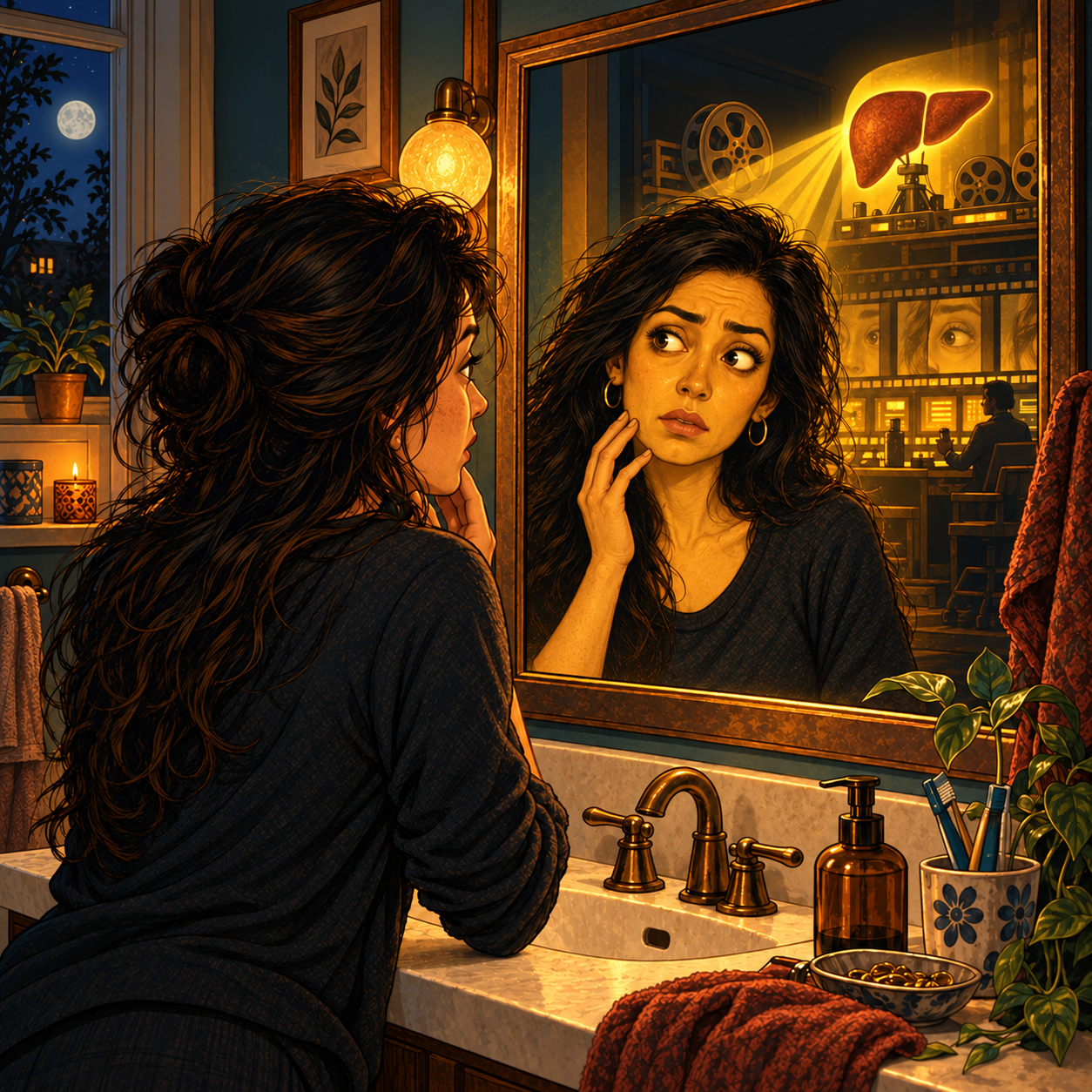
Not the first symptom. Just the first one with stage presence.
Fatigue could be blamed on life. Insomnia could be blamed on stress.
Appetite loss could be blamed on my body freelancing without a permit.
Tiny red dots on my chest could be filed under: concerning, but vague enough to ignore until further notice.
But yellow? Yellow read liver. Immediately. That was the part that stunned me.
The second I turned yellow, everyone around me seemed to understand the assignment before I did. Suddenly people were looking at me and thinking liver, and I was looking at them thinking:
How? How would you know that? What textbook did all of you secretly read?
Was there a secret seminar I somehow missed?
Maybe babies. Everybody knows babies can get jaundice. Everybody has a baby but me. Maybe that is where the general public picked up this information. I do not know.
But somehow, yellow entered the room with a label already attached to it.
Liver. And I was behind everyone else, standing there in my own skin, trying to catch up. Which, medically, is kind of fascinating.
Because jaundice is not actually your liver “turning you yellow.” It is bilirubin accumulating in your blood and tissues faster than your body can process and excrete it.
Bilirubin is produced every day when old red blood cells are dismantled. Hemoglobin gets broken apart, the heme component is converted into unconjugated bilirubin, and that pigment hitchhikes to the liver bound to albumin because it is not water-soluble yet.
The liver is supposed to take it in, conjugate it, make it water-soluble, package it into bile and send it toward the intestine for disposal."
So even before I knew the word bilirubin, my body had already become a very visible demonstration of what happens when that processing line stops keeping pace.
The night before, though? Nothing about me felt like a processing line had gone down.
The Night Before Everything Changed
The night before was unremarkable. And as you know, in medicine, “unremarkable” means a lot.
Nothing dramatic happened. No cinematic warning. No ominous music. No thunderclap over the hepatobiliary system.

I was at a friend’s house.
For reasons still unknown to historians, roughly twelve of us had gathered to watch a pay-per-view fight between people whose names we did not know, in a sport whose rules none of us could confidently explain.
But you would have thought we had bet the neighborhood clubhouse on the outcome.
We were invested. Wildly. Incorrectly. Baselessly.
The kind of invested people become when they are standing in a kitchen, holding paper plates, shouting advice at professional athletes through a television while possessing no relevant qualifications except proximity to beanie beanies.
Then the internet went out. Naturally. And suddenly we were passing cell phone hotspots around like classified military intelligence.
One phone to the next. Hotspot hot potato. Someone yelling, “Try mine.”
Someone else holding their phone toward the ceiling like it was receiving divine instruction.
A pay-per-view fight nobody understood, sustained by the technological equivalent of CPR.
And I think about that now.
How sometimes the little quilted stitches of your life carry the same thread before you know what pattern they are making. A fight. A holiday. A body about to declare war in a color I was apparently blind to.
A happenstance PPV fight foreshadowing the most feud-fueled family-adjacent event of the year, which would then collapse into the fight of my life.
That is an arc they do not sell at Blockbuster. Or if they did, maybe that is why it went out of business.
And yes, I know the question people want to ask.
Were you drinking? Yes. There were a few White Claws.
And here is where explaining alcohol gets strange, because there is no version of the answer that does not feel like someone is standing underneath it with a trapdoor.
Too much? Not enough? Often? Rarely? Did you know? How did you not know? Were you reckless? Were you unlucky? Were you already sick?
That is the hollow part of trying to explain drinking once liver disease enters the conversation.
No matter how plainly you say it, the bottom can fall out.
So yes, there were a few White Claws. And no, the night did not feel remarkable.

That is what still bothers me. It did not feel like the night before anything. It felt like a neighborhood night.
I walked home like a normal person after a normal evening, probably batting mosquitoes off my arm, irritated by nothing larger than humidity, spotty Wi-Fi, and the general indignity of being asked to care about boxing.
What I did not understand was that bilirubin does not need a dramatic external event to rise. The body is constantly producing it. The question is whether the liver can keep handling the daily load.
In cirrhosis, hepatocytes can become less efficient at taking bilirubin up, conjugating it and secreting it into bile. The microscopic architecture that normally moves blood and bile through the liver has been distorted by fibrosis, regenerative nodules and altered vascular flow.
The red blood cells keep retiring. The bilirubin keeps arriving. The factory does not get to close just because part of the machinery is failing.
And somewhere between that neighborhood night and the next evening, the backlog finally became visible.
I had no idea that within twenty hours my body would introduce me to a new definition of yellow.
A new definition of itch (the irony of the misquotes isn’t lost on me…).. A new definition of fear. A new definition of betrayal.
Friendsgiving: The Last Time the Table Was Just a Table
The next morning, I woke up and, lo and behold, it was Friendsgiving. And if you know me, you know I love Thanksgiving. I do not know why. It is chaos.
My family fights every year. We make too much food. Somebody gets stuck with the dishes. The house gets hot. Everyone is lightly annoyed. At least one person is pretending they are not mad while aggressively scraping a casserole dish.
And yet, regardless, I love it.
There is something about the simplicity of gathering around a meal. Which is ironic, considering cirrhosis also taketh away.
Food becomes math. Salt becomes strategy.
Protein becomes homework. Appetite becomes unreliable.
And meals, which used to be about comfort, can suddenly feel like negotiations with a body that has started hiring outside counsel.
But that morning, I was not thinking about any of that yet. That morning, I was preparing for the production of the year.
Friendsgiving is the one day I get to force all of my friends to sit around a table, choke down some turkey, and tell each other why we love each other until I am at my wit’s end, everyone’s bellies are full, and the kids are complaining.
It is a glorious event. And I take it spectacularly seriously.
So I was up early. Early early.
There was fall sangria that needed to soak all day. Green chile on the stove. A charcuterie plate to assemble, because naturally the pilgrims were snacking on the finest cheese and dried fruits Plymouth Rock could afford. Actually, maybe they were. That is kind of funny.
People were in and out of my house all morning.
Can we borrow the butter?
We forgot the milk.
So-and-so threw the measuring cup away.
What time are you going over there?
Do you have foil?
Who has the serving spoon?
It was chaotic bliss. A shared experience. Literally the exact thing I complain I have been abstracted from since getting sick. Sitting around a table. Passing wine. Passing food. Laughing without turning every bite into a calculation. Existing in the old-world luxury of eating with people without thinking quite so much about what eating might cost.
@diagnosis_cirrhosis 💚 One of the biggest misconceptions about supporting someone with cirrhosis is that people think it requires doing more. More help. More advice. More solutions. More check-ins. More grand gestures. And sometimes those things are wonderful. But honestly? A lot of the time supporting someone with liver disease is about subtraction, not addition. — People tend to think cirrhosis is mostly medication management. Take your meds. Get your labs. See your doctor. Done. But anyone living with it knows that’s only a tiny piece of the picture. There are medications. Sure. But there are also: 🧂 sodium considerations 🍽️ nutrition decisions ⚡ energy management ☀️ UV precautions with immunosuppressants 🦠 infection concerns 🧠 mental health 🏥 appointments 🩺 procedures 💊 side effects 😴 fatigue 💧 fluid management 🧾 insurance 📅 scheduling life around healthcare And that’s before you even get into the emotional side of carrying a chronic illness every day. The truth is that liver disease often becomes a thousand tiny calculations. Not one big one. — Which is why support is often much simpler than people think. Sometimes support isn’t adding something. Sometimes it’s removing something. Removing pressure. Removing guilt. Removing obstacles. Removing the need to explain. — Because cirrhosis already asks people to subtract a lot. 🧂 less sodium 🍷 less alcohol ⚡ less pushing through exhaustion 🌙 fewer late nights ☀️ more awareness of sun exposure 🦠 more awareness of infection risk 🍽️ more awareness of what goes into your body Sometimes it even means subtracting certainty. And that’s a hard one. — So when people ask how to support a friend with cirrhosis, autoimmune hepatitis, fatty liver disease, liver failure, portal hypertension, or another chronic liver disease, the answer is often much less complicated than they expect. You don’t always have to add something. Sometimes you just don’t add another burden. — Maybe it looks like: 🍽️ picking a restaurant where they can actually eat 🍷 not making alcohol the centerpiece of every gathering ☀️ understanding why they suddenly care about shade and sunscreen 😴 not making them justify being tired 📅 understanding when an appointment changes the plan ⚡ understanding when their energy runs out before yours does 🤷 not making them explain the same thing for the tenth time — A lot of chronic illness support is simply reducing friction. Making life easier instead of harder. Quieter instead of louder. Lighter instead of heavier. — And one of the kindest things you can do is understand that “fine” is a complicated word. Fine can mean: 👉 stable 👉 functioning 👉 surviving 👉 exhausted 👉 overwhelmed 👉 grateful 👉 frustrated 👉 all at the same time Someone can be fine and still carrying a lot. — I think that’s why the best support often feels almost invisible. It doesn’t demand attention. It doesn’t need recognition. It doesn’t make itself the story. It simply removes a little weight from someone else’s day. — Because cirrhosis is often a disease of subtraction. And supporting someone with cirrhosis is often the same. Not: “What can I add?” But: “What can I make easier?” And honestly? That answer is usually a lot more powerful than people realize. — 🧬 Common causes of cirrhosis and chronic liver disease include autoimmune hepatitis 🔥 fatty liver disease / MASLD / NAFLD / MASH / NASH 🍩 alcohol-related liver disease 🚫🍷 hepatitis B 🦠 hepatitis C 🦠 primary biliary cholangitis (PBC) 🧬 primary sclerosing cholangitis (PSC) 🧬 hemochromatosis ⚙️ Wilson’s disease 🪙 alpha-1 antitrypsin deficiency 🧩 drug-induced liver injury 💊 cryptogenic cirrhosis ❓ or other causes. 👩⚕️👨⚕️🩺 Always talk to your doctor, hepatologist, transplant team, therapist, dietitian, or another qualified healthcare professional about medications, nutrition, fatigue, mental health, exercise, symptom management, and your specific treatment plan. Liver disease is much bigger than medication management. And support is often much smaller than people think. 💚 #liverhealth #caregiver #fattyliver #liverfailure #livertransplant ♬ Slow Down Life - Naiara Costa Da Silva
That was what I was fighting so hard to get to. And maybe, somewhere deep down, my body knew it was the last time it would ever exist that way for me.
Not the last meal. Not the last Thanksgiving. Not the last gathering.
But the last time the fantasy was intact. The last time the table was just a table.
And bilirubin would eventually join that list too. Because once you have cirrhosis, yellow stops being a color and becomes a lab value.
Total bilirubin. Direct bilirubin. Indirect bilirubin.
Three phrases that sound like accounting categories because, essentially, they are.
Indirect bilirubin is largely the unconjugated pigment being carried toward the liver.
Direct bilirubin largely reflects bilirubin that has already been conjugated into its water-soluble form.
Total bilirubin is the full amount circulating.
And the pattern matters because the problem can happen at different points in the supply chain: too much bilirubin being produced, too little being conjugated, impaired hepatocyte handling, impaired secretion into bile or obstruction after processing.
In advanced liver disease, more than one step can malfunction at once. But that morning, bilirubin was not a fraction on a lab portal yet. It was somewhere underneath the green chile.
The Green Chile Warning Light
The green chile was on the stove.
And the green chile matters because I make it constantly. It is one of those family dishes that becomes less of a recipe and more of a household weather system. It is probably part of why I love Thanksgiving at all.
And I remember standing over that pot, swaying a little, looking down and wondering if I was stirring or if the spoon was.
Which is not normal. But it felt normal. That is one of the cruelest tricks of liver disease.
The warning signal can be screaming, but if it screams in the language of “tired human trying to survive the end of the year,” you can miss it.
The yellow light should have been red. But it did not feel red yet.
It felt like being busy. It felt like being exhausted. It felt like soldiering on.
And sickness does not always interrupt you in the way you think it will. Sometimes it does not arrive as a collapse. Sometimes it lets you keep stirring the green chile.
Sometimes the underworld opens beneath the most ordinary floorboards in your house, and you are still standing there asking whether anyone needs more foil.
That is another thing jaundice taught me later: the visible yellow is not necessarily the first physiologic thing happening. Bilirubin can already be rising before anyone notices a color change.
There is a threshold between “maybe the lighting is weird” and “holy shit, you are yellow,” and patients can cross it surprisingly quickly.
So when people ask me whether I really turned yellow that fast, the answer is:
Yes, visually. But the chemistry had a head start.
The Hostile Shower
Then I took a shower. And that shower hurt. Not the water. The act.
For the first time in my entire life, I remember thinking: Wow. Showers might be dangerous.
Not slippery-bathtub dangerous. Not “someone should buy a bath mat” dangerous.
I mean gothic-heroine-barefoot-dancingg-on-the-raged-splintered-floorboards dangerous
Like I had been assigned the simple act of bathing by a cruel medieval headmistress who wanted me dead before the second rinse.
And it was a hair-wash day. If you know, you know.
A hair-wash shower is not bathing. It is a full-court press. It is a municipal infrastructure project. It is a hot-girl shower, allegedly, except I was less hot girl and more damp zombie being prepared for the fainting couch.
I got out and I was annihilated. Not tired. Annihilated.
The kind of spent that makes the bathroom feel too bright, the towel too heavy, the floor too far away, and the act of standing upright something your ancestors should have warned you about in a letter sealed with black wax.
And because jaundice is so visual, I think people sometimes make the mistake of treating the color as though it is the whole symptom.
It is not. The yellow is the billboard.
The disease process behind it can be traveling with severe fatigue, nausea, poor appetite, cholestasis, itching, dark urine, pale stool, worsening synthetic dysfunction or any number of other manifestations depending on what is actually driving the bilirubin elevation.
The shower did not hurt because the color yellow has magical exhaustion properties. The shower hurt because I was extremely sick.
Jaundice was simply the first part of that sickness to make itself obvious to everybody else.
Then the real horror set in. I still had to do my hair. I still had to do my makeup.
Because we dress for Thanksgiving.

Friendsgiving or not, these people see me all year round. I was not about to let whatever pictures were taken that day feature me with a belly full of turkey, saggy sangria eyes, and hair that looked like it had lost a custody dispute.
But I could not do it. So I set an alarm. Thirty minutes.
A tiny nap. A reset. A tactical retreat.
I slept. I woke up. Shit. Back to buzzing.
The neighborhood had shifted from preparation into arrival. The butter emergencies had slowed. The milk had been found or mourned. The little domestic alarms were quieting. The meal was becoming inevitable.
I tried to sit down and do my makeup.
Immediately, I started negotiating away the day.
Hair and makeup were not both happening. Absolutely not.
One would have to be sacrificed to the Friendsgiving gods.
So I took another nap. Maybe an hour. Maybe less. Maybe more.
Time gets strange when your body is pulling a fire alarm and you still think it is just the smoke detector complaining about onions.
When I woke up, I felt awful.
You would have thought the night before we had been slamming Seagram’s like it was 2009 and I was back at a sorority fundraiser again. But no.
I had watched a fight I did not understand, drank a few White Claws, survived a hostile shower, and somehow woke up feeling like my body had been dragged behind a parade float.
But it was Friendsgiving. And the greatest crime, in my mind, would be missing the turkey. Not liver failure.
Not an ominous change in skin color. A dead bird that barely tastes good once a year.
Punctual Cheese During a Bilirubin Backup
By then, my husband had gotten home from wherever husbands go during the day, especially when you are busy cooking, destroying the kitchen, and using every pot and pan you own.
I gave him instructions.
Listen.
You have to get the charcuterie over there.
You have to get the sangria over there.
I just need to take a nap.
I am going to miss appetizers.
I do not want people waiting.
But I will be there.
I just need a nap.
This is the part that feels impossible to explain now.
That I was still coordinating logistics.
Still protecting the event.
Still thinking like a hostess.
My body was becoming a siren, and I was worried about punctual cheese.
So I laid down on the couch.
And it was the most haphazard slumber imaginable.
Not restful.
Not peaceful.
Not a sweet little holiday nap with cranberry-scented dreams.
It was the kind of sleep that feels less like sleeping and more like your body putting you in airplane mode without asking permission.
I had no idea this would be the nap to top all naps.
The coming-out story of the ages.
Woman turned Pikachu, just in time for pass the potatoes.
And not seasonally yellow.
Not a trendy Midas touch..
Not “you look warm-toned today.”
I mean jaundice yellow.
Canary-in-the-crypt yellow.
Caution-tape cherub yellow.
Bilirubin had broken into the editing room of my face and slapped on the worst Instagram filter of all time.
And the editing room metaphor is actually useful here.
Because conjugation is not the end of bilirubin processing.
Once the hepatocyte makes bilirubin water-soluble, it still has to actively transport that conjugated bilirubin into bile canaliculi so it can leave the liver through bile.
If hepatocytes are badly injured or bile flow becomes impaired, conjugated bilirubin can leak or reflux back into the bloodstream.
Because this form is water-soluble, the kidneys can filter it.
That is why jaundice can come with dark, tea- or cola-colored urine.
And if substantially less bilirubin reaches the intestine, less gets converted into the pigments that normally make stool brown, which is why significant cholestasis or obstruction can produce unusually pale or clay-colored stool.
Same bilirubin.
Different exit doors.
One entire bodily color palette being managed by a molecule I did not even know existed.
Welcome to Neptune.
Did It Really Happen That Fast?
One of the biggest questions I get from people is:
Did it really happen that fast?
Are you sure?
And here is the thing.
Yes.
That is the terrifying part.
You can spend a whole day orbiting people who know you. People who love you. People who see you all the time. You can stand over a stove, nearly perish in a shower, negotiate with your own face like it is a difficult subcontractor, and still believe you are simply having a hard day.
Then you can close your eyes.
And open them.
And the room has changed.
It was a bizarre cyclone of monotony, normality, and transition.
All the small sacraments of ordinary life were swirling together.
Food.
Friends.
Wine.
Noise.
Obligation.
Dishes.
Kids complaining.
Everyone asking for butter.
The greatest celebration of human behavior had become the undercurrent of an underworld.
And my brain had no way to rectify that.
Because nothing had looked like a medical emergency from the inside.
It looked like Thanksgiving.
Then I opened my eyes.
And the first thing I realized was:
Oh my God.
It is dark outside.
It is not dark during Friendsgiving.
Nobody eats Friendsgiving at dark.
If you do, you are crazy and I do not know you.
Actually, I love the midnights, so maybe Friendsgiving at 3 a.m. is next year’s to-do list.
Hepatic-friendly, honestly.
But that was not the point.
The point was:
What happened?
“You’re Yellow.”
My husband looked over at me and said, “Hey, babe. You were sleeping. You can’t.”
And I said, “What are you talking about? It’s Friendsgiving. I told you to wake me up. I told you it was just a little nap. How could you let me miss Friendsgiving?”
I was sure people were still there.
They had to be.
I started trying to get up.
I cannot even begin to tell you what the outfit I must have been wearing looked like, because nobody wears real clothes in November.
By November, we have all surrendered morals and laurels in favor of whatever spring florals are haunting the bottom drawer.
Laundry has collapsed. Standards are folklore. Everyone is wearing a sweater with questionable provenance and pretending it was intentional.
So I jumped up in whatever textile emergency I had cobbled together and prepared, with absolutely no evidence or physical ability, to march myself to Friendsgiving.
And then my husband looked at me.
And gasped.
Not a cute gasp.
Not a little “oh no” gasp.
A blood-curdling gasp.
The kind of sound that could only be produced inside an equally claustrophobic vessel system plagued by portal hypertension.
A gasp with architecture.
A gasp that turned the living room into a corridor.
And then he said:
“What the fuck is going on?”
Which is generally not the phrase you want to hear from someone looking directly at your face.
“You’re yellow.”
He kept saying it.
“You’re yellow. You’re yellow.”
And the thing about being told you are yellow is that you do not feel yellow.
You do not feel like a warning sign.
You do not feel like a medical textbook opened to the page everyone else apparently studied.
You feel like yourself.
A horrible version, maybe.
A tired version.
A version with wet hair, bad clothes, a half-formed argument, and a desperate need to get to appetizers.
But yourself.
There is a particular terror in having someone announce an appearance change you cannot feel.
It is not like being told you look tired.
It is like being told you have a twelfth toe.
And I do not have an eleventh toe either, so frankly eleven would have been equally traumatizing.
A new fact about your body has entered the room, and everyone seems to understand its consequences before you can even locate it.
And apparently the eyeballs are some of the biggest snitches in the entire bilirubin operation.
Scleral icterus is often one of the first visible manifestations of jaundice. The sclera contains elastin-rich tissue, and bilirubin has an affinity for elastin, which helps make yellowing of the whites of the eyes particularly noticeable.
Skin color is much easier to misread.
Lighting changes it.
Makeup changes it.
Photography changes it.
Baseline skin tone changes it.
But a yellow sclera has a tendency to ruin the whole plausible-deniability program.
Which is deeply disloyal after everything I have done for my eyes.
The Professional Panicker Is Finally Right
Now, sidebar.
My husband is a professional panicker.
He is.
If he tells me there is a tornado warning, I know that means I should grab a light jacket.
That is just life with him.
He is not uncaring. He is not unhelpful. He is simply fully prepared for the apocalypse at all times, emotionally and logistically.
I am the practical one.
I am the one quietly renegotiating the Treaty of Versailles in a bathrobe, trying to convert “medical concern” into “voilà, we still get to go to dinner.”
So when he said yellow, I did not immediately think:
medical emergency.
I thought:
What?
Did I get turmeric on my face?
Did fall sangria fruit betray me?
Was there saffron involved?
Had I become seasonally stained?
I said, “No, I’m not. Hold on. I have to go.”
And he said, “You’re not going anywhere.”
He was not theatrically announcing my doom to the neighborhood.
That part matters.
Because I would not have allowed it.
At that point, I was still the big yellow sunburst in the room insisting everything was fine. Exhausted, furious, glowing like an OSHA violation, and fully committed to the thesis that this was not a big deal.
So when he called the neighbors, his voice did the containment performance.
The one where someone is trying to sound normal because the abnormal thing is standing close enough to hear them.
“Hey, guys,” he said. “We’re not going to make it.”
Pause.
“No, Angie just doesn’t feel well.”
Not panic.
Containment.
Not “something is terribly wrong.”
More like: please accept this polite cancellation while I quietly stare at my wife, who has become a legal pad with cheekbones and is still trying to invoke maritime law for appetizer access.
And that may be what made it scarier.
Because he knew.
I could tell he knew.
He knew it was a big deal, and I was telling him it was not, and for once in our entire marriage, the professional panicker was right.
That was the part my brain could not reconcile.
Not the yellow.
Not yet.
Not the medical meaning.
Not the bilirubin or the liver or the fact that my body had apparently staged a coup while I was asleep on the couch.
It was him.
The man I had cohabitated with through the most blissful marriage years of my youth.
The resident conspiracy theorist of household danger.
The scariest prophecy producer in the world.
The person who could turn a weather advisory into an evacuation plan.
The person who heard one strange noise and immediately entered witness-protection-level preparedness.
The person whose most far-fetched theory usually required a flashlight, bottled water, and me saying, “Please sit down.”
And this time, he was right.
About me.
About something awful.
That is a specific kind of nightmare.
Not just finding out something is wrong.
Finding out that the person who always imagined the worst had finally imagined correctly.
And somehow it had all happened inside a normal day.
A neighborhood night.
A stupid pay-per-view fight.
Hotspot hot potato.
Mosquitoes on the walk home.
Green chile on the stove.
Butter emergencies.
A hostile shower.
A couch nap.
A missed appetizer course.
All these ordinary little beads strung together, and somewhere between them, my life split.
My favorite day was stolen in plain sight.
Not dramatically.
Not with thunder.
Not with a doctor walking in and saying the sentence.
It was stolen while I was trying to get to Friendsgiving.
While I was bargaining for hair and makeup.
While I was negotiating the Treaty of Versailles in a bathrobe.
While I was insisting, with the full authority of a woman who had no idea what was happening, that we were still going to dinner.
The night before, we had watched a fight nobody understood.
The next day, I woke up inside one.
And there is no way to make that neat.
No way to make the foreshadowing less insulting.
No way to soften the absurdity of a body turning canary-in-the-crypt yellow during the one day built around food, gratitude, noise, and belonging.
The whimsy of thankfulness had become a trapdoor.
The table was still somewhere nearby.
The people were still there.
The food was still warm.
And I was home, glowing like an omen, learning that sometimes the scariest story in the room is not exaggeration.
Sometimes it is the first accurate report.
That was the holy shit of it all.
A normal day had swallowed my favorite day whole.
My life had changed while I was asleep.
And the biggest panic on the planet had looked at me and, somehow, finally, been right.
The Bilirubin Assembly Line
OLD RED BLOOD CELLS
        ↓
HEME BREAKDOWN
        ↓
UNCONJUGATED BILIRUBIN
        ↓
ALBUMIN TRANSPORT
        ↓
LIVER UPTAKE + CONJUGATION
        ↓
CONJUGATED BILIRUBIN
        ↓
BILE EXCRETION
        ↓
INTESTINES / STOOL

When the liver cannot keep up:
BILIRUBIN BACKS UP → BLOOD → EYES + SKIN
The Data Breakdown: The Yellow Processing Failure
To understand how advanced chronic liver disease can go from a completely invisible internal problem to a color change that practically announces itself across the room, we have to follow bilirubin through the hepatobiliary processing line.
As I aggregated the medical literature, three major mechanisms mapped directly onto what happened to me: continuous bilirubin production, impaired hepatocellular processing, and disrupted biliary excretion.
1. Heme Catabolism and Albumin Transport (The Incoming Shipment)
Aging red blood cells are continuously removed from circulation. Hemoglobin is dismantled, heme is converted first to biliverdin and then to unconjugated bilirubin.
Because unconjugated bilirubin is lipid-soluble rather than water-soluble, it cannot simply float freely through plasma or be filtered into urine. It travels bound tightly to albumin until it reaches hepatocytes.
That means bilirubin production does not politely slow down just because the liver is injured.
The incoming shipment continues.
My Experience
This is the biological reason the night before could feel so completely ordinary.
While I was passing hotspots around, shouting at fighters whose names I did not know and walking home through mosquitoes, bilirubin production was carrying on exactly as designed.
My body was still generating the pigment.
The problem was downstream.
That is what makes jaundice feel so sudden from the patient side. The supply chain can already be backing up long before enough pigment accumulates in tissue for another human being to look at you and say:
You’re yellow.
Source Citation
The production of bilirubin from heme catabolism, its albumin-bound transport and the distinction between unconjugated and conjugated bilirubin are described in the NIH/NCBI clinical review StatPearls: Jaundice and standard adult hyperbilirubinemia evaluation literature.
2. Hepatic Uptake and Conjugation Dysfunction (The Editing Room Breakdown)
Once bilirubin reaches the liver, hepatocytes take it up and use the enzyme UDP-glucuronosyltransferase 1A1, or UGT1A1, to attach glucuronic acid.
This creates conjugated bilirubin, which is water-soluble and capable of being secreted into bile.
In advanced liver disease, hepatocyte injury and architectural remodeling can impair several pieces of this process simultaneously.
Cirrhosis distorts the relationship between sinusoidal blood flow, hepatocytes and biliary structures. Fibrosis and regenerative nodules do not merely make the liver “hard”; they alter the microscopic terrain through which molecules have to move.
So the processing floor can become inefficient before the outside world has any idea the factory is failing.
My Experience
This is why the worst Instagram filter metaphor still works for me.
The visible edit happened to my face.
The actual editing problem was inside my liver.
While I was standing over green chile wondering whether the spoon was moving or I was, hepatocytes were struggling with an entirely different workload.
While I was calculating whether I had enough energy for hair or makeup, my body was failing a calculation I did not even know existed.
And while I slept on the couch worrying about punctual cheese, bilirubin was crossing the threshold from internal lab abnormality to external costume change.
Source Citation
The mechanisms of hepatic bilirubin uptake, glucuronidation and hepatocellular dysfunction in jaundice are detailed in StatPearls: Jaundice, clinical reviews of bilirubin metabolism and adult jaundice evaluation guidance.
3. Canalicular Excretion and Cholestasis (The Exit Door Backup)
Conjugating bilirubin does not finish the job.
The liver still has to actively transport conjugated bilirubin across the canalicular membrane into bile.
If hepatocyte transport becomes impaired or bile flow is disrupted, conjugated bilirubin can accumulate within hepatocytes and reflux back into the circulation.
This is one pathway to conjugated hyperbilirubinemia.
And because conjugated bilirubin is water-soluble, it can appear in urine, producing the dark tea- or cola-colored urine many patients notice during jaundice.
At the same time, if less bilirubin-containing bile reaches the intestine, less pigment becomes stercobilin, the compound that helps give stool its normal brown color.
That is why severe cholestasis or biliary obstruction can produce pale or clay-colored stools.
My Experience
At the time, I thought jaundice meant exactly one thing:
yellow person = liver.
I did not know I was looking at the visible edge of a transport failure.
I did not know there was unconjugated bilirubin.
I did not know there was conjugated bilirubin.
I did not know my kidneys could become secondary witnesses to the whole disaster because water-soluble bilirubin could start leaving through urine when the hepatobiliary exit route stopped working correctly.
I just knew I went to sleep as myself and woke up looking like the color correction department had staged a coup.
Source Citation
The relationship between conjugated bilirubin, cholestasis, urinary bilirubin and reduced intestinal pigment delivery is described in NIH/NCBI jaundice reviews, the American Family Physician Evaluation of Jaundice in Adults, and established cholestatic liver disease guidance.
The Side Plot: Why Jaundice Can Itch
One of the things I originally assumed was that bilirubin itself must be the thing making people itch.
Yellow molecule.
Yellow person.
Itch.
Cause and effect.
Unfortunately, hepatology rarely gives us anything that tidy.
Cholestatic pruritus appears to involve multiple signaling pathways and circulating pruritogens. Research has implicated autotaxin, lysophosphatidic acid, endogenous opioid signaling and other mediators, while bilirubin itself does not neatly correlate with the severity of itching.
So a person can be dramatically jaundiced without catastrophic itching.
Another person can experience brutal cholestatic pruritus without having the most spectacular bilirubin value in the room.
Related?
Yes.
Identical?
No.
Which is a very liver-disease way for things to behave.
My Experience
I had no idea that within twenty hours my body would introduce me to:
A new definition of yellow.
A new definition of itch.
A new definition of fear.
A new definition of betrayal.
At the time, those experiences felt like one giant event.
Now I understand that my body was running several overlapping biological storylines at once.
What to Ask Your Healthcare Team: Specialist Questions
Questions for Your Hepatologist or Gastroenterologist
“Is my bilirubin elevation primarily direct, indirect or mixed?”
“Does the pattern look hepatocellular, cholestatic, obstructive or some combination?”
“How is my bilirubin trending relative to my INR, albumin, creatinine and sodium?”
“Has imaging shown any evidence of impaired bile flow or a biliary problem separate from my cirrhosis?”
“How much is my bilirubin contributing to my current MELD 3.0 score?”
“When my bilirubin improves, what other markers tell you whether my overall liver function is improving too?”
Questions About Pruritus
“Could my itching be cholestatic even if my bilirubin and alkaline phosphatase do not move in exactly the same direction?”
“What treatments are appropriate for cholestatic pruritus given my current liver function and medications?”
Summary: Yellow Read Liver
I think that is ultimately why jaundice landed differently from every symptom that came before it.
Fatigue could still be negotiated with.
Insomnia could still be blamed on stress.
Appetite loss could still be explained away.
A spider angioma could still be dismissed as some weird skin thing.
Yellow did not leave nearly as much room for interpretation.
It arrived already carrying its own mythology.
Yellow read liver.
Everybody around me knew it.
I did not.
And I still think there is something profoundly strange about that.
You can live inside a body every second of every day and still be the last person in the room to understand what it is saying.
Mine had been whispering for years.
That day, it finally chose a color.
And somehow it happened inside the smallest details of ordinary life.
A neighborhood night.
A stupid pay-per-view fight.
Hotspot hot potato.
Mosquitoes.
Green chile.
Butter emergencies.
A shower.
A nap.
Punctual cheese.
And then:
“You’re yellow.”
The night before, we had watched a fight nobody understood.
The next day, I woke up inside one.
And the biggest panicker on the planet looked at me and, somehow, finally, was right.
It’s Wild That
Your body can turn into a warning sign before your brain realizes there is anything to warn about.
Peer-Reviewed Sources and References
National Institutes of Health / NCBI Bookshelf — StatPearls: Jaundice
Clinical review of bilirubin production, albumin transport, hepatic uptake, conjugation, excretion and the differential diagnosis of hyperbilirubinemia.
American Family Physician — Evaluation of Jaundice in Adults
Clinical framework for distinguishing unconjugated from conjugated hyperbilirubinemia and hepatocellular from cholestatic causes.
European Association for the Study of the Liver — Clinical Practice Guidelines on Cholestatic Liver Diseases
Clinical guidance covering impaired bile flow, cholestatic disease and associated manifestations such as pruritus.
Kremer AE, et al. — Research on Autotaxin/Lysophosphatidic Acid Signaling in Cholestatic Pruritus
Mechanistic research examining why cholestatic itching cannot be explained by bilirubin concentration alone.
Kim WR, et al. — MELD 3.0: The Model for End-Stage Liver Disease Updated for the Modern Era. Gastroenterology.
Defines the modern MELD 3.0 model and its use of bilirubin alongside INR, creatinine, sodium, albumin and sex in estimating short-term mortality risk.
de Franchis R, et al. — Baveno VII: Renewing Consensus in Portal Hypertension. Journal of Hepatology.
Modern consensus framework for compensated advanced chronic liver disease, portal hypertension and hepatic decompensation.
