
Ascites
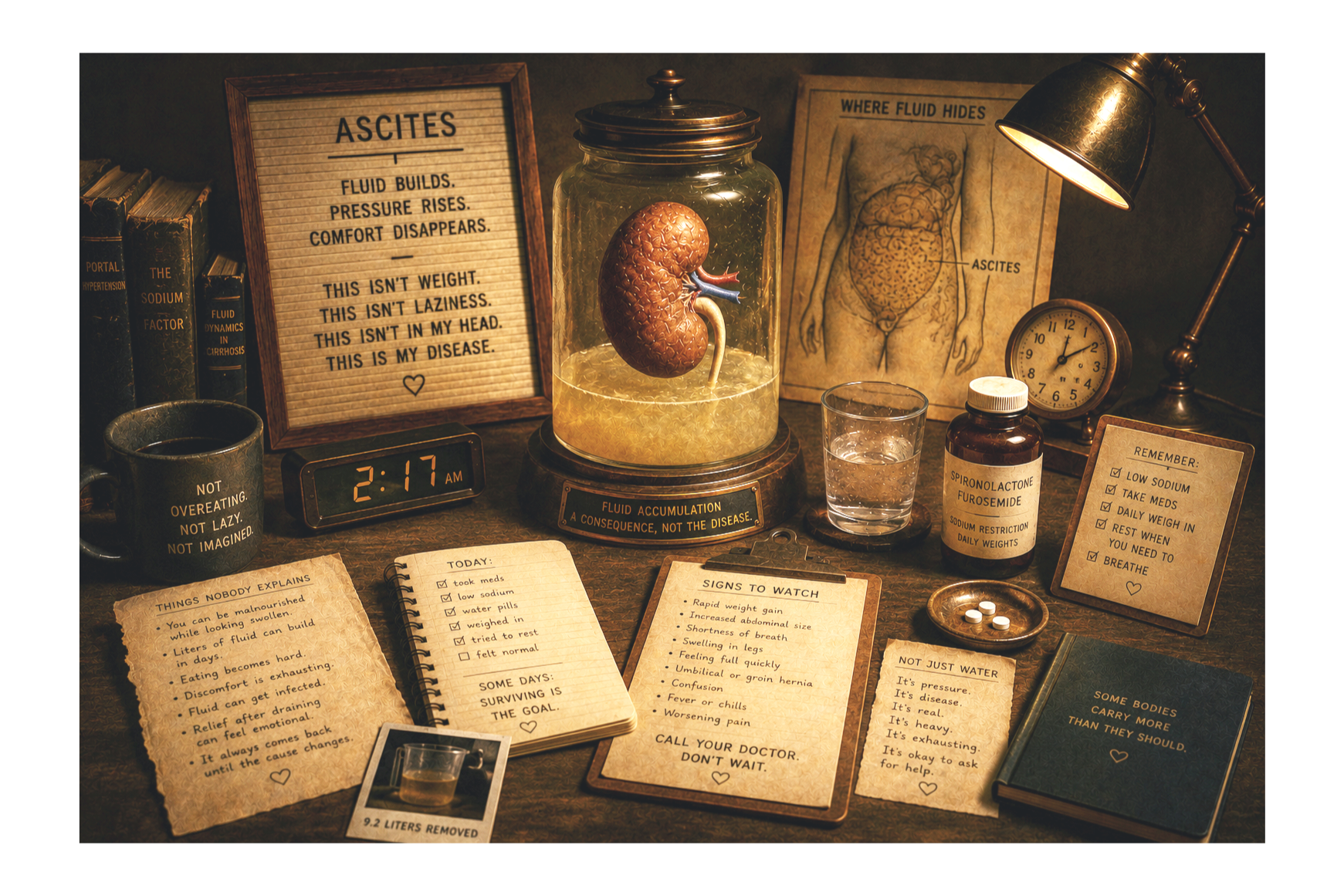
Understanding Ascites: The Severe Fluid Complication of Advanced Liver Disease
One day your body fits your clothes normally. The next, it feels like it is filling up from the inside out.
Ascites is the abnormal, pathological accumulation of free fluid within the peritoneal cavity. It represents the most frequent and definitive complication of decompensated liver cirrhosis, affecting nearly 50% of patients within ten years of diagnosis according to the NIH StatPearls Profile on Ascites.
People often call it "fluid retention," but that phrase barely captures the reality. This is an intense mechanical pressure—weight, stretching, deep physical exhaustion, and a frighteningly fast physical expansion that leaves you feeling breathless and unfamiliar with your own body.
What It Is
The human abdomen normally holds negligible amounts of free fluid. In advanced liver disease, severe scarring changes the basic vascular layout of the organ, forcing internal blood pressure to skyrocket. This structural resistance directly triggers Clinically Significant Portal Hypertension.
As hydrostatic pressure builds within these upstream vessels, blood plasma physically leaks out of the liver capsule and mesenteric veins, pooling inside the abdominal cavity.
The clinical severity of ascites is classified across a strict medical gradient:
Grade I (Mild): The fluid accumulation is minimal and visible only via diagnostic ultrasound imaging.
Grade II (Moderate): Symmetrical abdominal distension becomes visible, causing clothes to tighten and creating a constant feeling of abdominal fullness.
Grade III (Severe/Gross): Marked, tense abdominal distension that drastically impairs normal physical movement, lung volume, and internal organ function.
What It Feels Like
Ascites can fluctuate, but severe cases present a constant physical burden. Patients frequently describe the sensation as:
Carrying a heavy bowling ball trapped deep inside your lower abdomen.
Feeling your skin and abdominal wall stretched dangerously tight.
Pants and waistbands suddenly failing to close overnight.
Experiencing early satiety—getting full after only two or three bites of food because fluid is crushing your stomach.
A dull, constant pressure pushing up under the ribs, making it difficult to take a satisfying, deep breath.
Sharp rolling discomfort or a heavy "shifting" sensation when turning over in bed.
Severe fatigue from the baseline energy required to carry liters of excess weight through simple daily movements.
Why It Happens: The Vicious Fluid Cycle
The primary driver is portal hypertension, but the accumulation is accelerated by a profound systemic hormonal failure.
When blood cannot easily pass through the scarred liver, the rest of the body's vascular system dilates to compensate. The kidneys misinterpret this drop in systemic blood pressure as an emergency signal that the body is severely dehydrated.
In response, the kidneys activate the renin-angiotensin-aldosterone system, forcing the body to hold onto every single molecule of sodium and water it encounters, as detailed in the PMC Cirrhotic Ascites Review. This drives an unmanageable cycle:
Things Nobody Explains
1. The Fluid Volume Can Be Massive
This is not a small amount of dietary bloating. During a clinical drainage procedure, physicians regularly remove massive amounts of fluid. It is common to drain 5, 10, or even 14 liters of fluid from a patient's abdomen in a single medical session.
2. You Can Starve and Waste Away While Looking Larger
Ascites is pure waste fluid, not nutritional volume. At least 50% of cirrhotic patients simultaneously experience a devastating state called Protein-Calorie Malnutrition (PCM), according to the PMC Malnutrition in Cirrhosis Study. The patient experiences profound muscle wasting, weakness, and skeletal thinning in the arms and chest, while their abdomen continues to swell with fluid.
3. Eating Becomes a Physical Impossibility
As the peritoneal cavity fills, liters of fluid physically compress the stomach and intestines. This completely shuts down your appetite and slows down gut motility, making it incredibly difficult for liver disease patients to consume the calories they need to survive.
4. The Fluid Can Suddenly Turn Septic
Ascites fluid is highly susceptible to a life-threatening, spontaneous infection called Spontaneous Bacterial Peritonitis (SBP). Bacteria translocate directly from the gut into the stagnant fluid. As noted in the PMC Spontaneous Bacterial Peritonitis Guide, SBP is a medical emergency that can cause sudden fevers, abdominal pain, a rapid physical decline, or an abrupt worsening of Hepatic Encephalopathy.
What Helps: Clinical Management
Clinical management focuses heavily on altering the body's internal fluid dynamics through strict dietary rules and medical intervention.
Standard Lifestyle Interventions
Strict Dietary Sodium Restrictions: Minimizing sodium intake is a baseline medical requirement to stop the kidneys from trapping excess water.
Precision Daily Weight Tracking: Patients must weigh themselves daily to spot rapid fluid shifts before they translate into severe respiratory pressure.
Primary Medical Treatments
Dual Diuretic Therapy: Doctors commonly combine two fluid medications: spironolactone (an aldosterone antagonist that stops kidney sodium retention) and furosemide (a loop diuretic that forces the kidneys to excrete water). According to the PMC Diuretic Optimization Guide, this combination requires routine lab monitoring, as aggressive fluid drops can damage the kidneys and dangerously alter potassium and sodium blood levels.
Therapeutic Paracentesis: For tense, severe ascites, a physician inserts a sterile needle or catheter directly through the abdominal wall to manually drain the fluid. If a large volume (greater than 5 liters) is removed, guidelines from the PMC Management of Ascites Framework require an intravenous infusion of human albumin to prevent a dangerous drop in the patient’s systemic blood pressure.
The TIPS Procedure: If ascites becomes completely resistant to diuretics, a Transjugular Intrahepatic Portosystemic Shunt (TIPS) can be placed. This internal stent creates a low-resistance pathway through the liver scar tissue, dropping portal pressure and stopping fluid from leaking. However, it can increase the risk of mental confusion (HE).
Sources
NIH StatPearls:Ascites Profile – Comprehensive clinical analysis of peritoneal fluid accumulation, grading criteria, diagnostic steps, and core risks. https://www.ncbi.nlm.nih.gov/books/NBK470482/
PubMed Central (PMC) Review:Cirrhotic Ascites: Pathophysiology, Diagnosis, and Management – Deep dive into renal sodium retention, hyperdynamic circulation, and standard therapeutic pathways. https://pmc.ncbi.nlm.nih.gov/articles/PMC3664283/
PubMed Central (PMC) Clinical Study:Malnutrition in Liver Cirrhosis – Examination of the high prevalence of protein-calorie malnutrition and muscle wasting masked by fluid retention. https://pmc.ncbi.nlm.nih.gov/articles/PMC3990138/
PubMed Central (PMC) Infection Guide:Spontaneous Bacterial Peritonitis – Analysis of fluid infection mechanics, diagnostic paracentesis thresholds, and antibiotic treatment protocols. https://pmc.ncbi.nlm.nih.gov/articles/PMC2600063/
Medical Disclaimer & General Guidance
The information provided across these resources is for educational and informational purposes only. It is not intended to be a substitute for professional medical advice, diagnosis, or treatment. Advanced liver disease and its associated complications—including hepatic encephalopathy, portal hypertension, ascites, and varices—are complex medical conditions that require precise, individualized clinical management. Always seek the advice of your physician, hepatologist, or other qualified healthcare provider with any questions you may have regarding a medical condition or treatment plan.
For anything of concern, contact your hepatologist and/or dial 911 immediately.
Transient vs. Hepatic Ascites: Understanding the Fluid Retention Spectrum in Advanced Liver Disease
One day your body fits your clothes normally, and your abdomen moves comfortably as you breathe. The next, your stomach begins expanding from the inside out, turning into a heavy, taut, and visibly swollen dome that leaves you breathless, physically exhausted, and struggling to close your waistbands overnight.
Abnormal fluid pooling within the abdominal space exists on a highly specific developmental spectrum. Transient (or localized) ascites is a brief, temporary accumulation of peritoneal fluid—such as mild swelling secondary to a passing abdominal infection, localized trauma, or transient pelvic inflammation—that resolves cleanly once the primary irritation heals. Hepatic ascites is an ingrained, systemic failure where a cirrhotic liver’s structural collapse triggers an unmanageable combination of severe internal blood vessel backpressure and profound kidney failure, forcing gallons of blood plasma to continuously sweat out of your organs and drown your abdominal cavity.
People frequently look at abdominal swelling as simple dietary bloating, standard weight gain, or a temporary bout of water retention. In reality, transitioning from passing abdominal puffiness to true hepatic ascites marks a critical, irreversible biological milestone—the official transition of chronic liver disease into decompensated cirrhosis [1].
What It Is
The human abdomen normally holds a negligible, microscopic layer of free fluid designed to lubricate the moving surfaces of your intestines. When a passing inflammatory event irritates these surfaces, it triggers a brief period of transient ascites.
However, as chronic liver disease advances into stage F4 cirrhosis, the internal structural architecture of the organ collapses into rigid bands of scar tissue. Comprehensive clinical data demonstrates how this structural blockage completely rewires your systemic fluid dynamics:
The Rise of Portal Hypertension: Widespread liver scarring acts as a literal concrete block inside the portal vein—the main blood highway bringing fluid from your intestines to your liver. Because blood can no longer easily push through the hard, scarred liver tissue, internal portal blood pressure skyrockets, forcing blood plasma to physically leak out of the liver capsule and mesenteric veins [1, 5].
The Splanchnic Vasodilation Crisis: To cope with this dangerous bottleneck, your body releases massive amounts of nitric oxide to dilate the blood vessels inside your abdomen. This massive widening of the blood vessels causes a severe drop in the body's effective arterial blood pressure [5].
The Vicious Kidney Retention Loop: The kidneys misinterpret this dropped systemic blood pressure as an emergency signal that you are bleeding to death. In a desperate bid to save you, the kidneys activate the renin-angiotensin-aldosterone system [1, 5]. This triggers an unmanageable hormonal cycle, forcing your body to hold onto every single molecule of sodium and water it encounters, driving more and more fluid directly into your swollen abdomen [5].
The clinical severity of this fluid accumulation is classified across a strict medical gradient using specific diagnostic tracking parameters:
Grade 1 (Mild): The fluid accumulation is minimal and completely invisible to the naked eye, detectable only via a diagnostic ultrasound imaging scan.
Grade 2 (Moderate): Symmetrical abdominal distension becomes physically visible, causing clothes to tighten and creating a constant, uncomfortable feeling of abdominal fullness.
Grade 3 (Severe/Gross): Marked, tense abdominal distension that drastically impairs normal physical movement, lung volume, and internal organ function.
What It Feels Like
The physical weight and mechanical burden of fluid retention changes completely as the condition transitions from a simple slow-down to structural liver failure.
During Transient Ascites, you frequently feel:
A mild, passing tightness in your lower stomach after an illness or injury that completely fades away as your body naturally reabsorbs the fluid within a week.
A localized discomfort that does not impact your breathing, your ability to walk, or your capacity to eat a full meal normally.
When the condition crosses into Hepatic Ascites, the daily burden shifts completely. Patients experience:
Carrying an incredibly heavy, water-logged weight trapped deep inside your lower abdomen that feels like walking around with a solid bowling ball strapped to your stomach.
Feeling your abdominal wall and skin stretched dangerously tight, turning your belly into a hard, firm drum that is tender to the touch.
Experiencing early satiety—getting completely full after only two or three bites of food because the massive volume of fluid is physically crushing your stomach and intestines.
A dull, constant pressure pushing up under your ribs, making it incredibly difficult to expand your lungs and take a satisfying, deep breath.
A heavy "shifting" or rolling discomfort when attempting to turn over in bed, accompanied by severe, bone-deep fatigue from the sheer energy required to carry liters of excess weight through simple daily movements.
The Crossover Point: The Collapse of Effective Blood Volume
The transition from a stable, compensated liver stage to true hepatic ascites represents an absolute clinical "crossover point." In the progression of advanced liver disease, this boundary is the exact threshold where your internal fluid stops flowing inside your veins and begins permanently escaping into the "third space" of your body.
To visualize this structural crossover point, think of three concrete examples:
The Overflowing Basement Sump Pump: In transient ascites, a brief rainstorm pours water into your basement. The internal sump pump turns on, chugs along steadily, and pumps the water back outside—the system handles the stress. The hepatic ascites crossover point is equivalent to a massive city water main breaking directly under your foundation. Millions of gallons of water rush in all at once; the pump is completely submerged, short-circuits, and the basement fills to the ceiling with water.
The Slack Garden Hose: Imagine trying to spray water onto a roof with a firm, highly pressurized rubber hose—the water reaches the target effortlessly. The hepatic crossover point is equivalent to replacing that firm line with a giant, hyper-elastic fabric tube that expands to five times its normal width the moment water enters it. The water completely expands the middle of the hose inside the yard, losing all its forward pressure, causing the stream to limply drop to the ground without ever reaching the roof.
The Gridlocked Storm Drain: Think of a standard city street during a mild shower. The gutters catch the rainfall, directing the water down into the underground pipes seamlessly. The hepatic crossover point is equivalent to a category-5 hurricane hitting a city where the storm drains are completely packed with concrete. The water can no longer drop below ground level; it reverses direction, erupts out of the manhole covers, and creates an unmanageable lake across the entire neighborhood.
Clinical indicators universally establish that once a patient passes this structural crossover point, the abdominal swelling cannot be resolved with simple bed rest, motivational effort, or standard weight-loss diets. The fluid is a physical confirmation that your vascular system has lost its ability to retain liquid, indicating a critical need for targeted medical intervention to prevent life-threatening complications.
Things Nobody Explains
1. The Fluid Volume Can Be Absolutely Massive
This is not a small amount of dietary bloating or cosmetic water retention. During a standard clinical drainage procedure, physicians regularly insert a sterile catheter through the abdominal wall and manually remove staggering amounts of fluid. It is incredibly common for doctors to drain 5, 10, or even 14 liters of fluid—amounting to roughly 11 to 30 pounds of pure waste water—from a patient's abdomen in a single medical session [1].
2. You Can Starve and Waste Away While Looking Larger on the Scale
Ascites is pure waste fluid, not nutritional volume. At least 50% of advanced liver patients simultaneously experience a devastating state called Protein-Calorie Malnutrition (PCM) or Sarcopenia [1, 3]. This creates a terrifying optical illusion: a patient's arms, chest, and face experience profound muscle wasting and skeletal thinning, while their abdomen continues to swell larger and larger with fluid, masking their starvation on the bathroom scale [1, 3].
3. Eating Becomes a Physical Impossibility
As the peritoneal cavity fills with liters of fluid, it exerts a massive mechanical pressure on your internal organs. This fluid physically compresses the stomach and intestines, entirely shutting down your appetite, slowing gut motility, and causing severe acid reflux [1]. This makes it incredibly difficult for liver patients to consume the vital calories and high-protein foods they need to survive, accelerating their muscle loss [1].
4. The Trapped Fluid Can Suddenly Turn Septic
Ascites fluid is highly susceptible to a sudden, life-threatening internal infection called Spontaneous Bacterial Peritonitis (SBP) [1]. Because the gut wall is swollen, bacteria can translocate directly from the intestines into the stagnant, warm pool of fluid. SBP is an absolute medical emergency that can cause sudden fevers, abdominal pain, a rapid physical decline, or an abrupt worsening of brain-fog confusion (Hepatic Encephalopathy) [1].
What Helps: Clinical Management
Clinical management shifts away from basic lifestyle adjustments and focuses entirely on altering the body's internal fluid dynamics through strict hormone blocking and mechanical drainage.
Standard Lifestyle Interventions
Strict Dietary Sodium Restrictions: Minimizing table salt intake to less than 2,000 mg per day is a baseline medical requirement [1]. This stops the panicked kidneys from trapping excess water, preventing the ascites from rapidly refilling [5].
Precision Daily Weight Tracking: Patients must weigh themselves on a digital scale every single morning after their first restroom use. Spotting a rapid weight gain of 2 to 3 pounds in a single day allows patients to catch fluid shifts before they translate into dangerous breathing pressure.
Primary Medical Treatments
Dual-Diuretic Medication Therapy: Doctors commonly combine two powerful fluid medications: spironolactone (an aldosterone blocker that stops kidney sodium retention) and furosemide (a loop diuretic that forces the kidneys to excrete water) [1]. This combination requires routine blood monitoring, as aggressive fluid drops can damage the kidneys and dangerously alter potassium and sodium levels [1].
Therapeutic Paracentesis Draining: For tense, severe Grade 3 ascites, a physician performs a sterile paracentesis [1]. They insert a sterile needle directly through the abdominal wall to manually drain the fluid. If a large volume (greater than 5 liters) is removed, medical guidelines mandate an immediate intravenous infusion of human albumin to prevent a dangerous drop in the patient’s systemic blood pressure [1].
The TIPS Procedure Placement: If the ascites becomes completely resistant to high-dose diuretics, doctors deploy a Transjugular Intrahepatic Portosystemic Shunt (TIPS) [1]. A radiologist places an internal metal stent inside the liver to create a low-resistance detour path around the scar tissue, dropping portal pressure instantly and stopping fluid from leaking into the abdomen [1].
References
Moore, K. P., & Aithal, G. P. (2006). Fluid retention in cirrhosis: pathophysiology and management. QJM: An International Journal of Medicine, 99(2), 71–85. nih.gov
Mayo Clinic. (2024). Cirrhosis: Symptoms, Causes, and Portal Hypertension Risks. Mayo Clinic Disease Registry. mayoclinic.org
Dasarathy, S., & Merli, M. (2016). Sarcopenia from mechanism to diagnosis and treatment in liver cirrhosis. Journal of Hepatology, 65(6), 1232–1244. nih.gov
McPhail, M. J., & Taylor-Robinson, S. D. (2010). The neurobiology of fatigue and motor weakness in chronic liver disease. Metabolic Brain Disease, 25(1), 81–87. springer.com
European Association for the Study of the Liver (EASL). (2019). EASL Clinical Practice Guidelines on nutrition in chronic liver disease. Journal of Hepatology, 70(1), 172–193. nih.gov
Williams, F. R., & Armstrong, M. J. (2021). Exercise and physical activity in patients with chronic liver disease. The Lancet Gastroenterology & Hepatology, 6(8), 651–663. thelancet.com
Premium Clinical Meta-Analysis. (2025). Protein and Macronutrient Metabolism in Liver Cirrhosis. Journal of Clinical Gastroenterology, 59(2), e12608644. nih.gov
Advanced Hepatology Practice Group. (2026). Current management strategies for sarcopenia and frailty in cirrhosis. World Journal of Hepatology, 18(1), 115–128. nih.gov
Medical Disclaimer & General Guidance
The information provided across these resources is for educational and informational purposes only. It is not intended to be a substitute for professional medical advice, diagnosis, or treatment. Advanced abdominal ascites, spontaneous bacterial peritonitis, and decompensated liver conditions are severe, volatile medical scenarios that require constant, specialized oversight by a certified gastroenterologist or hepatologist. Always seek the direct advice of your physician before changing your dietary restrictions, altering your prescription diuretic schedule, or trying to manage sudden fluid retention at home.
