
Portal Hypertension & Movie Plot Plagiarism
Watch: Portal Hypertension Explained: The Problem Causing Problem 👀🛑
@diagnosis_cirrhosis 🩸🌊 Portal Hypertension: the complication nobody explains properly 👀 If you have cirrhosis, you’ve probably heard the term a hundred times. Portal hypertension. And everybody says it like you’re supposed to know what it means. But here’s the weird part: Portal hypertension isn’t just one complication. It’s the problem-causing problem. The thing behind a whole bunch of other cirrhosis complications. The supervillain nobody introduces properly 😭 — Most people aren’t lying awake at 2 AM searching: “What is portal hypertension?” They’re searching things like: 👉 Why is my stomach filling with fluid? Why a low sodium diet in cirrhosis? 👉 Why are my platelets low? 👉 Why is my spleen enlarged? 👉 Why did my doctor order an endoscopy? 👉 Why do I need carvedilol? 👉 What causes side effects in cirrhosis? 👉 What made me decompensate? 👉 Why does cirrhosis suddenly affect everything? And portal hypertension is often sitting somewhere in the middle of those answers. — 🫀 Think of your liver like a giant filter. Blood from your stomach, intestines, pancreas, and spleen is constantly trying to flow through it. Normally, blood moves through the liver pretty easily. But cirrhosis creates scar tissue. Scar tissue creates resistance. Think traffic 🚗🚗🚗 The cars keep coming. But suddenly the highway narrows. Traffic backs up. Pressure builds. And once pressure builds, the dominoes start falling. — 💧 Why is my stomach filling with fluid? Portal hypertension is one major reason ascites develops. As pressure rises, fluid can leak out of blood vessels and collect in the abdomen. — 🦵 Why are my legs and feet swelling? Why does low sodium matter? Portal hypertension can contribute to fluid retention throughout the body: 🦵 swollen ankles 🦵 swollen feet 🦵 swollen legs — 📉 Why are my platelets low? Portal hypertension can enlarge the spleen. Doctors call this splenomegaly. As the spleen enlarges, it can trap platelets, which is one reason platelet counts drop in cirrhosis. — 🩸 Why do I need an endoscopy? Because portal hypertension can create varices. Varices are pressure-relief detours that form when blood can’t move through the liver easily. Some form in the esophagus or stomach, where they can bleed. — 💊 Why am I taking carvedilol, propranolol, or nadolol? Beta blockers are often used in cirrhosis not for regular high blood pressure, but to help reduce portal pressure and lower variceal bleeding risk. — 🧠 What does portal hypertension have to do with hepatic encephalopathy? As pressure builds, blood can bypass the liver through collateral vessels. That means toxins may avoid normal liver processing, which can contribute to hepatic encephalopathy. — 😵💫 This is why portal hypertension feels like it’s everywhere. Because it kind of is. It can leave fingerprints on: 💧 ascites 🦵 edema 📉 low platelets 🧽 enlarged spleen 🩸 varices 🧠 hepatic encephalopathy 💊 beta blockers 🏥 endoscopies Suddenly the thing you were told was “just pressure” starts looking a lot more important. — 🧬 Common causes of cirrhosis and portal hypertension include autoimmune hepatitis 🔥 fatty liver disease / MASLD / NAFLD / MASH / NASH 🍩 alcohol-related liver disease 🚫🍷 hepatitis B 🦠 hepatitis C 🦠 PBC 🧬 PSC 🧬 hemochromatosis ⚙️ Wilson’s disease 🪙 alpha-1 antitrypsin deficiency 🧩 drug-induced liver injury 💊 cryptogenic cirrhosis ❓ or other causes. 👩⚕️👨⚕️🩺 Always talk to your doctor or hepatologist about ascites, swelling, low platelets, enlarged spleen, varices, hepatic encephalopathy, beta blockers, endoscopy results, decompensation, or any new symptoms. Because understanding portal hypertension helps explain why so many seemingly unrelated cirrhosis symptoms are actually connected 💚 #symptoms #liverhealth #fattyliver #bloodpressure #lowsodium ♬ Positive Vibes - Various Artist
Video Transcript & Key Points From My Caption:
The High-Speed Bottleneck: Portal hypertension is an intense increase in blood pressure within the portal vein system, caused when a hardened, scarred liver blocks normal circulatory flow
The Internal Detour: Because the main highway is completely blocked, the body is forced to build an alternative route—diverting high-pressure blood flow into the fragile, thin-walled veins of the esophagus and stomach, creating varices
The Threat of a Crash: Esophageal varices are highly fragile. When the internal pressure gets too high, these tiny vessels can rupture, leading to acute, life-threatening internal bleeding that requires immediate medical emergency intervention
Portal Hypertension: The Problem Causing Problem
By: Angie from @diagnosis_cirrhosis on TikTok
My Body Was Auditioning for a Low-Budget Horror Film
Portal hypertension is one of those cirrhosis complications that, looking back, absolutely should have terrified me more than it did. But in the chaos of Winter 2024, it honestly did not make the leaderboard.
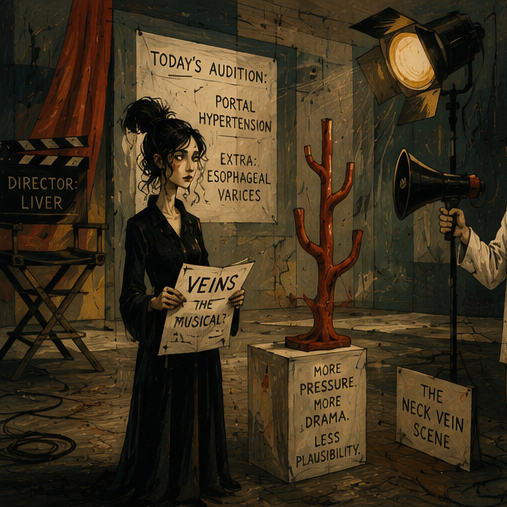
And that is not because portal hypertension is boring. In fact, it is arguably one of the most cinematic, body-horror-adjacent concepts in all of liver disease.I think it just sounded too absurd at the time to emotionally process. Because when doctors first started explaining it to me, all I really heard was: your liver is scarred, the blood cannot move correctly, pressure is building, veins can rupture, and technically yes, one in your neck could explode.
And I remember thinking:
That sounds medically dramatic.
That sounds fear-mongery.
That sounds like somebody got a little too excited in the pathology textbook section.
Because how does: “my liver is sick” somehow become: “my veins are auditioning for a low-budget horror film”? The escalation felt narratively unreasonable.
What’s funny is that now, if you have ever been in one of my TikTok lives, you have probably witnessed me explain portal hypertension through what can only be described as a deeply unfortunate interpretive dance routine. It starts with my left hand over my liver. Then my right hand swoops dramatically downward like a peregrine falcon dive-bombing a field mouse. Then suddenly — traffic jam. Clog. Backup. Pressure. And both hands erupt outward into this weird little exploding gesture that suspiciously resembles the butterfly dance move we all learned in middle school with crossed thumbs and wiggling fingers.
Which is objectively bizarre. I have a fully developed choreography routine dedicated to explaining the possibility of veins exploding inside my body. Explain that one to me. Actually don’t. I am already trying to spare my therapist enough material as it is.
Harry Potter Staircases and Jackson Pollock Platelets I mean Palettes
But portal hypertension itself is wild because the body becomes weirdly adaptive in ways that sound completely fictional until they happen to you. At different phases of my illness, especially when I was critically sick, my portal pressures were extremely high. So high that my body literally started forging alternate pathways to reroute blood flow around the liver altogether.
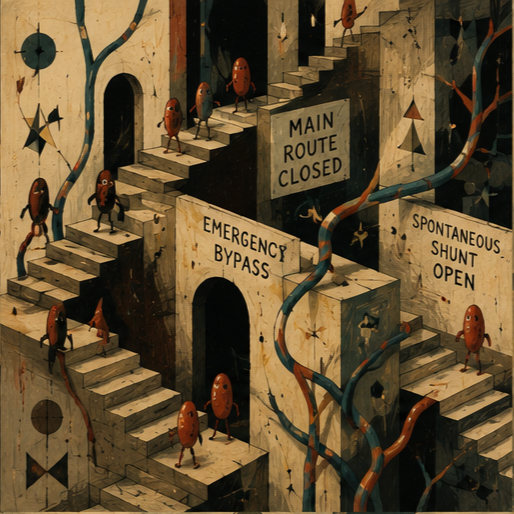
That is a crazy sentence. My body built detours. Spontaneous shunts. New venous pathways. Emergency bypass systems snaking through my abdomen because my circulation essentially looked at my liver and said: absolutely not, we’ll circle around.
And honestly? The closest thing I can compare it to is the moving staircases in Harry Potter. Nothing connects where it originally should anymore. Routes change. Passageways rearrange. The body starts improvising architecture in real time trying to survive itself. Which would almost be impressive if the stakes were not so horrifying.
Because the darker reality underneath portal hypertension is that this pressure buildup can create varices — fragile swollen veins that carry very real bleeding risk. And there is something deeply disturbing about realizing the human body can quietly transform itself into the conceptual origin story of a Jackson Pollock painting. Especially if red is your color palette. Honestly, horror movies may have been plagiarizing portal hypertension this whole time and none of us noticed.
And yes, it begs the question: why the F1 angle? I’ll be honest: I do not have an exceptional answer, except that it is my husband’s favorite sport, and every time I read the standard medical analogy about a high-speed car pileup inside the circulatory system, my brain was immediately burdened with the sound of extremely expensive cars turning left for hours. And for some unjust reason, I decided the rest of the internet should be burdened with that auditory experience too. Misery loves company. And apparently, so do bored car wives.
  The High-Speed Vascular Bottleneck:
 ┌───────────────────────────┐
 │ • Stiff Scar Tissue Blocks → The Main Portal Highway          │
 │ • Systemic Pressure Spikes → Blood Backs Up Into Organs │
 │ • Emergency Detour Built  → High-Flow Routed to Esophagus│
 │ • The Outcome: Fragile Varices Face Constant Fluid Strain.  │
 └───────────────────────────┘
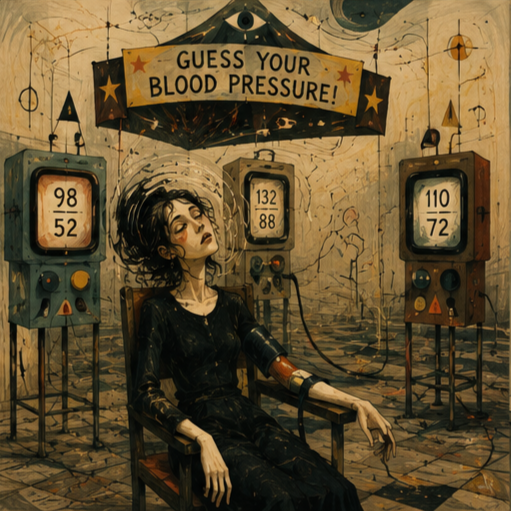
And yet, despite all of that, despite how objectively terrifying this complication actually is, I have to be honest: it still did not emotionally scare me the way other things did. I was significantly more stressed about the fact that my stupid blood pressure monitor would not give me the same reading twice.
Seriously. The idea that critically ill patients are somehow expected to accurately take their own blood pressure while dizzy, exhausted, medically overwhelmed, and beta-blocked into another dimension feels like a social experiment somebody forgot to shut down.
My Betas Are Blocked: The Scented Trash Bag Incident
Because these beta blockers are not casual little vitamins. They matter. And apparently, what I also did not realize at the time is that carvedilol functions as a sort of emotional governor too. For many people, lowering the heart rate lowers the physiological sensation of anxiety itself.
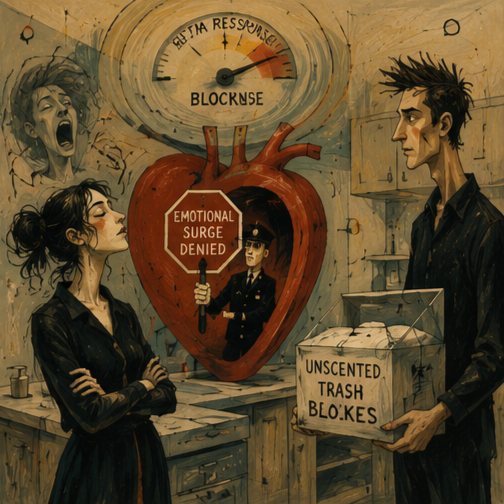
Which leads me to one of the stupidest and funniest revelations of my entire cirrhosis experience. One day, my husband committed what I considered at the time to be an act of absolute domestic treason: he bought unscented trash bags.
Now, if you have never been critically ill while surviving almost exclusively on protein shakes, supplements, medication schedules, and existential instability, perhaps you do not understand the emotional importance of a lemon-scented trash bag wafting softly through the kitchen after throwing away yet another sad little protein shake bottle. But I did. And normally? This would have absolutely launched me into orbit.
Except this time, I looked at him calmly and said: “Oh man, maybe next time you could grab the scented ones.”
And the look on his face was immediate confusion. He just stared at me and finally said: “Why aren’t you mad?”
And honestly? I did not understand either. Until later, when the realization hit me all at once and I finally erupted — emotionally, not esophageally, thank God — and yelled: “They stole my betas. My betas are blocked.” And somehow that remains one of the funniest accidental pharmacological discoveries of my entire illness journey.
The Data Breakdown: Harry Potter Staircases and Jackson Pollock Palettes

To understand why advanced chronic liver disease shifts from an internal tissue injury into a high-stakes vascular race, we have to look past the liver itself and dive straight into the metabolic, mechanical, and circulatory pathways. As I aggregated the peer-reviewed medical literature, I found three primary systemic mechanisms that link hepatic scarring to portal hypertension and fragile varices, all of which mapped directly to what I was feeling:
1. Increased Intrahepatic Vascular Resistance (The Brick Wall Bottleneck)
The portal vein is the primary vascular highway responsible for delivering blood from your digestive organs directly into the liver for filtration. When advanced tissue remodeling and structural scarring (fibrosis) harden the liver's internal architecture, they compress the microscopic hepatic sinusoids. This mechanical compression acts like a literal brick wall, choking off normal circulatory flow and causing fluid pressure within the portal vein system to spike to dangerous levels.
My Experience: This structural bottleneck is the exact biological reason why the phrase "veins auditioning for a low-budget horror film" felt so narratively real during my diagnosis. While my brain was trying to process the vague reality of being sick, my internal plumbing was fighting a massive, high-speed traffic jam. The blood couldn't pass through the scarred liver highway, triggering a silent, high-pressure backup that felt completely absurd to emotionally navigate until the clinical metrics forced the issue.
Source Citation: The physiological data tracking this vascular resistance and the mechanical backup of structural portal pressure points are documented under the PMC Comprehensive Guide on the Pathophysiology of Portal Hypertension on PubMed.
2. Collateral Circulation and Angiogenesis (The Harry Potter Detours)
When the main portal vein highway is completely blocked by stiff scar tissue, the body enters a survival engineering protocol. In a desperate bid to relieve the intense internal pressure, the circulatory system activates localized growth factors to forge spontaneous shunts, alternative pathways, and brand-new venous channels to route blood entirely around the obstructed liver.
My Experience: This automated vascular rearranging is precisely what I felt as a crazy, fictional reality—my body was literally building spontaneous detours snaking through my abdomen. It is the real-life equivalent of the moving staircases in Harry Potter, where nothing connects where it originally should anymore. Your circulatory system begins improvising architecture in real time, bypassing the brick wall entirely just to keep the internal train running and preserve core survival.
Source Citation: The clinical parameters tracking how these alternative venous channels form and alter long-term pressure metrics are evaluated in Clinical Significance of Portal Hemodynamics and Ratios in Chronic Liver Diseases on the World Journal of Gastroenterology.

3. Esophageal Variceal Decompensation (The Pressure Crash Risk)
Because these emergency detours are built rapidly out of necessity, the high-pressure, high-velocity blood flow is forced into preexisting, fragile, paper-thin micro-vessels lining the stomach and esophagus. These tiny, superficial mucosal veins were never biologically designed to handle corporate, high-speed vascular traffic. Under constant fluid strain, they dilate and swell into fragile internal balloons known as esophageal varices.
My Experience: This fragile structural strain is the darker reality that transforms the human body into the conceptual origin story of a Jackson Pollock painting. When the internal track pressure spikes too high, these thin-walled varices face a constant risk of a catastrophic crash and rupture. Understanding this mechanical pipeline is why we show up for every single surveillance track inspection scope—because preventing an acute, life-threatening internal vascular leak requires tracking the pressure before a crash ever happens.
Source Citation: The rigid guidelines governing risk stratification, surveillance intervals, and preventative surgical procedures like endoscopic variceal ligation are established under the AASLD Practice Guidance on Risk Stratification, Surveillance Scopes, and Variceal Banding on the American Journal of Gastroenterology.
What to Ask Your Healthcare Team: Specialist Questions
Surviving life in this club means learning how to manage the track conditions before a crash ever happens. Your medical portfolio uses a combination of pharmaceutical precision and surgical tracking to keep the pressure system humble. Bring this exact question checklist to your next clinic visits:
Questions for Your Hepatologist or Gastroenterologist
"Based on my most recent surveillance endoscopy, what is the exact clinical grade (e.g., small, medium, or large) of my esophageal varices?"
"Are we seeing any high-risk structural signs, like red wale markings, that indicate my vessel walls are experiencing dangerous pressure strain?"
"What is my exact resting target heart rate on my current dosage of non-selective beta-blockers (like carvedilol) to ensure my portal pressure is optimized?"
"If I require an over-the-counter medication for a routine issue, which specific options are completely safe to avoid triggering an upper GI bleeding risk?"
Questions for a Mental Health Professional or Counselor
"How can I untangle the physiological dampening effects of beta-blockers from my actual psychological processing of diagnostic trauma?"
"What strategies can I use to manage the baseline 'existential instability' that comes with tracking internal, invisible vascular pressure boundaries?"
Summary: Keeping the Track Safe
You stop actively falling apart, but you also never fully stop managing. One chronic minute at a time, you keep tracking, keep checking, and keep showing up for your body’s internal engineering.
Understanding portal hypertension shifts you away from feeling like a ticking time bomb and moves you into the role of a calculated track manager. Your body is fighting an incredibly complex, high-stakes race every single second just to build alternative hallways around a structural brick wall.
It can feel completely overwhelming to realize your internal architecture has rearranged itself like the moving staircases in Hogwarts. But reaching stability means learning how to manage the track conditions before a crash ever happens.
So if you are currently staring at a blood pressure monitor that won’t give you the same reading twice, or trying to navigate a dizzy, beta-blocked dimension, remember: you are running this race with precision. Stick strictly to your beta-blocker routines, show up for every single surveillance track inspection scope, and remember that when the world gets loud, it's okay to just calmly ask for the lemon-scented trash bags next time.
Your betas are blocked. Your pressure system is being managed. And you are navigating the circuit with absolute grace.
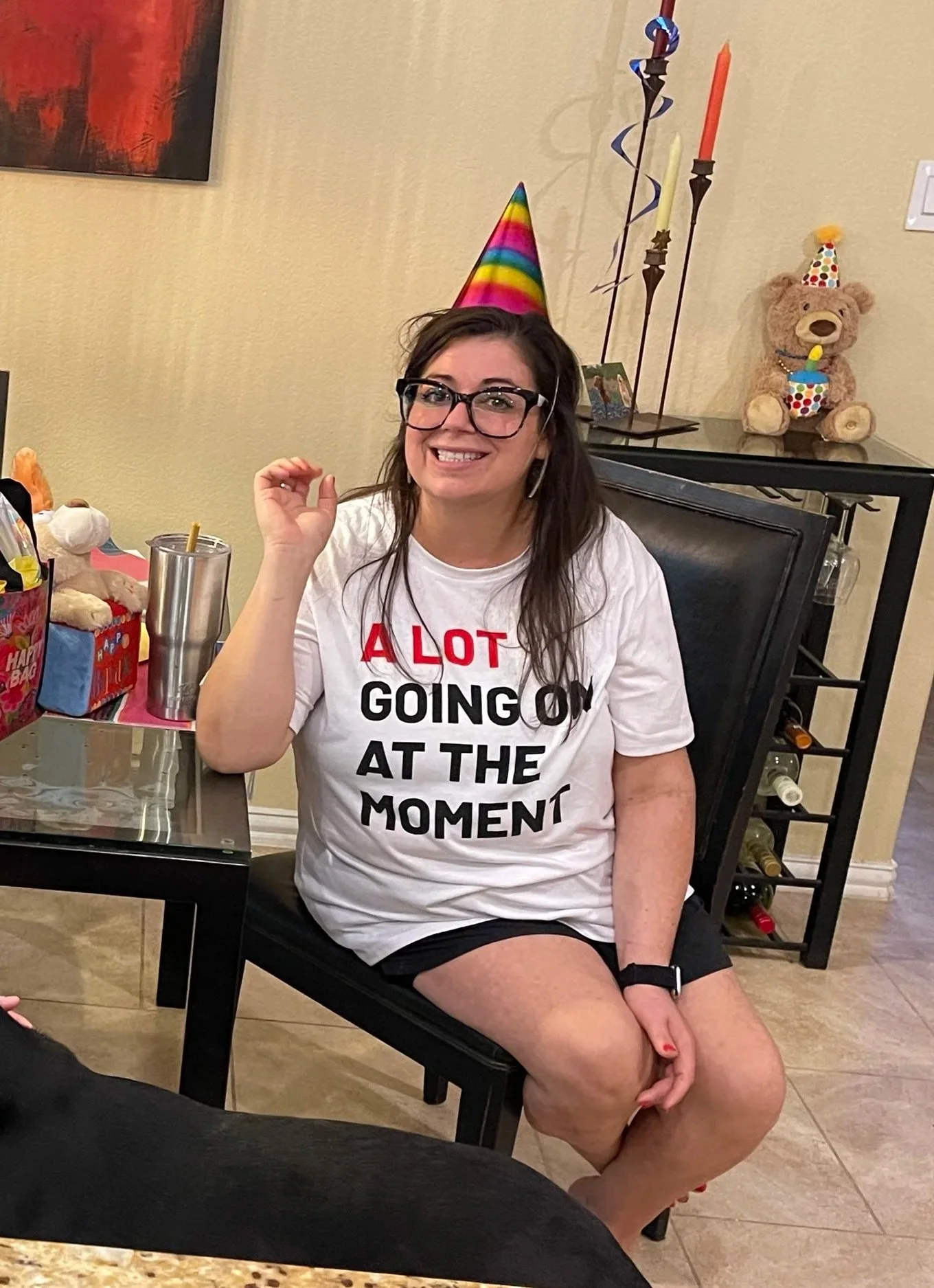
Not my birthday, thankfully. But a memorable moment. That evening my nose bled and bled and bled. Looking at this photo the next day I realized how much the shirt resembled the painting behind me. Thanks portal hypertension
Peer-Reviewed Sources and References
National Institutes of Health (NIH): Read the comprehensive hemodynamic data tracking vascular resistance and portal pressure points via The PMC Comprehensive Guide on the Pathophysiology of Portal Hypertension on PubMed.
Details the mechanical and cellular pathways that trigger a severe pressure build-up within the splenic and mesenteric vein systems.
Exposes how intrahepatic resistance alters baseline structural blood flow and shapes secondary cardiovascular load metrics.
American Journal of Gastroenterology: Review the clinical surveillance parameters and treatment guidelines for variceal care under the AASLD Practice Guidance on Risk Stratification, Surveillance Scopes, and Variceal Banding on the American Journal of Gastroenterology.
Establishes standard global tracking protocols for identifying high-risk red wale markings during screening endoscopies.
Outlines explicit medical and surgical thresholds for performing active prophylactic band ligation to prevent vessel crashes.
World Journal of Gastroenterology: Explore the research tracking how beta-blocker titration influences long-term pressure management in Clinical Significance of Portal Hemodynamics and Ratios in Chronic Liver Diseases on the World Journal of Gastroenterology.
Analyzes how non-selective beta-blockers like carvedilol drop splanchnic blood inflow to safely reduce variceal fluid tension.
Tracks the structural optimization timelines and hemodynamic ratios required to maintain chronic circulatory stability.
@diagnosis_cirrhosis 🏁🏎️ If you love Formula 1, this one’s for you — but there’s a twist. What does a massive F1 crash have to do with portal hypertension and cirrhosis? 👀🩸 In this video we break it down using the chaos of the Grand Prix as an analogy for what can happen when too much pressure builds up in the liver’s blood flow. When traffic piles up on the track… things can get dangerous fast. 🚗💥 And speaking of Melbourne, here are some real race highlights from the weekend 🇦🇺👇 🔥 Dramatic battle for the lead George Russell started on pole, but Ferrari’s Charles Leclerc surged from P4 to grab the lead at Turn 1. The two traded the lead seven times in the first 10 laps thanks to the new 2026 energy-deployment rules ⚡🏎️ ⏱️ Strategy swing Lap 11 changed everything when a Virtual Safety Car came out after Isack Hadjar’s Red Bull retired 🚧 Mercedes pitted both cars, while Ferrari stayed out — a decision that ultimately cost Leclerc the win after his later stop. 💔 Home heartbreak Australian favorite Oscar Piastri stunned the Melbourne crowd when he crashed his McLaren before the race even started on the way to the grid. 📈 Recovery drives Reigning champion Lando Norris finished 5th, while Max Verstappen climbed from 20th on the grid to 6th — one of the best comeback drives of the race 💪 🌟 Rookie debut 18-year-old Arvid Lindblad scored points on his Formula 1 debut, finishing 8th for Racing Bulls 👏 📊 2026 Championship Standings (Top 5) 1️⃣ George Russell — Mercedes — 25 pts 2️⃣ Kimi Antonelli — Mercedes — 18 pts 3️⃣ Charles Leclerc — Ferrari — 15 pts 4️⃣ Lewis Hamilton — Ferrari — 12 pts 5️⃣ Lando Norris — McLaren — 10 pts So what does all this have to do with the liver? 🤔 Watch the video to see how traffic jams, detours, and crashes on a race track can explain what’s happening inside the body with portal hypertension and varices. If you’re navigating cirrhosis — whether from autoimmune hepatitis 🔥, MASLD / NAFLD 🍩, MASH / NASH 🧪, alcohol-related liver disease 🚫🍷, hepatitis B 🦠, hepatitis C 🦠, primary biliary cholangitis (PBC) 🧬, primary sclerosing cholangitis (PSC) 🧬, hemochromatosis ⚙️, Wilson’s disease 🪙, alpha-1 antitrypsin deficiency 🧩, drug-induced liver injury 💊, metabolic or genetic conditions, cardiac / congestive liver disease, biliary diseases, fatty liver disease, cryptogenic cirrhosis ❓ — or any other liver condition 💚 — talk with your doctor or hepatologist about what’s right for you 👩⚕️👨⚕️ #f1 #grandprix #hypertension #liverhealth #liverfaliure ♬ original sound - diagnosis cirrhosis
