
Varices & Bleeding
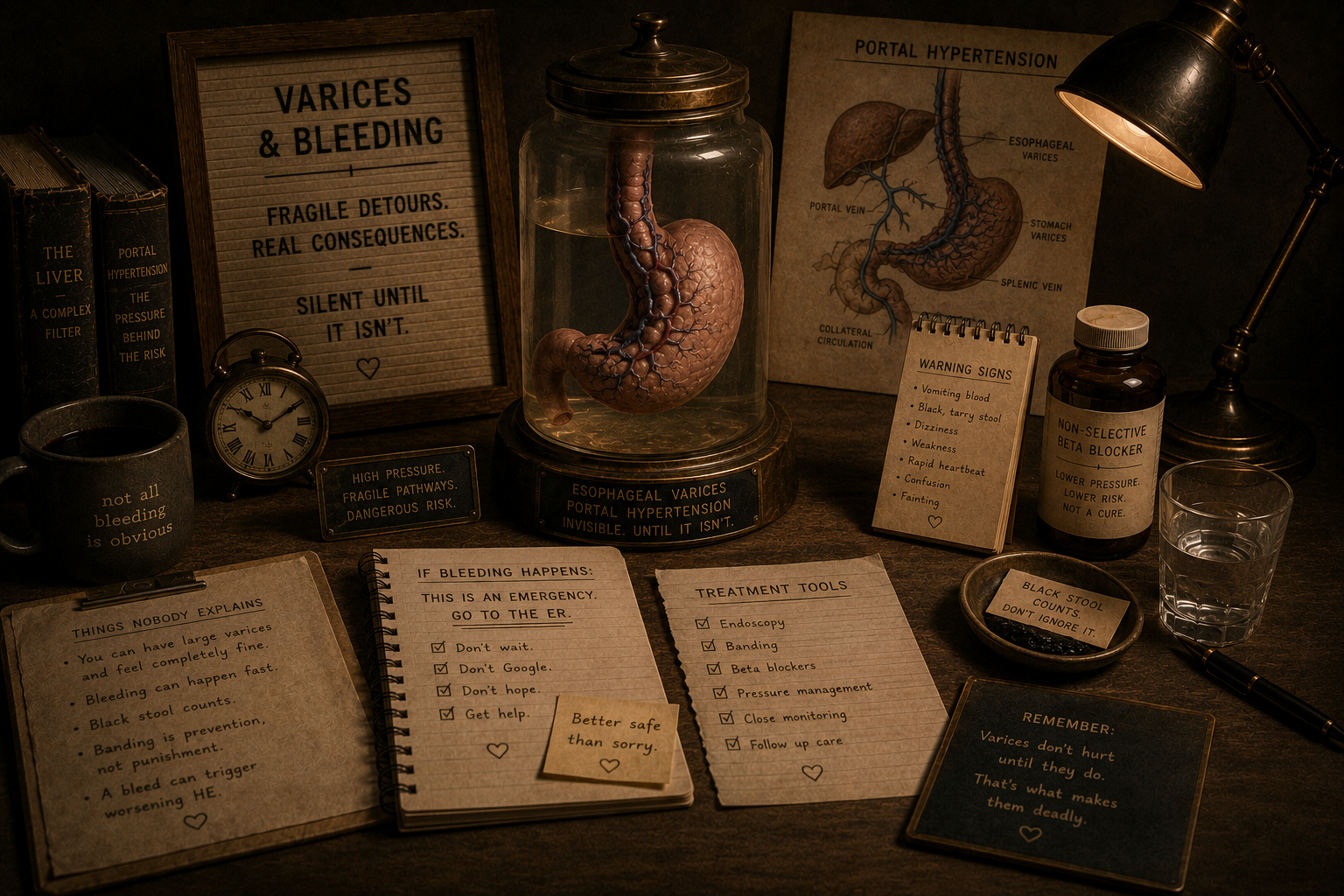
Understanding Esophageal and Gastric Varices: The Critical Bleeding Risk of Advanced Liver Disease
When chronic liver disease transforms a healthy, flexible liver into rigid scar tissue, blood can no longer pass through it easily. Yet, the body must keep blood moving.
Esophageal and Gastric Varices are severely enlarged, thin-walled veins that form in the lining of the esophagus and stomach. They develop as a direct, structural consequence of portal hypertension, which forces blood to seek alternative pathing around the obstructed liver.
The terrifying clinical reality of varices is that they are entirely silent. They cause no physical pain, no structural warning signs, and no obvious everyday symptoms. They swell in the background until the internal pressure stretches them beyond their breaking point, causing them to rupture. A variceal hemorrhage is a catastrophic, life-threatening medical emergency.
What It Is
Varices are pathological distensions of collateral veins within the gastrointestinal tract. Under normal physiological conditions, the veins in the esophagus and stomach carry minimal, low-pressure venous blood.
However, when advanced cirrhosis creates a structural bottleneck, the Hepatic Venous Pressure Gradient (HVPG) rises. Once this gradient crosses the threshold of Clinically Significant Portal Hypertension (\(\geq 10 \text{ mm Hg}\)), the body actively dilates these tiny vessels to create portal-systemic collaterals.
According to the NIH StatPearls Profile on Esophageal Varices, the risk of a spontaneous, explosive rupture spikes dramatically once the pressure gradient reaches or exceeds \(\geq 12 \text{ mm Hg}\).
Vascular specialists categorize varices by their physical size during diagnostic imaging:
Small Varices: Minimally elevated, straight veins that have not yet stretched the lining of the tissue.
Medium/Large Varices: Tortuous, bulging veins that occupy more than one-third of the interior space of the esophagus or stomach, frequently displaying distinct "red wheals" or "cherry-red spots" which signal an imminent risk of rupture.
What It Feels Like
Until a rupture occurs, varices feel like absolutely nothing. You cannot feel them when you swallow, eat, or breathe.
However, if a varix ruptures and begins to bleed, the internal hemorrhage triggers rapid systemic failure. Symptoms present immediately and require instant emergency medical intervention:
Hematemesis: Vomiting large quantities of bright red blood or dark, grainy material that looks exactly like wet coffee grounds.
Melena: Passing jet-black, sticky, tarry stools that carry a distinct, foul odor. This happens because blood from the upper GI tract has been partially digested by stomach acid.
Hematochezia: Passing bright red or maroon blood directly through the rectum, signaling rapid, massive upper GI bleeding.
Hemodynamic Shock: Sudden, severe dizziness, profound physical weakness, cold or clammy skin, a rapid heartbeat (tachycardia), fainting, and complete loss of consciousness.
Why It Happens: Highway Traffic on Backup Roads
The baseline cause of varices is a profound mismatch between vascular volume and vessel wall strength.
Think of the collateral veins in your esophagus and stomach as narrow, fragile side streets. When cirrhosis blocks the main highway (the liver), the body tries to force high-velocity, high-volume highway traffic down these side streets.
Because these vessels lack the thick muscular walls of true arteries, they cannot accommodate high-pressure flow. They stretch, balloon outward, and thin out until their walls are as fragile as wet tissue paper. Any sudden increase in internal pressure—such as severe coughing, vomiting, or straining due to constipation—can cause them to tear open.
Things Nobody Explains
1. You Can Have Dangerous Varices and Feel Completely Healthy
Because varices do not alter your digestion or cause internal pain, you can walk around with large, near-rupture vessels while feeling perfectly fine. This is why regular screening endoscopies are mandatory for anyone diagnosed with advanced liver disease.
2. Black, Tarry Stool Means Internal Bleeding
Many people wait for dramatic vomiting before taking action, ignoring changes in their stool. Black, sticky, tar-like stool means blood is pooling and digesting inside your digestive system. It is a critical warning sign that a varix is actively leaking blood.
3. A Variceal Bleed Directly Triggers Hepatic Encephalopathy
When a varix bleeds, massive amounts of blood enter the stomach and intestines. Your gut bacteria digest this blood as a massive protein meal. As they break down the blood cells, they generate a huge surge of toxic ammonia, which rapidly crosses the blood-brain barrier and triggers an acute, severe episode of Hepatic Encephalopathy (HE).
4. Variceal Banding Is Proactive Structural Prevention
If a doctor finds medium or large varices during a routine screening, they will not wait for them to bleed. They will perform a preventive procedure called Endoscopic Variceal Ligation (EVL), placing tiny rubber bands around the base of the veins to safely cut off their blood flow, causing them to scar over and disappear.
What Helps: Clinical Management
Clinical management focuses entirely on two priorities: aggressively lowering pressure within the portal vein system to prevent a first bleed, and deploying rapid endoscopic interventions if a bleed occurs.
Critical Preventative Interventions
Routine Endoscopic Screening: Undergoing regular upper endoscopies (EGDs) allows your medical team to grade the size of the veins and intervene before a rupture happens.
Strict Avoidance of Straining: Constipation and heavy lifting cause a sudden spike in internal abdominal pressure, which can instantly trigger a varix rupture. Managing daily bowel movements is a structural necessity.
Primary Medical Treatments
Targeted Non-Selective Beta-Blockers (NSBBs): Medications like carvedilol, propranolol, and nadolol are heavily utilized. Unlike standard blood pressure medications, NSBBs are chosen because they deliberately tighten the splanchnic arteries feeding the digestive organs. This reduces the total volume of blood rushing into the portal vein system, lowering the internal pressure inside the varices and slashing the risk of a primary bleed by roughly half.
Emergency Medical Protocols: If a bleed occurs, hospital care requires a highly coordinated, ICU-level emergency response. According to the PMC Variceal Hemorrhage Management Guide, this includes infusing vasoactive drugs (like octreotide) to clamp down internal blood flow, administering proactive antibiotics to prevent systemic infections, and performing emergency endoscopy to band the active bleed. In severe or resistant cases, an emergency TIPS Procedure is performed to create an internal shortcut through the liver, dropping portal pressures immediately.
Sources
NIH StatPearls:Esophageal Varices Profile – Clinical guidelines on the classification, pathophysiology, and management of esophageal collaterals. nih.gov
PubMed Central (PMC) Therapeutics Review:Management of Acute Variceal Bleeding – Comprehensive breakdown of emergency protocols, octreotide dosing, antibiotic prophylaxis, and rescue TIPS indications. nih.gov
PubMed Central (PMC) Consensus Framework:Prevention and Management of Gastroesophageal Varices – Detailed analysis of non-selective beta-blocker (NSBB) mechanisms, carvedilol efficacy, and endoscopic banding intervals. nih.gov
NIH StatPearls:Portal Hypertension Monograph – Technical breakdown of venous pressure thresholds, hepatic gradients, and the development of collateral circulation paths. nih.gov
Medical Disclaimer & General Guidance
The information provided across these resources is for educational and informational purposes only. It is not intended to be a substitute for professional medical advice, diagnosis, or treatment. Advanced liver disease and its associated complications—including hepatic encephalopathy, portal hypertension, ascites, and varices—are complex medical conditions that require precise, individualized clinical management. Always seek the advice of your physician, hepatologist, or other qualified healthcare provider with any questions you may have regarding a medical condition or treatment plan.
For anything of concern, contact your hepatologist and/or dial 911 immediately.
Transient vs. Hepatic Varices: Understanding the Rupture Spectrum in Advanced Liver Disease
One day your digestive tract functions in absolute stability, letting you consume meals without a single thought of internal tissue vulnerability. The next, a sudden, painless eruption of bright red blood fills your mouth, or you experience a rapid dark-staining of your stool, revealing a critical vascular emergency hidden deep inside your gastrointestinal lining. [1]
Abnormal venous swelling in the upper digestive tract exists on a distinct pathophysiological spectrum. Transient (or localized) vascular dilation is a brief, superficial widening of mucosal blood vessels—such as transient esophageal inflammation or a temporary Mallory-Weiss tear from severe vomiting—that resolves cleanly once the primary irritation heals. Hepatic varices are an ingrained, structural vascular crisis where a cirrhotic liver’s absolute mechanical blockage forces systemic blood flow to bypass the organ entirely, swelling fragile veins in the esophagus and stomach into thin-walled, high-pressure networks that are highly vulnerable to catastrophic rupture. [1, 2, 3]
People frequently mistake liver-related internal bleeding for standard stomach ulcers or temporary digestive tears. In reality, transitioning from mild, stable portosystemic compensation to an active variceal hemorrhage marks a critical biological milestone—the official transition from compensated liver disease into decompensated cirrhosis. [1]
What It Is
The body’s digestive plumbing relies on the portal vein to carry more than 1,500 mL of blood per minute from the intestines and spleen directly through the liver for essential filtration. When a patient experiences passing stomach upset or brief inflammation, it triggers minor, transient vascular dilation. [, 2]
However, as chronic liver disease advances into stage F4 cirrhosis, the internal structural architecture of the organ collapses into dense, rigid bands of collagen scar tissue. Comprehensive data demonstrates how this blockage shifts blood flow into dangerous alternative paths: [1, 2]
The Development of Portal Hypertension: Widespread liver scarring acts as a literal concrete block inside the portal venous highway. Because the portal system features no internal valves, this high resistance forces venous pressures to skyrocket from a normal 5 mmHg to severe heights of 15 to 20 mmHg.
Portosystemic Collateral Routing: To prevent your abdominal organs from bursting under this pressure, your vascular network reverses its flow. Blood begins seeking alternative, low-resistance detour paths to return to the heart, forcing its way into tiny, delicate submucosal veins lining the distal esophagus and upper stomach.
Vascular Wall Thinning and Critical Tension: These tiny collateral vessels were structurally designed to carry only minimal, slow blood volume. Under the relentless pounding of high portal pressure, they stretch and swell into tortuous, dilated networks known as esophageal or gastric varices. As the varices grow, Laplace’s Law takes over: the greater the vessel diameter, the thinner and more brittle the vein wall becomes, leaving it teetering on a structural breaking point. [1, 2, 3, 4]
The diagnostic line between quiet, stable varices and an active, high-risk hemorrhage is heavily tracked by clinical teams using specific endoscopic screening indicators: [1]
Low-Risk Varices: Small, thin, straight veins confined to the lower esophagus that demonstrate no surface abnormalities and are managed defensively to prevent progression.
High-Risk Varices: Large, winding blood vessels that protrude heavily into the digestive canal and display "Red Wale Marks" (visible red streaks resembling whip marks), which indicate the vein wall has worn down to paper-thin limits and is preparing to rupture. [1, 2, 3]
What It Feels Like
The physical presence and sensory burden of varices changes entirely as the vessels transition from a quiet structural detour to an active internal rupture. [1]
During the Silent Variceal Phase, you frequently feel:
Absolutely nothing at all. Because varices develop beneath the moist lining of the digestive tract and have no sensory pain fibers, you can carry large, highly pressurized veins for years without experiencing a single physical symptom.
A normal capacity to swallow food and go about your daily routine, completely unaware of the structural tension mounting inside your chest. [1, 2]
When the condition crosses into an Active Variceal Bleed, the physical experience turns into an immediate emergency: [1]
A sudden, warm, and painless rushing sensation in the back of your throat, followed immediately by the projectile vomiting of massive amounts of bright red blood.
A distinct, overwhelming metallic taste filling your mouth, accompanied by an involuntary choking reflex as blood rapidly floods your upper digestive airway.
The presentation of melena—passing loose, sticky bowel movements that look completely black and tarry, and carry a distinct, pungent odor driven by your stomach acids digesting the massive volume of internal blood.
A terrifying, sudden cardiovascular crash where your blood pressure plummets, your skin turns ice-cold and clammy, your heart pounds wildly, and you experience profound dizziness or a complete loss of consciousness from rapid blood loss. [1, 3]
The Crossover Point: Crossing the 12 mmHg Pressure Boundary
The transition from a stable, compensated vein detour to an active variceal hemorrhage represents an absolute structural "crossover point." In the physics of liver disease, this boundary is dictated by a specific metric: the Hepatic Venous Pressure Gradient (HVPG). [1, 2]
To visualize this structural crossover point, think of three concrete examples:
The Overinflated Bicycle Tire: In early stages, pumping air into a tire causes the rubber to expand firmly—the tire handles the increased pressure safely. The variceal crossover point is equivalent to clicking the air pump up to a dangerous, extreme pressure level. The rubber stretches so thin that a tiny thread bare patch forms on the outer tread; the wall can no longer contain the internal force, resulting in a sudden, explosive blowout.
The Overloaded Garden Terrarium: Imagine an enclosed glass greenhouse built with delicate, thin windowpanes. A transient load is a light sprinkle of rain on the roof. The hepatic crossover point is equivalent to a massive mudslide slamming directly into the back wall of the structure. The dense, heavy mud exerts an unmanageable physical weight against the fragile glass frames, causing the windows to shatter inward all at once and instantly flooding the entire room.
The Strained Fire Hydrant System: Think of standard city water lines supplying household kitchen sinks. A normal adjustment is a temporary slow-down during morning use. The hepatic crossover point is equivalent to opening a massive, high-pressure street fire hydrant and routing that raw, high-velocity water volume directly through a tiny, flexible plastic kitchen sink hose. The plastic pipe instantly balloons, stretches to its breaking limit, and rips wide open at its weakest connection joint.
Clinical consensus establishes that once your internal HVPG crosses the critical threshold of 12 mmHg, your body has passed the structural crossover point. At this pressure, the delicate wall of the varix can no longer withstand the mechanical tension, making spontaneous rupture an absolute physical certainty without immediate medical intervention. [, 2]
Things Nobody Explains
1. A Common Cough or Heavy Lifting Can Instantly Trigger the Rupture
Many patients believe varices only burst if their liver health suddenly drops overnight. Nobody explains that when a vein wall is stretched to paper-thin limits, a simple spike in abdominal pressure—such as a heavy coughing fit, straining during a bowel movement, or lifting a heavy suitcase—can provide the exact final mechanical force needed to tear the vein wide open. [1, 2]
2. Your Body's Natural Clotting System is Too Weak to Stop the Bleed
With a standard stomach ulcer or skin cut, your blood's platelets rush to the scene to plug the tear and stop the bleeding. Nobody explains that advanced cirrhosis completely paralyzes this defense. Because the scarred liver can no longer synthesize essential blood-clotting proteins and your spleen actively traps and destroys your remaining platelets, your body lacks the chemical tools required to clot the blood, turning a minor tear into an unmanageable, continuous hemorrhage. [1]
3. Surviving the Bleed is Only the First Step; the Fluid Turns Toxic to Your Brain
When a patient survives an acute variceal bleed, they often think the danger has entirely passed. Nobody explains that a massive pool of blood sitting inside your digestive tract acts as a giant, highly concentrated protein meal for your gut bacteria. As these microbes break down the old blood, they produce explosive amounts of ammonia that rush straight to your brain, frequently plunging patients into a state of severe, emergency mental confusion known as Hepatic Encephalopathy within 48 hours of the bleed.
4. The Risk of a Second Bleed is Highest Right After the First One Stops
This is the ultimate clinical hazard of variceal management: the moment emergency doctors successfully stop your internal bleeding, your risk of a sudden re-bleed peaks at its absolute highest level over the next 6 weeks. Because your cardiovascular system is unstable and your portal pressures remain elevated, those thin vein walls are highly prone to tearing open a second time at the exact same location. [1]
What Helps: Clinical Management
Clinical management shifts away from basic monitoring and focuses on immediate mechanical stabilization and aggressive pressure reduction to protect your structural safety.
Preventing the First Bleed (Primary Prevention)
Non-Selective Beta-Blocker (NSBB) Therapy: Doctors frequently prescribe targeted medications like carvedilol or propranolol. Instead of treating general blood pressure, these specialized drugs work directly on your internal circulation, reducing the volume of blood pumping into the portal vein and lowering your internal HVPG safely below the 12 mmHg danger line.
Prophylactic Endoscopic Band Ligation: If an endoscopy reveals paper-thin, high-risk varices, a gastroenterologist will perform a preventative procedure. Using a specialized camera scope, they place tiny, medical-grade rubber bands directly around the base of the swollen veins, cutting off their blood supply and causing them to safely wither into harmless scar tissue. [1, 2, 3, 4]
Emergency Management of an Active Hemorrhage
Immediate Vasoactive Medication Infusions: The moment an active variceal rupture is suspected, emergency teams start a continuous intravenous infusion of medications like octreotide or terlipressin. This treatment acts as a chemical clamp on the internal arteries of your abdomen, instantly slowing down the rush of blood toward the portal system and dropping the pressure at the site of the leak.
Emergency Endoscopic Banding: Within 12 hours of stabilizing your vitals, a specialist performs an emergency endoscopy to physically stop the bleed. They use a scope to locate the exact point of the rupture and mechanically clamp it shut with a rubber band ligation, sealing the broken vessel.
The Rescue TIPS Procedure Deployment: If a patient's bleeding cannot be stopped by banding or continues to rupture repeatedly, doctors deploy an emergency Transjugular Intrahepatic Portosystemic Shunt (TIPS) within 24 to 72 hours. A radiologist threads a metal stent directly through the neck vein down into the liver, creating an internal bypass route that allows portal blood to effortlessly skirt around the scar tissue, dropping internal pressures instantly and stopping the bleeding at its root source. [1, 2, 3, 4, 5, 6]
References
Mayo Clinic. (2025). Esophageal varices - Symptoms and causes. Mayo Clinic Disease Registry.
MyHealth Alberta / Kaiser Permanente. (2025). Cirrhosis Complications: Variceal Bleeding. Kaiser Permanente Health Encyclopedia.
UpToDate. (2026). Patient education: Esophageal varices (Beyond the Basics). UpToDate Portal.
Marot, A., & Deltenre, P. (2022). Management of varices and variceal hemorrhage in liver cirrhosis. Journal of Clinical Medicine, 11(4), 9218432. PMCID: PMC9218432.
UCSF Department of Surgery. (2025). End-stage Liver Disease (ESLD): Portal Hypertension and Esophageal Varices. UCSF Patient Care Guide.
StatPearls Bookshelf. (2026). Esophageal Varices Pathophysiology, Rupture Prognosis, and Complications.National Library of Medicine (NCBI).
Baveno VII Faculty. (2022). Baveno VII – Renewing consensus in portal hypertension. Journal of Hepatology, 77(4), 11090185. PMCID: PMC11090185.
Triantos, C., & Kalafateli, M. (2017). Variceal bleeding in cirrhotic patients: Baveno consensus implementation. World Journal of Hepatology, 9(14), 5554384. PMCID: PMC5554384.
Medical Disclaimer & General Guidance
The information provided across these resources is for educational and informational purposes only. It is not intended to be a substitute for professional medical advice, diagnosis, or treatment. Active variceal hemorrhages, severe portal hypertension, and decompensated liver conditions are life-threatening, volatile medical emergencies that require immediate activation of local emergency services (911) and specialized critical care. Always seek the direct advice of your hepatologist or gastroenterologist regarding your specific endoscopy screening schedules, beta-blocker adjustments, or complications management. [1, 2]
