
Accidentally Inciting Ascites
Important Medical Disclaimer: I am Angie, a cirrhosis patient sharing my personal lifestyle, nutrition, and mindset journey. I am a data aggregator and community builder, not a licensed medical professional, doctor, or dietitian. Content on diagnosiscirrhosis.com is based solely on my personal experience living with advanced liver disease and is intended for informational and educational purposes only. It does not constitute medical advice or a substitute for professional medical care. Always follow the recommendations of your own healthcare team and consult your physician before changing your diet, medication, or lifestyle routine.
@diagnosis_cirrhosis 💧🌊 How much ascites is “a lot”? 👀 Honestly? Even a few liters can feel absolutely miserable. Ascites is fluid buildup inside the abdomen caused by advanced liver disease, cirrhosis, portal hypertension, low albumin, sodium retention, and fluid imbalance ⚠️ And one of the hardest parts is how FAST it can happen. Some people retain: 💧 1–2 liters = bloating, pressure, tighter clothes, discomfort 💧💧 3–5 liters = visible swelling, appetite changes, breathing discomfort 🌊 5+ liters = major abdominal pressure, rapid weight gain, mobility changes 😳 10+ liters = severe distention, shortness of breath, difficulty functioning normally And yes — fluid can build shockingly quickly. One of the strangest parts for me personally was trying to visually understand what these numbers even meant. I actually used a STRING to track what 4 liters looked like around my abdomen after paracentesis because my brain could not conceptualize it otherwise. And something important: do not be surprised if doctors do NOT remove every possible ounce of fluid during a paracentesis 👀 Sometimes they intentionally remove less than expected because: 🩺 blood pressure matters 🩺 kidney function matters 🩺 albumin shifts matter 🩺 overall stability matters So if you are swollen and hear “4 liters removed” and think: THAT was only 4 liters?!?! you are not alone 😳 Also — weigh yourself. Seriously. Measurements help, mirrors help, photos help, but fluid can move FAST and your brain acclimates to gradual swelling more than you realize. Daily weights can sometimes reveal what your eyes are still emotionally negotiating with. If you are searching in a panic for answers: 🔎 how much ascites is a lot 🔎 what does ascites mean 🔎 is ascites dangerous 🔎 can ascites go away on its own 🔎 why can’t I pee out ascites 🔎 how long does ascites last 🔎 will ascites come back after paracentesis 🔎 does ascites leak 🔎 can ascites fluid leak from skin 🔎 why is my stomach suddenly huge 🔎 why do I look pregnant with cirrhosis 🔎 why am I gaining weight overnight 🔎 can ascites make it hard to breathe 🔎 why are my legs swelling too 🔎 why does my stomach feel tight or hard 🔎 does ascites mean liver failure 🔎 what stage of cirrhosis causes ascites 🔎 can ascites happen suddenly 🔎 why am I swollen everywhere 🔎 ascites and edema together 🔎 low albumin swelling 🔎 portal hypertension fluid buildup Ascites is NOT: ❌ “just bloating” ❌ ordinary weight gain ❌ simply drinking too much water Ascites can affect: 😮💨 breathing 🚶 walking 🍽️ appetite 🛌 sleep ⚖️ weight 🦵 edema / leg swelling 💥 abdominal pressure ⚡ energy levels 🧍 posture 🩳 clothing fit 🫁 stamina and mobility And one of the cruelest parts? A lot of people do not realize how sick they are at first because the swelling can happen gradually… until one day it suddenly doesn’t feel gradual anymore. Always call your doctor urgently for: 🚨 fever 🚨 severe abdominal pain 🚨 confusion 🚨 trouble breathing 🚨 vomiting blood 🚨 black stool 🚨 reduced urination 🚨 leaking fluid 🚨 sudden worsening swelling because ascites can become dangerous quickly and may be associated with complications like spontaneous bacterial peritonitis (SBP), kidney dysfunction, worsening portal hypertension, or advanced liver failure 🩺💚 #symptoms #sideeffects #liverhealth #fattyliver #patient ♬ Funky Frog Parade - Lil New Prophet
Cirrhosis and Your Liver can Cause Severe Fluid Retention?
My Story of Swapping High Hydration (+ Beef Stroganoff!) before Checking My Abdomen. By Angie from @diagnosis_cirrhosis on TikTok
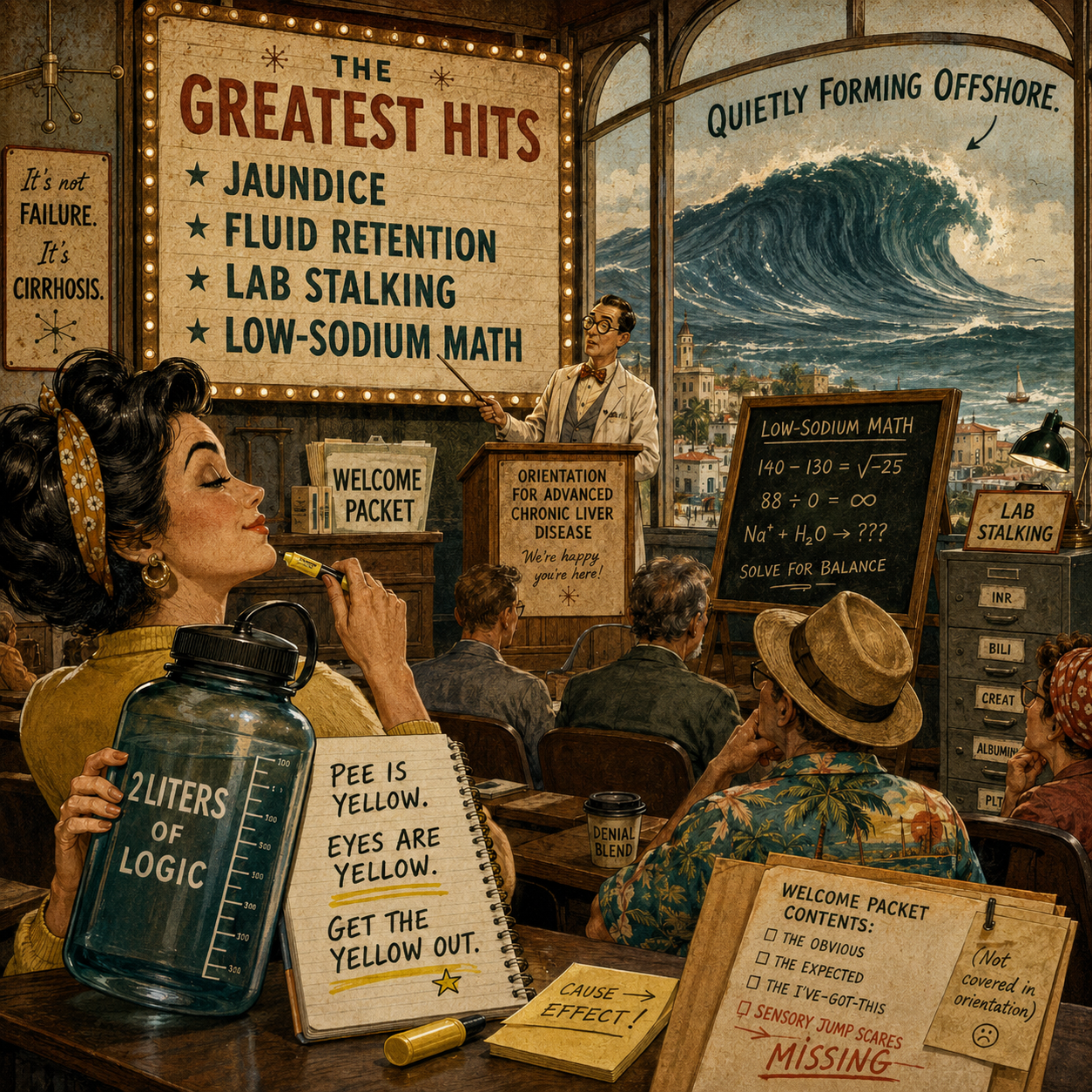
When you get diagnosed with advanced chronic liver disease, you brace for the greatest hits.
Jaundice.
Fluid retention.
Lab stalking.
The endless low-sodium math problem no one asked to be assigned.
What nobody puts in the welcome packet are the sensory jump scares. The weird little body plot twists that make you stop mid-sentence and think: wait… is my liver doing this too?
When I got sick, I turned yellow.
That made sense to me.
My liver was damaged. Bilirubin was elevated. Case closed. There was logic there. Cause and effect. My body had essentially highlighted the problem in neon Sharpie across my skin and the whites of my eyes.
Easy enough.
Fix liver.
Fix yellow.
What I did not understand was the tsunami of pressure, fluid, and swelling quietly forming offshore while I was busy obsessing over the jaundice.
The Hyper Hydration Trap
And maybe part of why I missed it is because I have always been aggressively hydrated. I mean that sincerely.
I had a Nalgene bottle on the playground before reusable emotional-support water bottles became a personality trait. We are talking old-school hydration commitment. Water bottles have been my accessory of choice long before lip glosses, compact mirrors, or checking my braces after lunch in middle school bathrooms.
So when I got sick and the internet said:
drink water
I thought:
Perfect. Finally. A health recommendation I have been accidentally training for my entire life.
For once, I was ahead of the curve. So far ahead of the curve I was basically tap dancing on the equator.
And when your body turns yellow, drinking more water feels intuitively correct. Pee is yellow. Jaundice is yellow. Somewhere in my severely underqualified understanding of human physiology, I apparently concluded:
get the yellow out.
Unassuming Tsunami
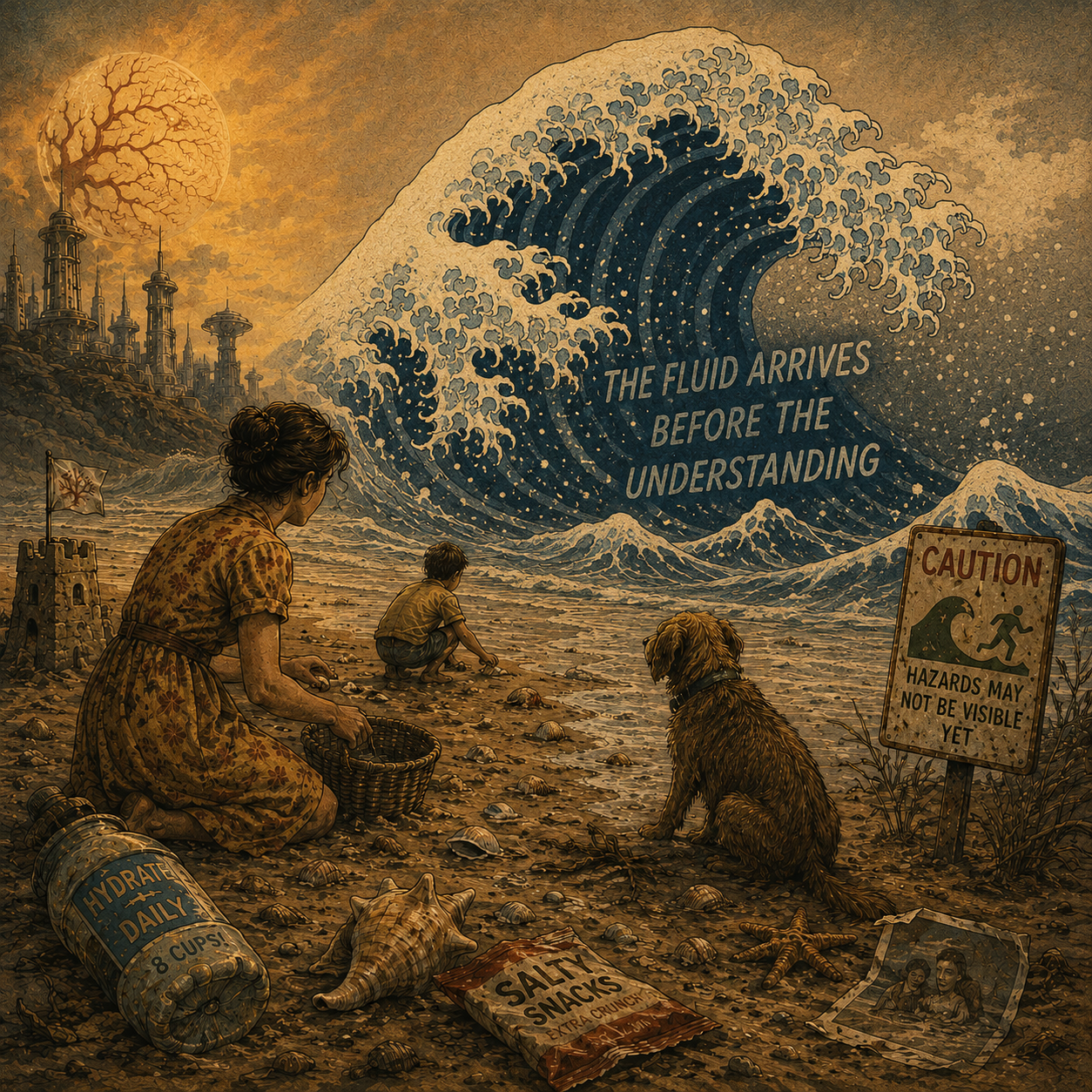
Unfortunately, what I did not appreciate at the time was that ascites was waiting for me like a tidal wave gathering force just beyond visibility.
Or honestly, more like I pictured the Great Wave of Kanagawa where a family is standing calmly on the beach collecting seashells while, impossibly far in the distance, the ocean has already started pulling away from shore.
The danger has technically already begun. Just nobody understands it yet.
Victorian Orphan & The Gas Station Survival Kit
At that point, my appetite was gone, my body was deteriorating rapidly, my husband was out of town, and my mom was helping take care of me while we all collectively tried to understand what was happening in real time.
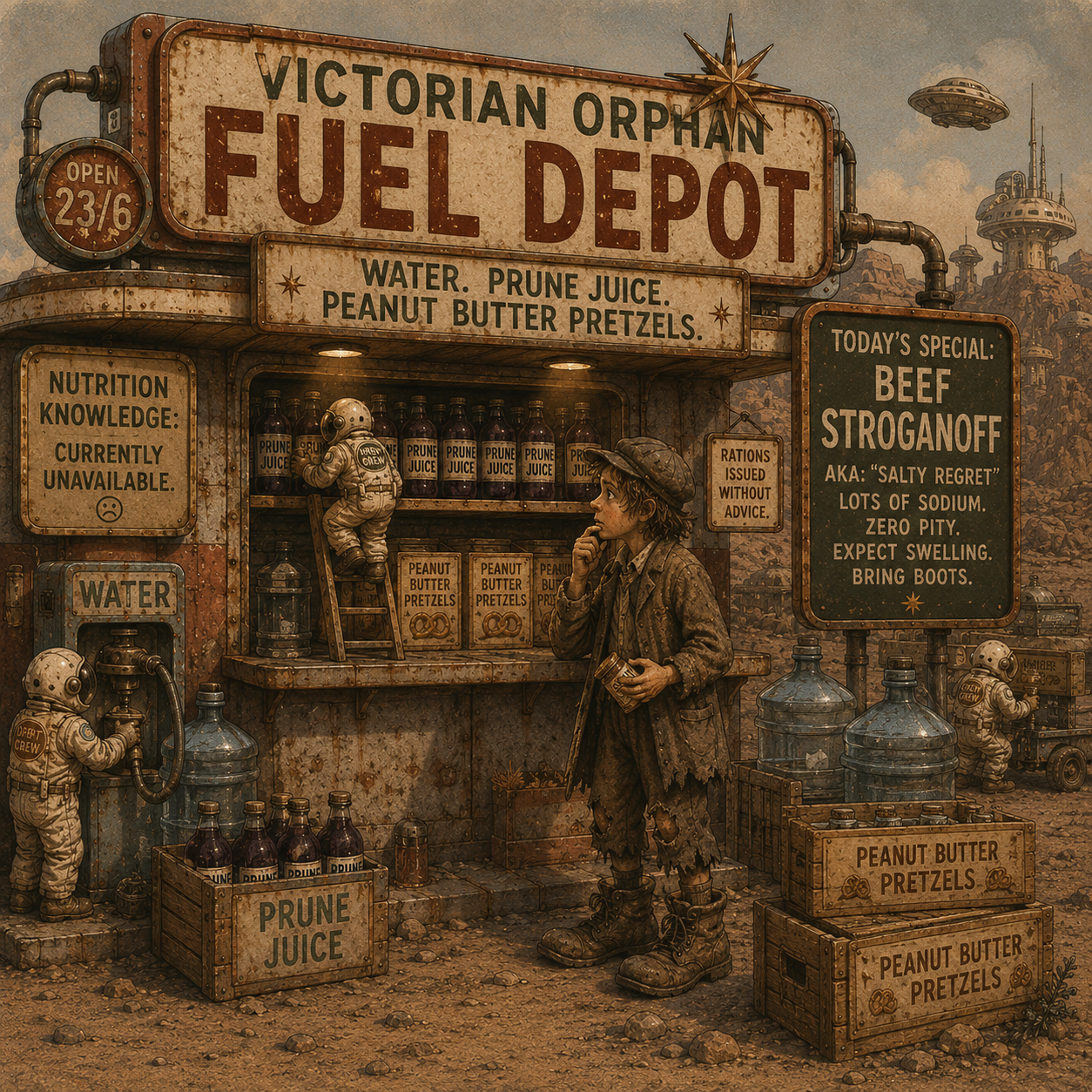
And in the complete absence of meaningful cirrhosis nutrition knowledge, I essentially survived on:
water
prune juice
peanut butter pretzels
Which, in hindsight, is less “healing protocol” and more “gas station survival kit assembled by a Victorian orphan.”
The amount of sodium I was probably consuming is genuinely horrifying to think about now.
Especially because sodium had not yet revealed itself to me as the looming supervillain of cirrhosis. It was still standing quietly in the cinematic fog somewhere far off in the distance, waiting for its dramatic entrance like a Marvel villain with an unnecessarily expensive soundtrack.
And then one night, in one of the more offensively ironic decisions of my liver failure career, I requested beef stroganoff.
Now listen.
If you have cirrhosis, I know you just physically recoiled reading that sentence.
I can practically hear the collective sympathetic sodium retention occurring through the screen.
But at the time? Who doesn’t love beef stroganoff?
Aquarium Anyone?
Little did I know I was essentially constructing an internal aquarium one salty meal at a time while proudly hitting my hydration goals like an overachieving office intern trying to impress upper management.
And when the fluid came, it came fast.
Not metaphorically fast.
Violently fast.
That tsunami I mentioned earlier finally hit shore.
And suddenly my body was flooding.
But the strange part is I still did not fully recognize what was happening because I had always carried weight primarily in my midsection anyway. I was not tiny at that point in my life. So when my abdomen started expanding, my first instinct was not:
medical emergency.
It was:
well this seems personally rude.
And the absolute last thing I was interested in doing while yellow, exhausted, swollen, and barely functioning was stepping onto a scale to quantify the situation further.
Why would I voluntarily log additional emotional damages in gross tonnage?
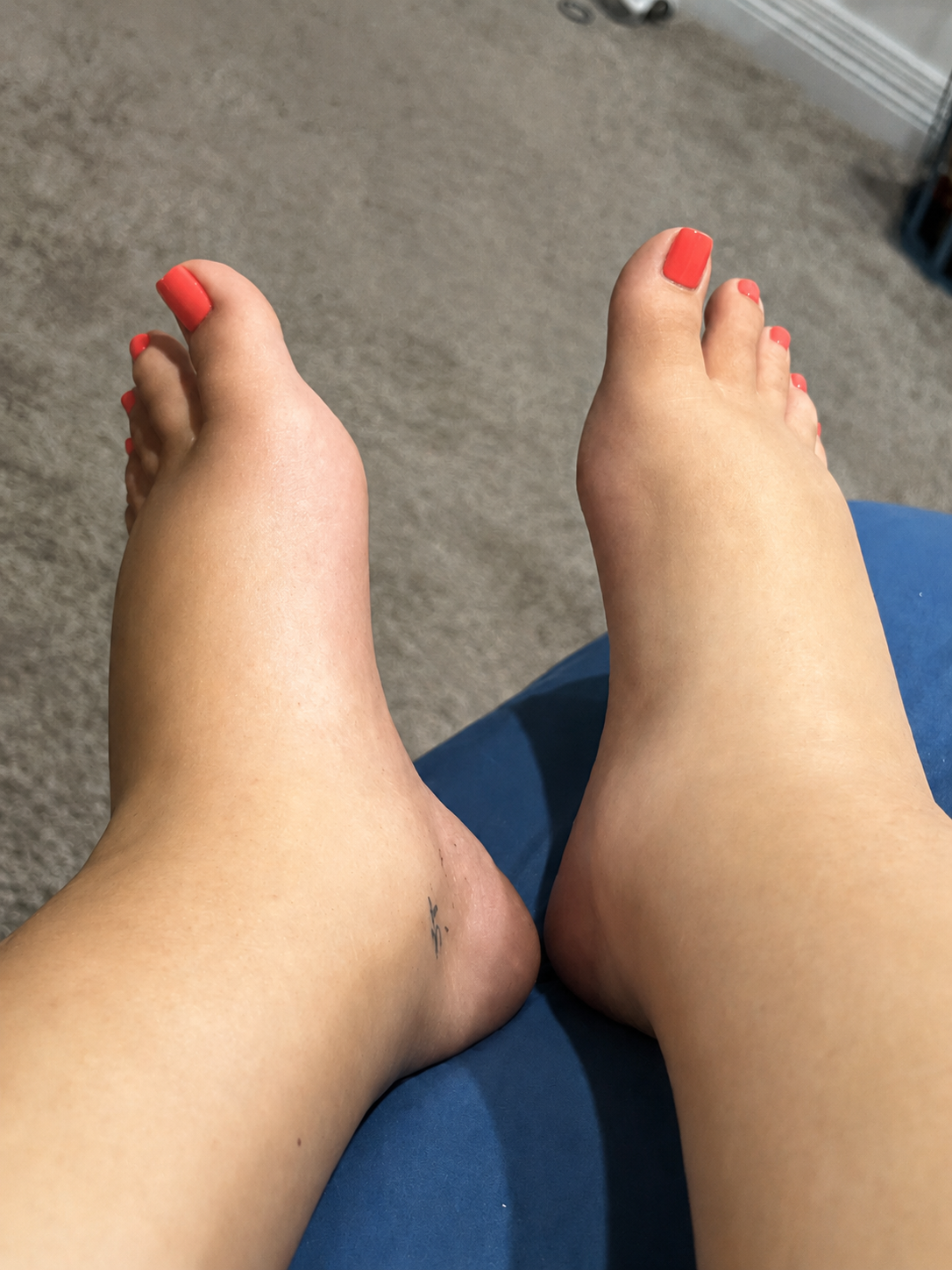
I noticed my feet swelling.
My legs swelling.
But people’s feet swell.
Airplanes exist.
Summer exists.
Bodies are weird.
So in my head, I assumed maybe this was some kind of pressure-related issue. Maybe inflammation. Maybe weight fluctuation. Maybe my body was just generally freelancing at this point.
What I could not understand yet was that fluid was actively searching for space inside me.
Every nook.
Every cranny.
Every available cavity.
My body had become oversaturated terrain.
And then my husband came home. He looked at me and immediately said:
“Oh my God.”
Cue the Parentheses
Which is generally not the phrase you want from somebody who has spent the previous several weeks becoming the unofficial John Stamos of cirrhosis education in your household.
And I remember saying:
What? I don’t get it.”
And he looked horrified.
“You need a paracentesis.”
Except here is the thing:
I did not call it a paracentesis.
I called it a parentheses.
Which, honestly, feels accidentally poetic now.
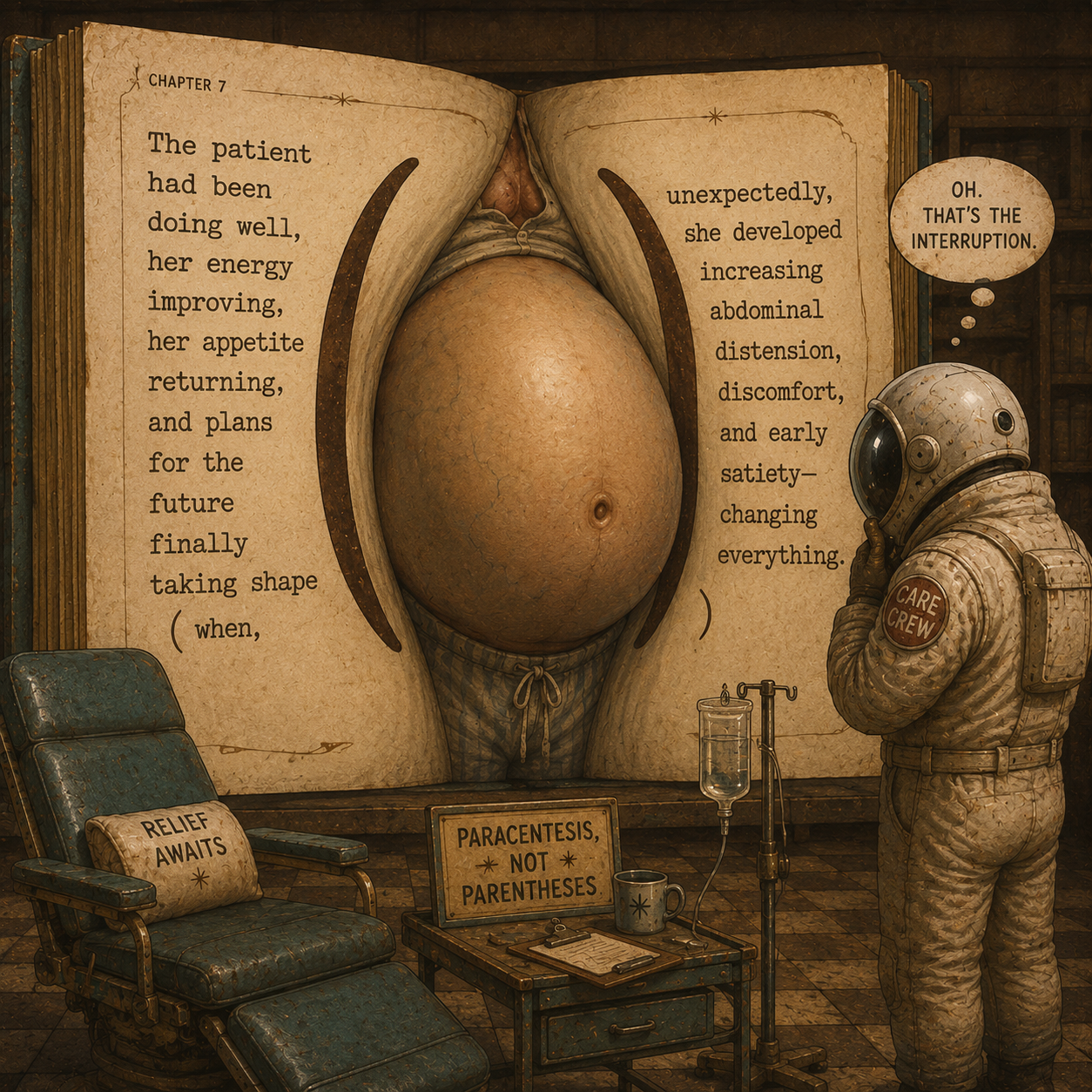
Because when I think of parentheses, I think of something bulging outward from the middle of a sentence. An abrupt side expansion interrupting the normal flow of thought.
Which is pretty much exactly what my abdomen had done.
And apparently, while I was busy trying to hydrate the jaundice away and survive on prune juice and peanut butter pretzels, my body had quietly started filling itself like a water balloon nobody remembered to stop inflating.
The Data Breakdown: How Hepatic Stress Alters Fluid Dynamics
To understand why advanced liver disease impacts your fluid balance, we have to look past the abdomen and dive straight into the metabolic, chemical, and vascular pathways. As I aggregated the peer-reviewed medical literature, I found three primary systemic mechanisms that link hepatic function to ascites and systemic swelling, all of which mapped directly to what I was feeling:
1. Portal Hypertension (Vascular Resistance)
The liver acts as the main filtration highway for blood returning from your digestive organs. When hepatic tissue undergoes advanced structural remodeling and scarring (fibrosis), it acts like a literal brick wall. The portal vein system encounters massive resistance, and blood pressure spikes drastically.
My Experience: This backpressure is what caused the "tsunami" to hit shore so violently. Because the blood highway was completely blocked, plasma fluid was physically forced to leak through the walls of the blood vessels, seeking out every open cavity and nook inside my abdomen. It felt like an overnight expansion because the plumbing pressure had quietly maximized while I was entirely focused on the yellow in my skin.
Source Citation: The physiological consensus proving that liver cleanses have absolutely no clinical basis for reversing structural organ damage is documented under the The Pathophysiology of Ascites and Splanchnic Hemodynamics on PubMed.
2. Severe Albumin Deficits (Oncotic Pressure Drop)
The liver is the sole factory responsible for synthesizing albumin, a crucial plasma protein that acts like a sponge to hold water inside your bloodstream. When liver synthesis drops to critical levels, the lack of serum albumin destroys the blood's osmotic pressure balance.
My Experience: My deterioration and exhaustion were deeply tied to this systemic chemical failure. Without enough albumin "sponges" in my blood vessels, my body lost its ability to retain fluid where it belonged. The water I was so aggressively drinking wasn't hydrating my cells; it was slipping out of circulation entirely, turning my midsection, legs, and feet into oversaturated terrain because the chemical architecture keeping fluid contained had collapsed.
Source Citation: The physiological consensus proving that liver cleanses have absolutely no clinical basis for reversing structural organ damage is documented under the The Physiology of Serum Albumin Synthesis and Intravascular Volume Regulation on PubMed.
3. The Kidney Renin-Angiotensin Activation (The Sodium Trap)
When portal hypertension builds and fluid leaks out of blood vessels, the kidneys sense a drop in overall blood volume. They mistake this internal leak for severe dehydration or blood loss and go into an emergency panic protocol, releasing hormones that command the body to hold onto every single grain of salt and molecule of water.
My Experience: This is exactly why my Victorian orphan "gas station survival kit" of peanut butter pretzels and my fateful plate of beef stroganoff were so devastating. I was proudly drinking water to "get the yellow out," completely unaware that my panicked kidneys had locked into a severe sodium trap. Every milligram of sodium I consumed acted like an absolute magnet, holding onto the fluid and inflating my abdomen like a water balloon that wouldn't stop filling.
Source Citation: The clinical parameters and toxic thresholds of popular wellness extracts are meticulously cataloged in the AASLD Practice Guidance on the Management of Ascites and Hepatorenal Syndrome on AASLD.

Summary: The Internal Aquarium and the Parentheses Break
Navigating the hidden fallout of advanced fluid retention is the ultimate exercise in physical vulnerability. It strips away your structural comfort, hijacks your body's plumbing baseline, and forces you to play a high-stakes guessing game against an internal landscape that is actively expanding behind your back.
But finding your footing inside this bloated, terrifying tsunami means realizing that your boundaries are still yours to build. You are not a broken machine, a water balloon, or a collection of gross tonnage metrics; you are a human being fighting a calculated, metabolic heavyweight battle against a silent structural bottleneck every single second.
When the fluid hits violently fast and your body failure forces a dramatic architectural pause, show yourself the grace you deserve. Trust the safety parameters of your medical portfolio—your exact diuretic timing, your strict low-sodium regimens, and your coordinated paracentesis procedures—to act as the anchor keeping you tethered to reality.
You don’t have to outwit the fluid dynamics alone, and you don’t have to run the pipeline by yourself. You are managing the metrics, protecting your data baseline, and surviving the storm with absolute strength.
What to Ask Your Healthcare Team: Specialist Questions
Managing the sudden swelling and fluctuating sodium sensitivities of advanced ascites requires radical coordination with your care network. Bring this exact question checklist to your next appointments:
Questions for Your Hepatologist or Gastroenterologist
"How do my current abdominal fluid measurements or sudden weight jumps correlate with my underlying portal hypertension and baseline protein production?"
"Are there specific adjustments we can make to my current spironolactone or furosemide schedule if my fluid accumulation begins outrunning my daily dose?"
"What specific physical red flags—such as a fever, acute stomach pain, or breathing changes—should tell my care partner to completely bypass the clinic and head to the emergency room for an urgent paracentesis?"
Questions for a Mental Health Professional or Care Partner
"How can we structure our daily check-ins so that tracking my physical changes and dry weight variables feels like a safe, collaborative data review rather than an isolating examination?"
"What coping strategies can I use to process the intense grief, bodily dysmorphia, and loss of physical control that arrives when my body's internal plumbing compromises my external appearance?"
Questions for Your Registered Dietitian or Nutritionist
"Since I accidentally triggered a severe fluid backup with sodium, how can we safely map out a strict, low-sodium grocery framework that doesn't rely on generic processed alternatives?"
"What are the safest whole-food sources of protein and caloric intake that I can easily prepare to fight muscle wasting without increasing my fluid volume?"
Peer-Reviewed Sources and References
National Institutes of Health (NIH): Read the pathological data on portal pressure overrides and fluid accumulation mechanics via The Pathophysiology of Ascites and Splanchnic Hemodynamics on PubMed.
Exposes how advanced tissue remodeling and structural scarring create a high-pressure block in the main portal vein highway.
Explains how hydrostatic pressure forces plasma fluid to actively leak into and flood the peritoneal cavity.
American Journal of Gastroenterology: Review the clinical consensus parameters for fluid reduction and diuretic tracking under the AASLD Practice Guidance on the Management of Ascites and Hepatorenal Syndrome on AASLD.
Provides the concrete medical consensus for safely titrating standard loops of diuretics and potassium-sparing diuretics.
Establishes the precise safety thresholds, surveillance intervals, and criteria for performing a large-volume therapeutic paracentesis.
World Journal of Gastroenterology: Explore how advanced circulatory strain and recurrent fluid drainage impact daily patient metrics in Clinical Burden, Sodium Retention, and Quality of Life Outcomes in Cirrhosis on the World Journal of Gastroenterology.
Isolates the cellular signaling pathways that increase endothelial microvascular permeability during advanced inflammation.
Analyzes the osmotic tipping points where fluid shifts from the blood system into empty tissue space.
