
INR - International Normalized Ratio
Top 4 Need to Knows
Important Medical Disclaimer: I am Angie, a cirrhosis patient sharing my personal lifestyle, nutrition, and mindset journey. I am a data aggregator and community builder, not a licensed medical professional, doctor, or dietitian. Content on diagnosiscirrhosis.com is based solely on my personal experience living with advanced liver disease and is intended for informational and educational purposes only. It does not constitute medical advice or a substitute for professional medical care. Always follow the recommendations of your own healthcare team and consult your hepatologist or physician before changing your diet, medication, or lifestyle routine.
My Experience with It
By Angie from @Diagnosis_Cirrhosis on TikTok
The tricky part is that INR feels like it should be a simple bleeding-risk score.
High INR: danger. Lower INR: confetti.
But no. Obviously not.
Because cirrhosis looked at “blood stays inside body” and decided even that needed a multi-department approval process.
The way I think about it now is that bleeding control has different jobs.
Platelets are the first little emergency crew. They rush to the scene and try to form the initial plug. They are the tiny construction workers throwing themselves at the hole like:
Absolutely not. We are not leaking today.
That platelet plug matters.
But it is only the first part of the job.
After that, the body has to reinforce the plug with clotting factors — the proteins that help stabilize the clot so it is not just a sad little temporary patch flapping in the biological wind.
INR vs. Platelets
That is where INR enters the chat. INR is not counting platelets.
INR is more about timing. It gives doctors a sense of how long it takes your blood to clot through a pathway that depends on several clotting factors, many of which are made by the liver.
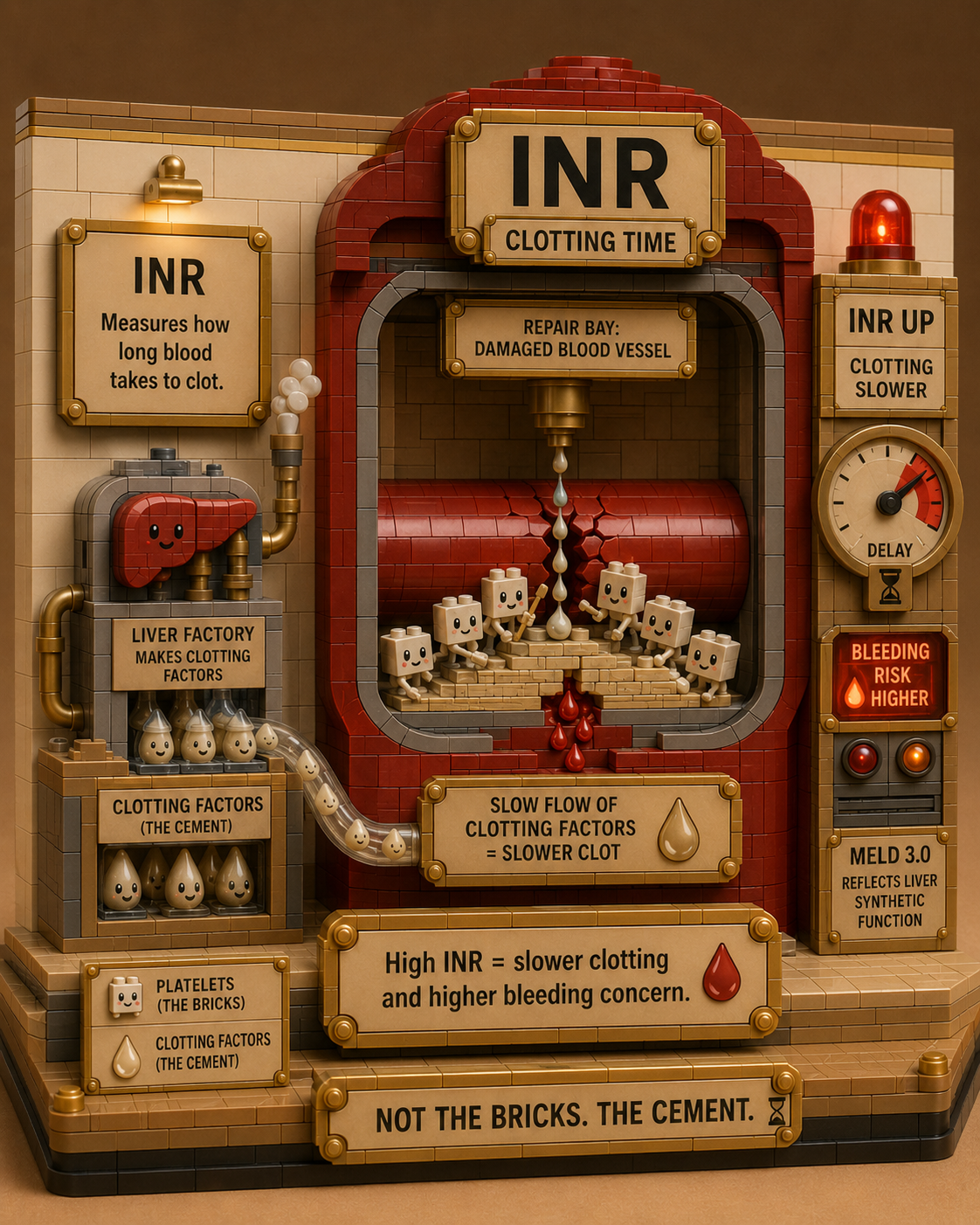
So when the liver is struggling, INR can rise because the clotting-factor assembly line is not exactly operating at peak factory efficiency.
The workers may be there. The hole may be identified.
But the cement truck is late, the clipboard is missing, and someone named Factor VII has apparently called out sick.
That is why INR and platelets are connected but not interchangeable.
Platelets are about the plug. INR is about whether the clotting process behind the plug is moving with the right speed and materials.
Different jobs. Same bleeding-risk neighborhood.
And with cirrhosis, you really do need both conversations.
Do we have enough platelet workers to start the plug?
Is the clotting cement actually setting?
Are there varices involved?
Is there a procedure coming?
Are medications changing the risk?
Is this just a lab number, or is my body actively trying to turn flossing into a deleted scene from Saw?
That is why INR can be misleading. Because you want it to be simple.
High INR means bleeding. Lower INR means release the butterflies.
For me, INR became memorable because it made liver disease feel less abstract.
This was not just enzymes doing interpretive dance in my portal
This was my body negotiating one of its oldest maintenance agreements:
Keep the blood moving. Keep the blood useful.
And when necessary, keep the blood inside the original packaging.
Why Is It in the MELD ?
@diagnosis_cirrhosis 🚨📊 MELD update… and yes, my liver brought the panel 😅🎭 We ran the numbers and landed at a MELD 15 📈 For anyone wondering what a MELD score is, it’s the number doctors use to estimate mortality risk and help determine liver transplant priority 🏥⏳ It’s calculated from blood work and labs like: 👉 Bilirubin 🟡 👉 INR 🩸 👉 Creatinine ⚙️ 👉 Sodium 💧 👉 Albumin 🧱 So no… not random and definitely not vibes 😅 just math 🧠📊 Higher MELD = higher urgency 🚨⬆️ But here’s the part people don’t always realize 👇 👉 it reflects risk of mortality, not always how you feel day to day 😵💫 And liver disease can come from a LOT of places… autoimmune hepatitis 🛡️🔥, MASLD / NAFLD (fatty liver) 🍩, MASH / NASH 🧪, alcohol-related liver disease 🚫🍷, hepatitis B 🦠, hepatitis C 🦠, PBC 🧬, PSC 🧬, hemochromatosis ⚙️, Wilson’s disease 🪙, alpha-1 antitrypsin deficiency 🧩, drug-induced liver injury 💊, cryptogenic cirrhosis ❓… or any other cause 👉 Fatty liver and fibrosis can progress to cirrhosis… but they don’t always — they can be reversible if caught early 💡✨ So for now… we’re at 15 and we keep going 💪💚 Always talk to your doctor or hepatologist about your labs and what they mean for YOU 👩⚕️🩺 #livertransplant #liverhealth #medicaltiktok #nursingschool #chronicillnessawareness ♬ original sound - diagnosis cirrhosis
INR does not just take a high-priority slot on a liver function panel; it is a founding, heavily weighted cornerstone of the Model for End-Stage Liver Disease (MELD) score calculation. While liver enzymes track temporary cell irritation, your INR is a direct, un-fakable signature of your liver's remaining acute synthetic and manufacturing capacity.
The Fastest Lens of Organ Collapse
The primary reason INR is cemented into the MELD formula is its unparalleled speed and precision in tracking real-time liver failure.
The Short-Lived Proteins: The blood-clotting proteins manufactured by the liver have exceptionally short lifecycles—some degrade in a matter of hours. If your liver suddenly faces an acute crisis or begins to shut down, it stops making these proteins immediately, causing your PT and INR to spike on paper long before your bilirubin or kidney markers even begin to budge.
An Un-Fakable Survival Indicator: Because international clinical data proves that a patient's short-term survival window drops drastically the moment their blood loses its clotting power, your exact INR number is a primary driver that dictates your ranking position on the national transplant waitlist.
What If INR Were Excluded?
If INR were removed from the MELD score, the entire national organ allocation system would become dangerously blind to a patient's immediate risk of mortality.
The Illusion of Stability: A patient with advanced, decompensated cirrhosis could show normal or baseline numbers on other tests while their liver's protein factory is completely failing behind the scenes. Without the INR to sound the alarm on this manufacturing collapse, the allocation computer would falsely assume the patient was stable, robbing critically ill individuals of the priority transplant points they need to receive a life-saving donor organ in time.
Read more about what else is included in the MELD 3.0:
Key Takeaways:
Find Out More
What the Procedure Is
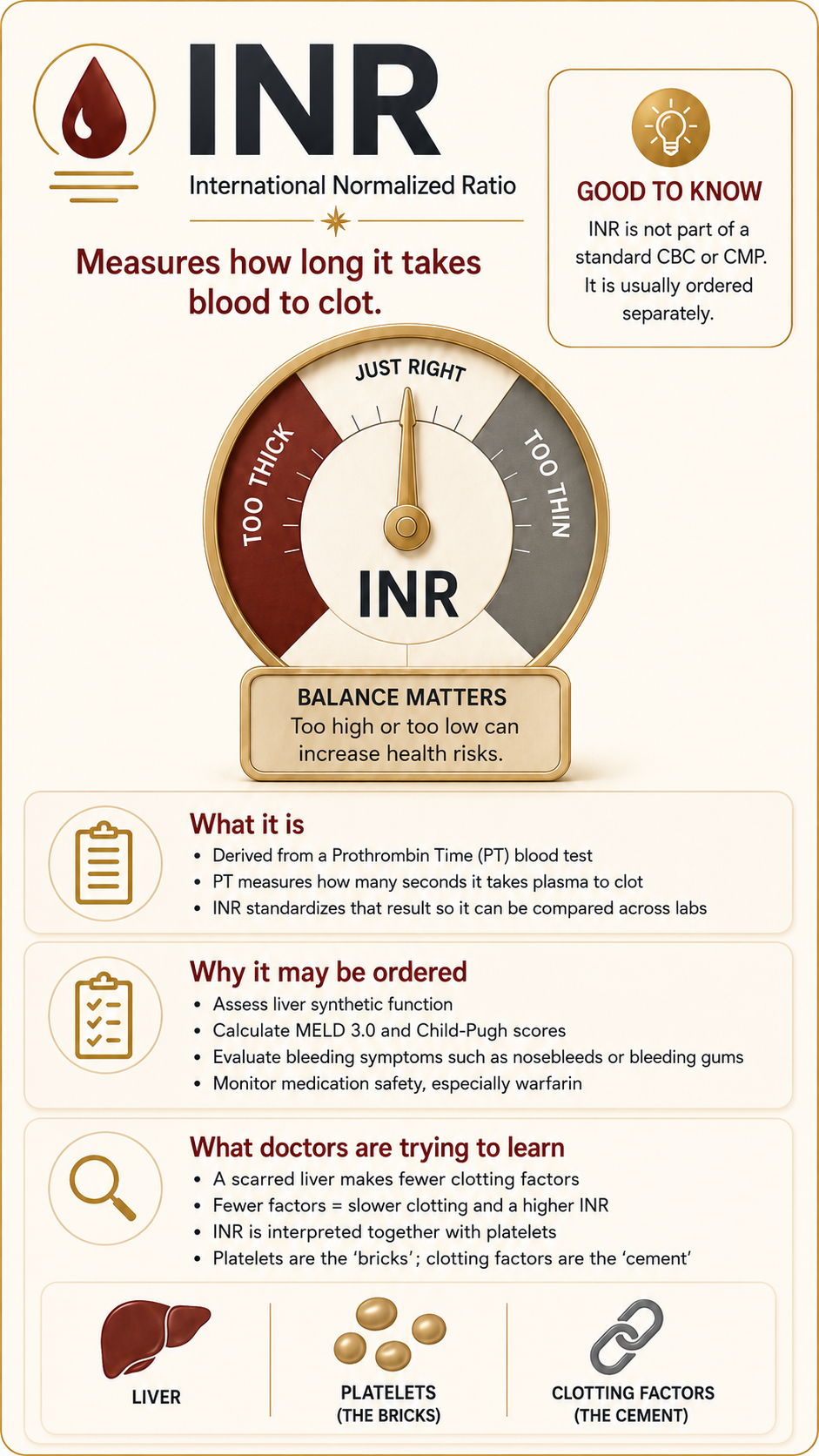
The INR test is a standardized laboratory calculation derived from a Prothrombin Time (PT) blood test [5]. Prothrombin time measures exactly how many seconds it takes for the liquid portion of your blood, or plasma, to form a solid clot [1]. Because different laboratories use varying testing chemical reagents, the raw seconds are converted mathematically into a universal ratio—the INR—allowing healthcare providers anywhere in the world to interpret the results identically [2].
Why This Procedure May Be Recommended
Because the vast majority of vital proteins required to clot blood are manufactured exclusively by the liver, an INR test is a crucial diagnostic tool [3]. In advanced liver care, a doctor will specifically order this test to:
Assess synthetic function: Checking whether the organ still has enough healthy cells to manufacture essential blood-clotting proteins called coagulation factors [4].
Calculate staging scores: Serving as a mandatory variable required to compute both the MELD 3.0 score and the Child-Pugh classification system [3].
Evaluate bleeding symptoms: Tracking spontaneous issues including frequent epistaxis, nosebleeds, hemorrhage, or bleeding gums [5].
Monitor medication safety: Ensuring safety protocols if a patient is taking prescription blood thinners like warfarin [1].
@diagnosis_cirrhosis 🧪🩸 First bloodwork trip since becoming immunocompromised 😷🧬 Today was my first trip to the lab since starting medications that make me immunocompromised. That word gets used a lot, but what it actually means is pretty simple: My immune system — the thing that normally fights off viruses, bacteria, and infections — is intentionally suppressed. 🛡️⬇️ Why would doctors do that? Because in autoimmune hepatitis, the immune system mistakenly attacks the liver itself. 🔥🫀 So medications like immunosuppressants are used to slow that attack and protect the liver from further damage. 💊🧬 The trade-off is that when your immune system is dialed down, it can’t fight infections as easily. That’s why precautions matter more now: 😷 wearing a mask in medical settings 🧼 frequent hand washing 🚶♀️ avoiding unnecessary exposure to illness 🏥 being cautious in crowded healthcare spaces like labs and waiting rooms It might look like overkill to some people, but when your immune defenses are lowered, a routine infection can become much more serious. One thing many people don’t realize is that some liver diseases require immunosuppressive treatment long before transplant is ever part of the conversation. Autoimmune hepatitis is one of them. 🛡️🔥 The treatment itself requires calming the immune system, which means patients may already be immunocompromised years before transplant is even considered. Many other causes of cirrhosis — like MASLD/NAFLD 🍩, alcohol-related liver disease 🚫🍷, hepatitis B or C 🦠, or genetic conditions 🧬 — don’t require immune suppression as part of treatment. Different diseases. Different treatments. Different risks. So if you see someone masking at the lab, the pharmacy, or the doctor’s office… sometimes it’s not about fear. It’s just about protecting the immune system they have left. 💚😷 #autoimmune #bloodwork #adayinthelife #liverdisease #chronicillnesswarrior ♬ original sound - diagnosis cirrhosis
What Doctors Are Trying to Learn
Physicians utilize your INR to measure the actual manufacturing power of your liver and evaluate your systemic protection against bleeding [2]. When a liver becomes heavily scarred from cirrhosis, its factory slows down, and it produces fewer clotting factors [3]. Fewer clotting factors mean it takes a longer time for your blood to successfully plug a blood vessel leak, causing the INR number to climb upward [4].
Hepatologists are also trying to learn how your INR is communicating with your platelet count [3]. While your platelets are physical cellular fragments that act as the structural “bricks” to plug a bleed, the clotting factors measured by your INR act as the chemical “cement” that binds those bricks together [2]. By looking at both tests, doctors gain a complete understanding of your true coagulation profile [4].
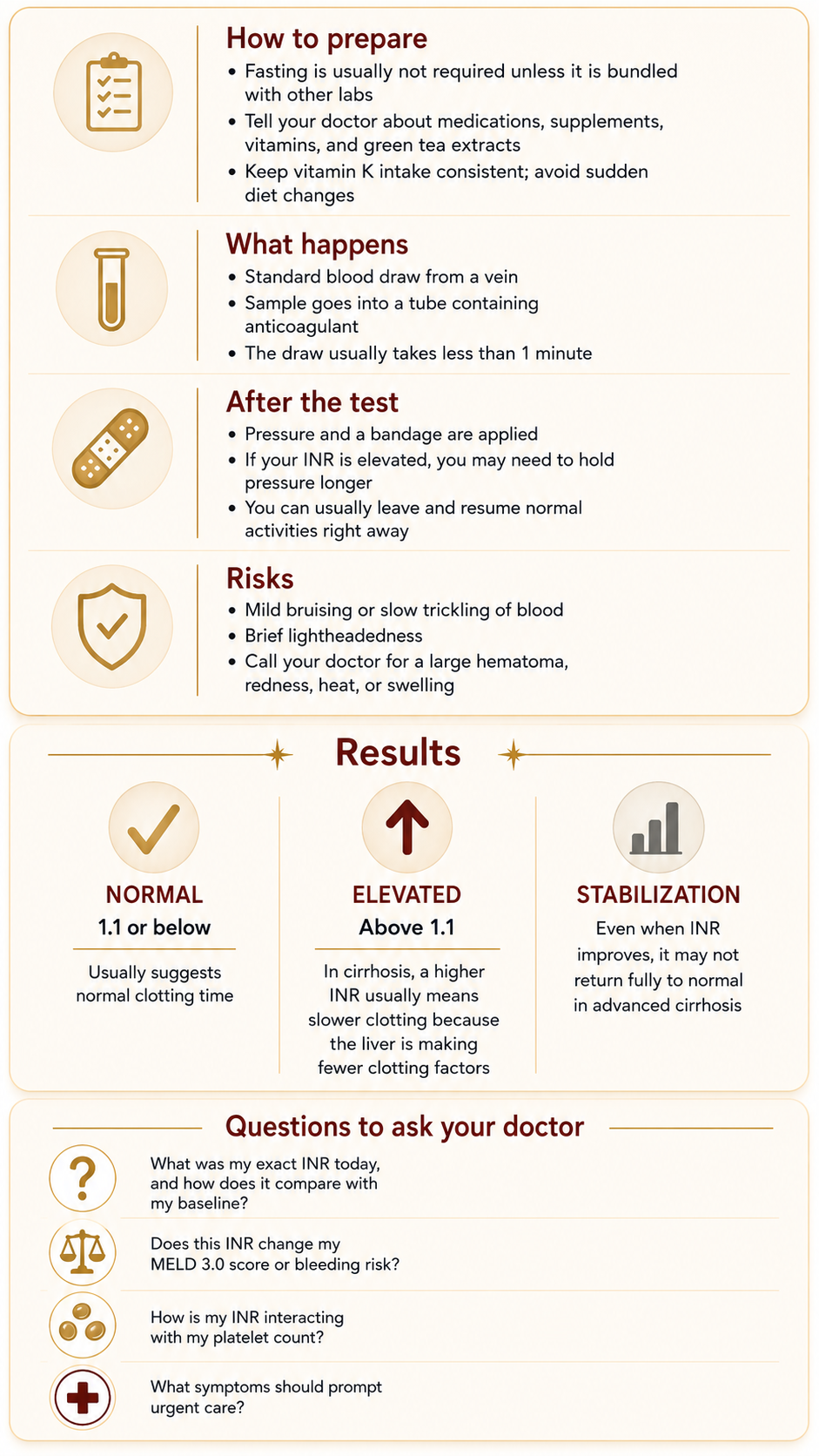
How to Prepare
An INR blood draw is highly routine and requires very little specialized physical preparation:
Fasting Requirements: Fasting is typically not required if you are only running a PT/INR test, but an 8-to-12-hour fast is standard if it is bundled into a broader metabolic panel [5].
Medication Disclosures: It is vital to tell your doctor about all daily medications, supplements, and vitamins you take. Compounds high in Vitamin K, green tea extracts, or everyday pain relievers can directly skew clotting data [1].
Consistency in Diet: Avoid sudden, drastic changes in your intake of green, leafy vegetables directly before the test, as these are rich in Vitamin K and can temporarily alter your blood’s clotting capabilities [2].
What Happens During and After
The test is a standard needle stick, or venipuncture, performed by a healthcare professional [5]. An elastic band is wrapped around your upper arm to isolate a vein, the skin is sterilized with an antiseptic wipe, and a small needle is inserted [1]. The blood is drawn into a specific collection tube containing an anticoagulant to preserve the sample, and the draw finishes in under a minute [5].
Once the needle is removed, a sterile gauze pad is applied to the puncture site [5]. Because an elevated INR directly means your blood takes longer to clot, you will likely need to hold firm pressure on the gauze significantly longer than a standard patient to ensure the bleeding has stopped completely before an adhesive bandage is applied [4]. Afterward, you can leave immediately and resume your normal daily activities [1].
Risks and What to Watch For
An INR blood test carries a very safe profile with minimal risks [1]. Temporary localized side effects can include:
Localized bruising: Experiencing mild bruising or prolonged trickling of blood around the exact venipuncture site [5].
Lightheadedness: Feeling brief lightheadedness during or immediately following the stick [2].
Signs to report: Call your doctor if you experience rare complications like a large, expanding lump under the skin, called a hematoma, or signs of infection like spreading redness, swelling, or heat at the needle site [5].
What Results May Mean
For a healthy individual who is not taking blood-thinning medications or living with liver disease, a standard normal INR value is typically 1.1 or below [1].
Normal Range: 1.1 or below. This suggests that the liver is synthesizing a healthy, adequate supply of clotting proteins and the body can form a stable fibrin clot within standard time limits [2].
Elevated Levels: Above 1.1 to 2.0+. In a cirrhosis patient, an elevated INR means the liver’s manufacturing capacity has slowed down due to parenchymal scar tissue [3]. When the number climbs to a 2.6 or 2.7, it signals a significant delay in clotting time and a high clinical urgency, directly raising your priority on the MELD 3.0 transplant score list [4].
The Stabilization Reality: Through healthy lifestyle adjustments, medications, and medical management, a severely elevated INR can improve and trend down to a lower, much safer range. However, because advanced structural changes remain in a cirrhotic liver, the INR may permanently live slightly out of bounds, meaning you must maintain continuous, careful lifestyle awareness regarding bleeding hazards [3].
Questions to Ask Your Doctor
To help you track your clinical trends and advocate for your health at your next medical visit, consider bringing these specific questions to your provider:
What was my exact INR value on today’s lab panel, and how does it compare to my baseline over the last six months?
Given my current INR number, are my daily bleeding risks stable, or should I be taking extra physical precautions to avoid minor injuries?
How is my current INR interacting with my platelet count to protect me against spontaneous bleeding or bruising?
How does today’s INR value affect my current MELD 3.0 score calculation or my overall disease staging?
What specific signs—like a certain duration of a nosebleed or specific dark stools—should prompt me to seek immediate emergency care based on my clotting time?
Sources
Source 1: Mayo Clinic: Prothrombin Time Test and INR Overview
Source 2: Cleveland Clinic: Understanding the International Normalized Ratio (INR) Test
Source 3: Journal of Hepatology / PubMed: Guidelines on Liver Synthetic Function and Coagulation in Cirrhosis
Source 4: The American Journal of Gastroenterology: Clinical Guideline for Evaluation of Liver Chemistries
Source 5: National Institutes of Health (NIH) / MedlinePlus: Prothrombin Time Test and INR (PT/INR)
