The Strange Social Currency of a MELD Score
Important Medical Disclaimer: I am Angie, a cirrhosis patient sharing my personal lifestyle, nutrition, and mindset journey. I am a data aggregator and community builder, not a licensed medical professional, doctor, or dietitian. Content on diagnosiscirrhosis.com is based solely on my personal experience living with advanced liver disease and is intended for informational and educational purposes only. It does not constitute medical advice or a substitute for professional medical care. Always follow the recommendations of your own healthcare team and consult your hepatologist or physician before changing your diet, medication, or lifestyle routine.
🚨👀 Watch: The arithmetic of survival and how an acronym becomes small talk for organ failure. (POV: Realizing a four-letter mortality estimate has accidentally become your public identity marker 😵💫⏳)
@diagnosis_cirrhosis 🔴📊 Watching your MELD score change in real time… it does something to you 👀 There’s something surreal about having your health reduced to a number. A number that quietly asks: are you moving toward 6… or toward 40? It’s not just data. It’s a constant reminder of mortality — quantified, tracked, updated 🧾 Every lab draw 🩸 Every portal refresh 📱 Every appointment 📅 You’re watching your body… in numbers. And somewhere in that process, your fragility starts to feel fractioned — split across bilirubin, INR, creatinine, sodium, albumin 📊 But here’s the part that number doesn’t hold: ❌ Your resilience ❌ Your day-to-day fight ❌ How you actually feel ❌ The life you’re still living in between the labs MELD measures risk. It does not measure you. If you’re living with cirrhosis — from: 👉 MASLD (fatty liver) 🍩➡️🩺 👉 MASH/NASH 🧪 👉 Alcohol-related liver disease 🚫🍷 👉 Hepatitis B 🦠 👉 Hepatitis C 🦠 👉 Autoimmune hepatitis 🛡️🔥 👉 PBC 🧬 👉 PSC 🧬 👉 Hemochromatosis ⚙️ 👉 Wilson’s disease 🪙 👉 Alpha-1 🧩 👉 Drug-induced liver injury 💊 👉 Or anything else ❓ —you’re more than a score. Always talk to your doctor or hepatologist 👩⚕️👨⚕️🩺 and follow their guidance. But don’t let a number define your entire story. #livehighlights #tiktoklive #livertransplant #liverhealth #chronicillness ♬ Radiant Streets - Nostalgia Waves
Video Transcript & Key Points From My Caption:
The Identity Marker: The MELD score shifts from a cold clinical math equation into a strange social currency, acting as an identity marker that people use to grade your baseline.
The Grading Curve Misconception: Because the system measures short-term mortality risk rather than daily quality of life, a "better" or lower numeric score is often falsely equated with true wellness.
The Algorithmic Evolution: Navigating the upgrade from the legacy system to the modernized MELD 3.0 protocol humbles you instantly when you realize how the tracking metrics handle structural variables.
The Strange Social Currency of a MELD Score
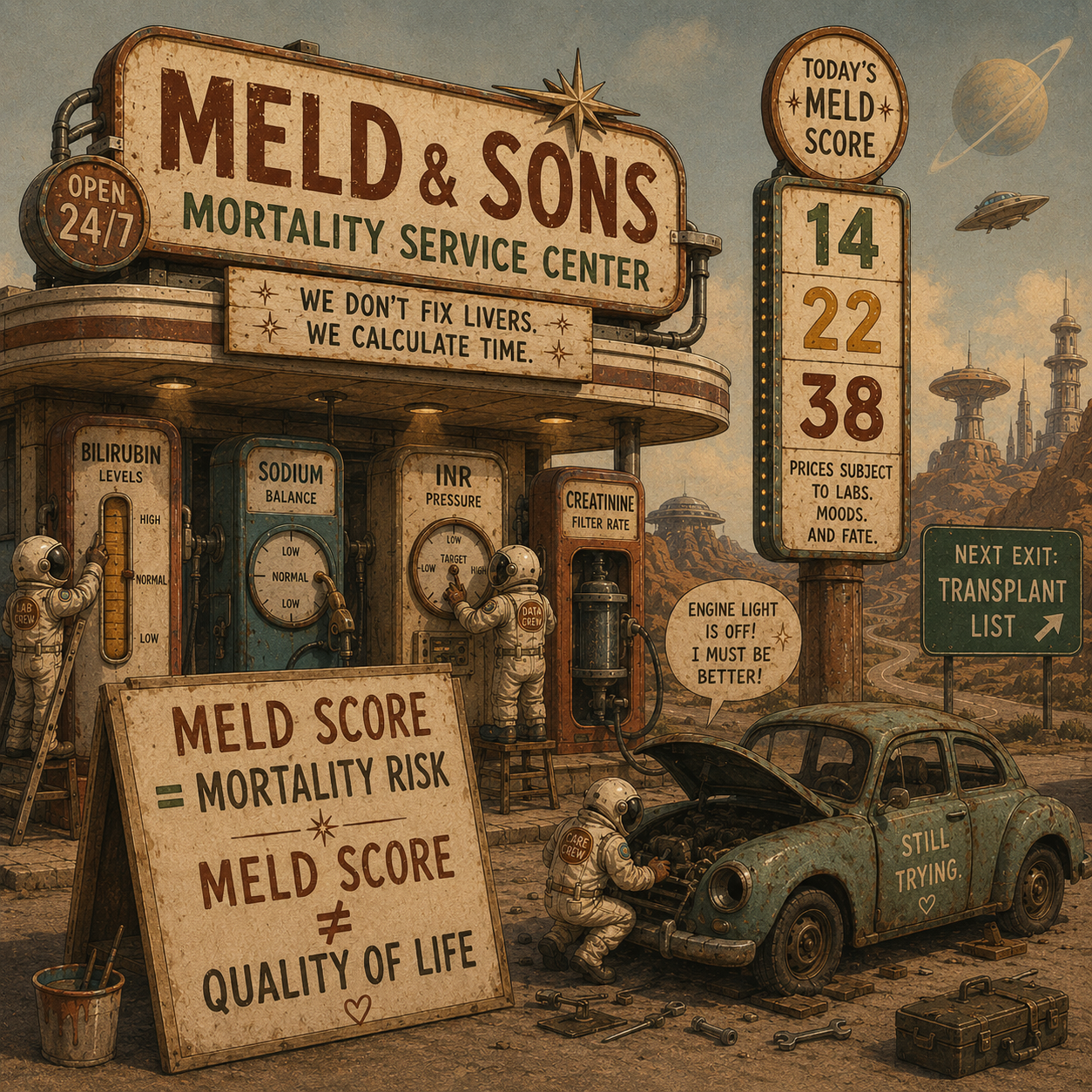
Sometimes your MELD score improving is like your engine light finally going off even though your car is still falling apart. Nice, but not helpful
By Angie from @diagnosis_cirrhosis on TikTok
The Unhinged Odometer of Chronic Illness
When it comes to living with cirrhosis, your sense of time becomes something between an odometer and a tachometer. Except instead of MPH and RPM, it is percentages and 30/60/90-day mortality increments. Which is just an absolutely unhinged way for a human being to experience time,by the way. I will spare you the “I was told I had three months to live” monologue because if you are here, you probably know enough about livers already to understand where the bottom drops out faster than the only glass bottle in the ripped grocery bag you knew was too full. You know the sound. You know the feeling.
And sitting at the center of all of it is this strange little acronym: MELD. The Model for End-Stage Liver Disease. A name that somehow manages to sound both deeply ominous and weirdly like a software company that went bankrupt in 2004after overpromising cloud integration solutions. “MELD Technologies.” “MELD Systems.” “Your future, seamlessly integrated.”
The Clean Geometry of a Chaotic Reality
Anyway. I do not care what anybody tells you: the MELD score becomes an identity marker.Even if you personally refuse to claim it. It becomes the statistic everyone asks about as though it is supposed to summarize your entire existence. “What’s your MELD?” “How’s your MELD?” “Did your MELD improve?” “What was your highest MELD?” And I understand why people do it. Humans love numbers because numbers reduce ambiguity. Numbers feel clean. Organized. Containable. People do not know what to do with liver failure, mortality, transplant lists, bodily deterioration, and uncertainty. But they do know what to do with: “14 is better than 22.” That feels manageable.
The problem is that the MELD score is a mortality estimate, not a quality-of-life score. And those are wildly different things. A person can have a lower MELD and still feel absolutely horrific. A person can look “stable” on paper and still feel like their body has become an unreliable narrator. The transplant community talks about this constantly because it is one of the biggest gripes, growls, and groans surrounding the MELD system. It determines urgency, transplant priority, and access—how the system perceives severity. But it does not fully capture exhaustion, brain fog, muscle wasting, nausea, fear, pain, and the psychological experience of feeling your body malfunction in real time. It is like trying to summarize an entire collapsing casino by reporting whether one slot machine is technically still operational.

I always say MELD is the score you can’t ignore… unless you don’t have one
The Grading Curve of Sickness
And somehow that number still becomes your public-facing identity. It reminds me a little bit of sports statistics. Like asking a quarterback how many touchdowns he threw and pretending that singular stat tells you whether the offensive line collapsed, whether he played injured, whether the weather was terrible, whether the team around him was imploding, or whether the entire game was chaos. The stat matters. But it is not the whole story.
And one of the funniest stories I have ever heard about MELD came from a friend whose score dropped from a 22 to a 14 over about six months. He was thrilled. Absolutely beside himself. He goes to his doctor and says: “Can you believe this? I’m a 14!” And the doctor says: “Yeah, this is good.” So naturally my friend goes: “So… I’m basically not sick anymore then?” And the doctor pauses and says: “Guess what my MELD score is.” My friend says: “I don’t know… maybe like a 12? You look healthy.” And the doctor goes: “I don’t have one.”
Which is objectively hilarious and emotionally devastating at exactly the same time. Because it is such a sharp reminder that people with liver disease become so acclimated to operating inside the grading curve of sickness that a “better” number starts feeling synonymous with wellness, when in reality the existence of the number itself means your life has already fundamentally changed.
Small Talk for Organ Failure
And honestly, my own relationship with MELD has been bizarre from the beginning. I will never forget when whispers started making their way around the neighborhood that I had cirrhosis. And one of my dearest friends happened to know what a MELD score was because her neighbor had undergone a transplant. Now listen. If this was not the biggest part urban legend, part suburban legend situation I have ever witnessed, I do not know what was. This woman took the concept of MELD and absolutely ran with it. Suddenly everybody knew what a MELD score was. Everybody. Overnight I stopped being Angie and became: “the girl with the MELD.”
And it was not malicious. People were trying. This was simply the most tangible framework they had for understanding what was happening to me. People like scales, benchmarks, ranges, and metrics. And the uninteresting reality is that MELD is often the only line of liver lingo they know how to use when exchanging pleasantries. It becomes small talk for organ failure. But there is something deeply strange about becoming numerically narrativized. About watching a four-letter acronym flatten an entire human experience into a fluctuating mortality estimate.

The Secret Arithmetic of the Liver Lore
And then there is the transplant community itself, which develops this entirely separate statistical folklore around liver disease. People start discussing lab values the way retired athletes discuss career records. “My highest MELD was 38.” “My bilirubin hit 27.” “Oof. Rough INR.” “Yeah, sodium got me.” And everybody immediately understands the archetype being described. Like somehow we are all sorting ourselves into characters inside this strange monotonous amalgam of arithmetic that only a microscopic percentage of the global population could possibly care about. But inside liver disease spaces? Those numbers become lore. People remember peak bilirubin the way athletes remember personal records. Lab values become war stories. Urban legends. Suburban legends.
And after a while the MELD starts feeling less like a medical score and more like a cartoon speech bubble floating over your head everywhere you go:
CURRENT MORTALITY ESTIMATE: LOADING…
Imagine if everyone walked around like that. Little illuminated placards hovering above us all. Not attractiveness, people. Not: “She’s a 10.” I mean: “I would be a 10 but I lost points for cholesterol, gained a few from cardiac health, took a sodium hit, glucose is acting up…” How bizarre would that be? And yet for people with cirrhosis, this is basically the psychological experience.
I understand why the system exists. Most people are not standing in line waiting for spare human organs to become available. But emotionally? The whole thing is surreal.

If Madame MELD-ina was real, would you visit her?
The False Confessions of the Organ Failure Olympics
And then there is this second transition that happens where the MELD score evolves from terrifying into… weirdly obsessive. You start treating tiny lab improvements like merit badges. Not only did I avoid sodium today, but bilirubin improved, creatinine is behaving, INR is cooperating, and portal hypertension is still chaotic but theatrically manageable. And yes, for the record, I am talking about prothrombin time, not Pilates.
I used to get irrationally excited over tiny improvements. I would come home from appointments absolutely gleeful, plug my numbers into the calculator, and celebrate some glorious new all-time low score like I had just beaten a personal record at the Organ Failure Olympics. Only to realize I had accidentally used the wrong MELD calculator. Because apparently we needed a sequel. Anyone who knows, knows. Nothing humbles you faster than celebrating your fake improved mortality estimate before realizing you forgot the MELD 3.0 adjustment.
And honestly, that feels deeply on-brand for liver disease. The MELD becomes a scoreboard, a surveillance system, a social shorthand, a floating calculation, and a strange form of identity. And to be completely honest? I think part of me will be a little sad if I ever stop having one. I think I will long for that familiar calculation. The one I pick for roulette numbers. The one that appears anytime somebody says: “Pick a number between 1 and 40.” Because it becomes a constant companion. The closest thing I have to a medically sanctioned Magic 8 Ball: five little vials of blood.
The Data Breakdown: The Variables of the Survival Scorecard
To truly comprehend how five small vials of blood are flattened into a singular mortality estimate, we have to bypass the social folklore and step inside the laboratory tracking matrix. The medical community relies on these specific, objective metrics to establish transplant equity. As I aggregated the peer-reviewed clinical literature, I found that the modern calculator relies on five foundational biological variables to score our severity:
1. Total Bilirubin (The Filtration Backlog)
Bilirubin is a yellowish byproduct created by the natural breakdown of old red blood cells. A healthy liver routinely filters this pigment out of the bloodstream and excretes it through bile. When structural scarring causes the liver’s filtration pathways to fail, bilirubin backs up into peripheral tissues, surfacing visibly as jaundice.
My Experience:Peak bilirubin is the ultimate war story value in patient forums. It is the visible scoreboard of liver failure. While the algorithm weighs it heavily as an indicator of direct functional decline, watching the number fluctuate feels like waiting for a traffic jam to clear inside an underground tunnel.
More Reading:The essential parameters tracking how serum bilirubin alterations accurately reflect short-term mortality risks are established under the clinical protocols outlined by the National Institutes of Health (NIH) StatPearls MELD Staging Profile.
2. International Normalized Ratio / INR (The Coagulation Timeline)
The liver is the body's primary manufacturing plant for clotting factors—the essential proteins responsible for thickening blood to halt internal and external bleeding. The International Normalized Ratio (INR) evaluates prothrombin time, measuring exactly how many seconds it takes for your blood plasma to form a clot compared to a standardized laboratory baseline.
My Experience:In liver disease spaces, a rough INR is spoken about with immediate, sober understanding. It means your body is running out of active structural components to manage basic clotting security. It translates directly to why simple everyday tasks carry a silent boundary of bleeding risk.
More Reading:The exact mathematical weight assigned to prothrombin time variations within waitlist mortality predictions is verified by the American Association for the Study of Liver Diseases (AASLD) in the core documentation on Why the Allocation System Utilizes the MELD Framework.https://www.google.com/url?sa=i&source=web&rct=j&url=https://www.aasld.org/liver-fellow-network/core-series/why-series/why-do-we-use-model-end-stage-liver-disease-meld-score&ved=2ahUKEwiYjpDY7c6UAxVNnCYFHffLOH0Q0YISegYIAAgIEAE&opi=89978449&cd&psig=AOvVaw2ZjHeTGu_H5X-WDYKi7DaX&ust=1779606694560000
3. Serum Creatinine (The Renal Safety Net)
Creatinine is a chemical waste molecule generated continuously by normal muscle metabolism. Healthy kidneys filter creatinine out of the blood and flush it through urine. Because advanced liver disease causes systemic fluid shifts and severe vascular changes, blood flow to the kidneys often plummets, causing serum creatinine levels to spike as the renal filtration system begins to choke.
My Experience:This is the variable that routinely humbles patients who think liver disease stays contained inside a single organ. The moment your creatinine starts creeping upward on your lab portal, the algorithm panics and aggressively drives your score higher, recognizing that your internal systems are running out of structural backups.
More Reading:The definitive laboratory rules regarding serum creatinine limits and their direct correlation with secondary renal strain are extensively cataloged in the VA National Viral Hepatitis and Liver Disease MELD Guidance.
4. The MELD 3.0 Modernized Updates: Serum Sodium and Albumin (The Volume Balancers)
In July 2023, the Organ Procurement and Transplant Network (OPTN) formally modernized organ allocation protocols by transitioning to the updated MELD 3.0 model. This upgraded calculation introduces serum sodium and serum albumin levels directly into the equation while adding an automatic structural adjustment for female sex to eliminate historical waitlist disparities.
My Experience: This is the exact sequel that caught me completely off guard. Celebrating a lower score on an old, outdated calculator is a rite of passage until you plug your numbers into the 3.0 matrix. The addition of albumin and sodium means the algorithm is now directly tracking the precise fluid mechanics that drive ascites and severe volume shifts under the surface.
More Reading:The clinical validation data demonstrating how the MELD 3.0 revision accurately reclassifies patient mortality risk and reduces systemic sex-based organ allocation disparities is meticulously detailed in the peer-reviewed report published in Gastroenterology: The Model for End-Stage Liver Disease Updated.
What to Ask Your Healthcare Team: Targeted Technical Questions
Navigating the statistical folklore of a MELD score requires moving past casual pleasantries and asking your care team for precise, long-term trends. Bring these focused questions to your next lab review:
Questions for Your Hepatologist or Gastroenterologist
"When evaluating my current lab portal trends, are we calculating my score using the updated MELD 3.0 framework to ensure my sex, serum albumin, and sodium variables are being weighted accurately?"
"While my overall numeric score appears stable on paper, do my underlying creatinine or INR trends indicate that my secondary renal or coagulation pathways are facing hidden structural strain?"
"Given my current score, does my baseline trigger the threshold for an active referral to a liver transplant center for formal baseline evaluation and listing consideration?"
Questions Regarding Symptomatic Disconnects and Management
"Because the MELD calculator focuses strictly on short-term mortality metrics, how can we separate my lab numbers from my severe quality-of-life complications, like muscle wasting or hepatic encephalopathy?"
"Are there specific MELD exception points or clinical parameters that my care team should document to ensure my file reflects severity markers not captured by my basic blood work?"
"How frequently do my baseline numbers require repeated laboratory checks based on my current staging to ensure our surveillance data remains active and accurate?"
Peer-Reviewed Sources and Authority References
National Institutes of Health (NIH) StatPearls Archive – Model for End-Stage Liver Disease (MELD). A comprehensive clinical textbook overview tracking the calculation parameters, laboratory variables, and statistical application of short-term mortality staging in chronic organ failure.
American Association for the Study of Liver Diseases (AASLD) – Why Do We Use the Model for End-Stage Liver Disease (MELD) Score? The official liver society matrix analysis tracking prothrombin time variations, INR math formulas, and organ allocation equity.
U.S. Department of Veterans Affairs National Viral Hepatitis and Liver Disease Program – Cirrhosis and the MELD Score Guidance. The definitive government laboratory manual outlining creatinine thresholds, renal safety parameters, and multi-system diagnostic monitoring rules.
Gastroenterology Journal (AGA) – MELD 3.0: The Model for End-Stage Liver Disease Updated for the Modern Era. The authoritative peer-reviewed data validating the addition of serum albumin, sodium interaction terms, and gender equity reclassifications in the modern allocation era.
Summary: Don’t forget, It is a 4 letter word after all
It is incredibly easy to get sucked into the strange social shorthand of liver disease—treating your blood work like a daily sports scoreboard or sorting yourself into brackets based on your peak bilirubin levels. But a collection of numbers typed into an online calculator will never be able to measure the sheer amount of grit it takes to move through the day with muscle wasting, navigate the haze of brain fog, or wake up every morning to look uncertainty dead in the eyes.
And there’s a phase in all of this I have yet to live… that’s when the MELD score going down feels like a disappointment. While your death risk is lower, your quality of life has likely reduced… because you will be waiting longer. That’s the painful paradox of when those thresholds hit. “I want to be at least 15 so I’m listed, 16 or 17 to be safe”, or “ok I am in the low 20’s this is game time” to the “oh now, this is 30 territory. Will I be ok? That step function escalation of hope and horror is truly the the tick tick tick up the rollarcoaster where your sincerest wish is that you don’t get stuck before being at the top.
A lower number is an excellent sign of stability, but it isn't an automated pass that means you're suddenly symptom-free or "not sick anymore." And a higher number isn't a failure—it's just your body's way of raising a flag so your medical team knows exactly when to step in with reinforcement. Don't let a four-letter acronym flatten your humanity. Keep tracking your data, advocate for your care, and remember that you are the person living the story, not the statistic floating above it.