
Kale
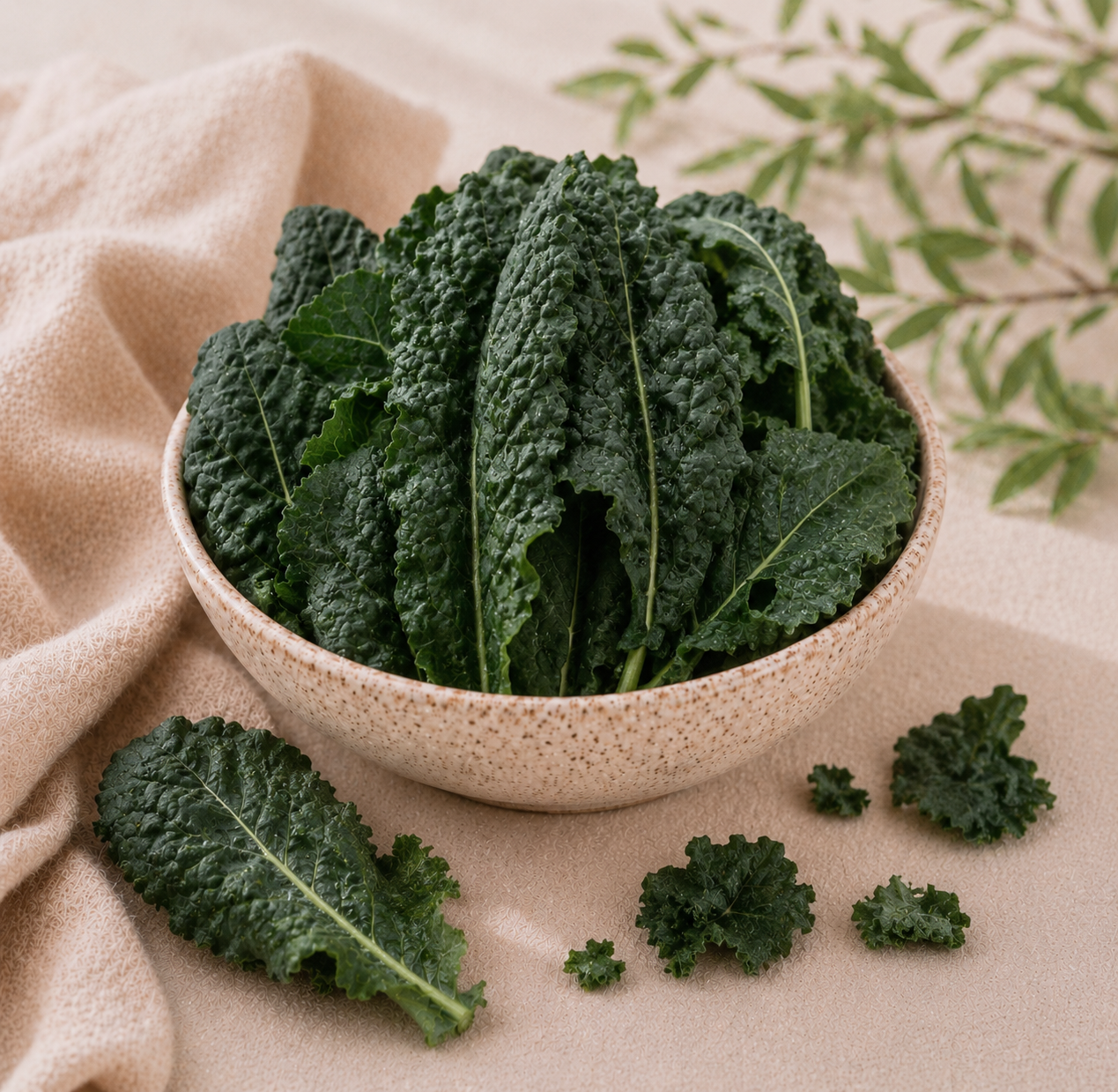
Is Kale Safe for Cirrhosis?
Yes, whole kale is entirely safe and serves as a powerful metabolic asset for liver support, but it requires strict preparation awareness to navigate medication interactions and thyroid/filtration strains.
Why Kale is Safe For You:
Phase II Detoxification: Packed with glucosinolates that trigger Phase II enzymes, helping defend remaining healthy liver tissue from toxic oxidative damage.
Blood Health Support: Loaded with natural chlorophyll and essential B-vitamins crucial for managing cellular regeneration and blood integrity.
The Ammonia Defense: High in dietary soluble fiber, acting as a natural binder in your gut to trap ammonia waste before it can cross into your bloodstream.
My Cirrhosis - Kale Crisis of Faith:
My first nutritionist consult in the hospital was not exactly a buffet of thrilling possibilities. There was a lot of talk about protein. A lot of talk about sodium. A lot of talk about muscle loss, fluid retention, labs, and how suddenly every bite of food had a job description.
And then came kale. Naturally.
Because apparently it is not enough to get diagnosed with cirrhosis. At some point, someone also has to look you in the eye and suggest leafy greens.
Kale has always felt suspicious to me. Is it food? Is it decoration? Is it what restaurants put under the food they actually expect you to eat? Hard to say.
But once you start learning about liver disease, Vitamin K, and INR, kale becomes harder to dismiss. Annoying, but true.
That was one of the first big nutrition lessons for me: I did not have to be excited about every food. I just had to understand why some foods were worth making easier.
Because cirrhosis nutrition is not really about becoming a perfect health person. It is about building a routine your actual life can tolerate. That’s my pitch on giving kale a shot - it’s really not THAT bad, I promise!
Kale: The "Chlorophyll Commander" for Blood Health and Toxin Neutralization
In the high-stakes nutritional management of liver cirrhosis, Kale (Brassica oleracea var. sabellica) stands as a dominant functional food. Often hailed as the "Queen of Greens," kale belongs to the cruciferous family—a group of vegetables scientifically recognized as the most potent natural stimulators of the liver’s detoxification enzymes. For a patient with a scarred liver, kale offers a triple-action defense: it provides a massive dose of Vitamin K to support blood clotting, glucosinolates to trigger Phase II detoxification, and chlorophyll to neutralize environmental toxins before they can damage remaining healthy tissue.
As the liver loses its ability to filter blood efficiently, incorporating these "Commander" compounds becomes a critical strategy for organ longevity. In this 2,000-word deep dive, we explore the ancient roots, the molecular science, and the culinary strategies that make kale a non-negotiable staple for liver restoration.
A Voyage Through Time: From the "Peasant’s Cabbage" to the Roman Field Rations
The history of kale is a 4,000-year saga of human reliance on one of the hardiest and most nutrient-dense plants on Earth. Unlike modern "headed" cabbages, kale is much closer to the wild cabbages that originated in Asia Minor and the Mediterranean.
The Ancient Greek Panacea: The Ancient Greeks were so convinced of kale’s medicinal powers that they used it as a primary remedy for mushroom poisoning and intestinal "sluggishness." They believed that eating kale before a feast would protect the liver from the "heat" of indulgence—an early, intuitive understanding of the vegetable’s hepatoprotective properties.
The Roman Field Rations: The Romans referred to kale as Brassica, and it was a mandatory part of the field rations for their legions. Roman soldiers relied on kale to maintain their stamina and "fortify the blood" during long marches across Europe. It was the Romans who first introduced kale to the British Isles and France, where it became a survival staple for the working class.
Scotland’s "Kail-Bell": In medieval Scotland, kale was so central to the diet that the word "kail" became synonymous with food itself. A "kailyard" was a vegetable garden, and the "kail-bell" was the dinner bell. During the brutal Scottish winters, when no other crops could survive the frost, kale remained standing in the fields, providing the Vitamin C and minerals that prevented scurvy.
The Victory Garden Hero: During World War II, the British government encouraged citizens to grow kale in their "Victory Gardens." Because it was easy to grow and resistant to pests, it provided a vital source of iron and Vitamin K during a time of intense food rationing, helping a nation stay resilient under pressure.
Why Kale is a "Liver-Specific" Superfood
For a patient with cirrhosis, the liver’s "filter" is partially blocked by scar tissue. Kale provides the chemical tools to help the remaining healthy tissue work at peak efficiency.
Vitamin K: The Clotting Commander One of the most dangerous complications of cirrhosis is the liver’s inability to produce the proteins required for blood clotting. According to the National Institutes of Health, kale is one of the world's richest sources of Vitamin K1. By providing this nutrient, kale supports the liver’s remaining capacity to manage blood health, reducing the risk of easy bruising and dangerous bleeding episodes.
Phase II Detoxification Support (Glucosinolates) The liver detoxifies the body in two stages. In a scarred liver, "Phase II"—the stage where toxins are "packaged" to be safely removed—can become sluggish. Kale is packed with glucosinolates. Research published in PubMed Central (PMC) shows that when chewed or chopped, these turn into isothiocyanates, which specifically ramp up Phase II enzymes. This ensures that toxins don't linger in the liver, where they can cause further oxidative stress on scarred tissue.
Chlorophyll and Heavy Metal Defense The deep green color of kale is a signal of its high chlorophyll content. ScienceDirect research indicates that chlorophyll acts as a biological "sponge" in the digestive tract, binding to heavy metals and environmental pollutants. This prevents these toxins from being absorbed into the bloodstream and reaching the liver, directly reducing the organ's filtration workload.
Lutein and Zeaxanthin: The Carotenoid Guard Kale is loaded with lutein and zeaxanthin. While famous for eye health, these fat-soluble antioxidants are also stored in the liver. Clinical studies highlighted by the Cleveland Clinic indicate that these carotenoids can help dampen the systemic inflammation that drives the progression of fibrosis (scarring).
The Green Commander Illusion: Two Critical Warnings You Cannot Ignore
While kale delivers exceptional tissue-protective benefits, its specific chemical compounds introduce sudden real-world risks that every advanced liver patient must track:
The Blood Thinner / Medication Clash: Kale is a powerhouse of Vitamin K, the body's primary blood-clotting mechanism. If your cirrhosis care plan includes prescription blood thinners (like Coumadin/Warfarin) to manage portal vein thrombosis risks, a sudden spike in your kale intake can completely neutralize your medication. Keep your daily green portions highly consistent to prevent throwing your clotting time (INR labs) into a volatile danger zone.
The Digestion & Thyroid Side Quest: Raw kale contains goitrogens, which can suppress thyroid function and cause sudden, intense abdominal bloating if consumed in large quantities. Because a cirrhotic digestive system already struggles with slow motility, never eat massive amounts of raw kale. Always steam, sauté, or blanch your greens to break down the rough fibers.
Kale is loaded with lutein and zeaxanthin. While famous for eye health, these fat-soluble antioxidants are also stored in the liver. Clinical studies highlighted by the Cleveland Clinic indicate that these carotenoids can help dampen the systemic inflammation that drives the progression of fibrosis (scarring).
How I Eat It: My actual life was not going to include a daily kale salad. So I put it in a smoothie. That is my entire kale personality now.
I do not lovingly massage it. I do not pretend it is the main character. I do not build a lifestyle around it. I throw it into a blender with fruit, protein, and whatever else is happening that morning, and I move on with my day.
It works because it removes the negotiation.
No staring at a bag of greens in the fridge wondering what kind of person I am supposed to become. No dramatic salad assembly. No chewing through what feels like a decorative hedge.
Just blend it and let it do its job.
Now kale is an everyday thing for me, not because I adore it, but because it became easy enough to repeat. And when you are living with cirrhosis, repeatable matters.
This article gets into kale, Vitamin K, INR, and why leafy greens can matter in liver disease nutrition.
But personally, my kale advice is simple: Hide it in the smoothie.
Let it be useful.Do not make it a personality.
Are You an Aspiring Chef? Here are the Winning Combos:
Since cirrhosis requires a strict low-sodium diet to manage fluid retention (ascites), kale’s earthy and slightly bitter profile is a critical tool for adding "umami" depth without salt.
The "Liver-Flush" Salad: Massage kale with Extra Virgin Olive Oil and Lemon Juice to break down the tough fibers. Add roasted Beets and crushed Walnuts. The lemon stimulates bile, the beets move fat, and the walnuts flush ammonia.
The "Andean Repair" Bowl: Fold sautéed kale into warm Quinoa. Serve with a Baked Salmon Fillet. The salmon’s healthy fats ensure your body absorbs the fat-soluble Vitamin K from the kale.
The "Immune-Boost" Stir-Fry: Sauté kale with plenty of minced Garlic and sliced Bell Peppers. The garlic provides the sulfur for detox, and the peppers provide the Vitamin C to boost collagen repair.
Kale Blueberry Smoothie: This is a daily go to for me! here’s the recipe - 🥬🫐🥒 RECIPE + MACROS High-Protein Green Smoothie (Serves 1) Ingredients: • 3 cups kale 🥬 • ½ cup blueberries 🫐 (frozen) • 1 tbsp chia seeds 🌱 (soaked 10–15 min) • 2 scoops Isopure (clear whey, citrus lemonade) 💪🍋 • ¼ avocado 🥑 (frozen) • ½ cup cucumber 🥒 • 2 stalks celery 🌿 • 1 cup Trader Joe’s green juice 🧃 • Squeeze lemon 🍋 • Optional: ice ❄️Instructions: 1. Soak chia seeds 10–15 min 🌱💧 2. Blend kale + green juice first 3. Add everything else 4. Blend until smooth Macros (approx): ~430–480 calories ~50–55g protein 💪 ~30–40g carbs ~10–13g fiber ~9–12g fat ~110–160mg sodium 🧂
See my videos below:
@diagnosis_cirrhosis 🥬🫐🥒 This is what I actually drink almost every single day 👀✨🔥 Created with my nutritionist 👩⚕️🧠 — high-protein 💪, low sodium 🧂, and built with ingredients that actually support liver health 💚 ✨ Kale 🥬 — rich in vitamin K 🩸 (important for clotting), antioxidants, and fiber to support overall liver function 🫐 Blueberries — packed with antioxidants to help combat oxidative stress (big in cirrhosis, fatty liver, and fibrosis) 🌱 Soaked chia seeds — fiber + omega-3s to support digestion and reduce inflammation 🥑 Avocado — healthy fats to support energy + nutrient absorption 🥒 Cucumber + celery 🌿 — hydration + electrolytes without excess sodium 🍋 Lemon — supports digestion + helps balance flavors 🧃 Green juice — added micronutrients + makes it actually drinkable 💪 Protein — ~50g+ to help prevent muscle wasting (sarcopenia), which is a major risk in cirrhosis 🧠 If you’re living with cirrhosis, fatty liver (MASLD / NAFLD), MASH / NASH, or fibrosis — this matters Your body is dealing with inflammation 🔥, metabolic changes ⚖️, and increased protein needs 👉 This combo helps support: • Muscle maintenance 💪 • Energy levels ⚡ • Reduced oxidative stress 🫐 • Digestive support 🌱 • Hydration 💧 And yes… soaking chia seeds matters 🌱💧 Better texture, easier digestion, and improved nutrient absorption 💡 This is a super versatile base 🔁 Swap fruits 🍓, rotate greens 🥬, adjust texture 🌀 — it doesn’t have to be complicated to be consistent 🙌✨ If you’re navigating: Autoimmune hepatitis 🛡️🔥 MASLD / NAFLD (fatty liver) 🍩 MASH / NASH 🧪 Alcohol-related liver disease 🚫🍷 Hepatitis B 🦠 Hepatitis C 🦠 Primary biliary cholangitis 🧬 Primary sclerosing cholangitis 🧬 Hemochromatosis ⚙️ Wilson’s disease 🪙 Alpha-1 antitrypsin deficiency 🧩 Drug-induced liver injury 💊 Cryptogenic cirrhosis ❓ …or any other cause This is one of those real-life, repeatable options that supports your body 🫶 without overthinking it 🤍✨ #highproteinbreakfast #greenjuice #easyrecipe #liverhealth #hearthealth ♬ original sound - diagnosis cirrhosis
@diagnosis_cirrhosis 🚨 Your Liver is Calling 📞 Need an optimal combination of ingredients to support liver health? 🥬 🫐 🥑 🫘 💪🏼 This smoothie was designed by my nutritionist 🧑🍳 and hits all of the major nutrients and macros your liver needs most (and you probably like to eat least 😉) I eat this almost every day and I would swear it has helped my MELD via INR, albumin, and billirubin. 🩸📊 No matter if you are working on MASD, alcoholic liver disease (ALD), metabolic dysfunction associated steatohepatitis (MASH), MetALD, or autoimmune hepatitis (AIH). And it’s not just for breakfast 🍳, I reach for it any time of day! ☀️ 🌙 Don’t have cirhhosis or fibrosis? No problem - your liver still loves and needs this in your diet! 💚🥤 #liverhealth #cirrhosis #highproteinmeals #nutritiontips #smoothie ♬ original sound - diagnosis cirrhosis
🚨 Your Liver is Calling 📞 Need an optimal combination of ingredients to support liver health? 🥬 🫐 🥑 🫘 💪🏼 This smoothie was designed by my nutritionist 🧑🍳 and hits all of the major nutrients and macros your liver needs most (and you probably like to eat least 😉) I eat this almost every day and I would swear it has helped my MELD via INR, albumin, and billirubin. 🩸📊 No matter if you are working on MASD, alcoholic liver disease (ALD), metabolic dysfunction associated steatohepatitis (MASH), MetALD, or autoimmune hepatitis (AIH). And it’s not just for breakfast 🍳, I reach for it any time of day! ☀️ 🌙 Don’t have cirhhosis or fibrosis? No problem - your liver still loves and needs this in your diet! 💚🥤 #liverhealth#cirrhosis#highproteinmeals#nutritiontips#smoothie
Nifty Prep Tools for the Liver-Friendly Kitchen
To keep your "Chlorophyll Commanders" fresh and maximize their healing potential, these tools are essential:
Fullstar 9-in-1 Vegetable Chopper: Kale is fibrous and can be difficult to digest if not finely chopped. This tool allows you to shred a whole bunch of kale into uniform "ribbons" in seconds, making it much easier on a sensitive digestive system.
OXO Good Grips Salad Spinner: Moisture is the enemy of kale storage. This spinner ensures your kale is bone-dry before you store it, preventing the rot and Vitamin C loss that occurs in damp leaves.
Rubbermaid FreshWorks Produce Saver Containers: Kale is a "living" vegetable that needs to breathe. These containers regulate oxygen flow, keeping your kale crisp and nutrient-dense up to 80% longer.
Wüsthof Classic 3.5-inch Paring Knife: The stems of kale are very high in cellulose and can be hard for a cirrhosis patient to digest. A sharp paring knife is essential for "de-ribbing" the kale leaves quickly and safely.
Summary of Benefits for Cirrhosis
Blood Health: Massive Vitamin K1 levels support the liver's remaining blood-clotting factors.
Phase II Detox: Glucosinolates activate the enzymes that package toxins for efficient removal.
Toxin Sponge: Chlorophyll binds heavy metals in the gut to reduce the liver's filtration workload.
Anti-Fibrotic Carotenoids: Lutein and zeaxanthin protect liver cell membranes from inflammatory damage.
Fiber-Rich Flush: High insoluble fiber assists in moving ammonia rapidly through the digestive tract.
Credible Sources for Your Journey
American Liver Foundation: 13 Foods Good for the Liver
National Institutes of Health (PMC): Mechanisms Underlying Biological Effects of Cruciferous Vegetablesor Botanical Vegetable Consumption and Liver Health
Cleveland Clinic: Kale: What It Is, Nutrition, and Benefits
Medical News Today: Kale: Health Benefits, Nutrition, Eating, and Risks
Healthline: 9 Health Benefits of Kale [1]
