
Sodium
@kiwellnutrition Replying to @diagnosis cirrhosis day 15 of 30 discussing all things liver disease and nutrition - today we discuss sodium levels in blood work. #cirrhosis #liverhealth #liverdiseaseawareness #masld #fattyliver ♬ original sound - Amy | KiWell Nutrition
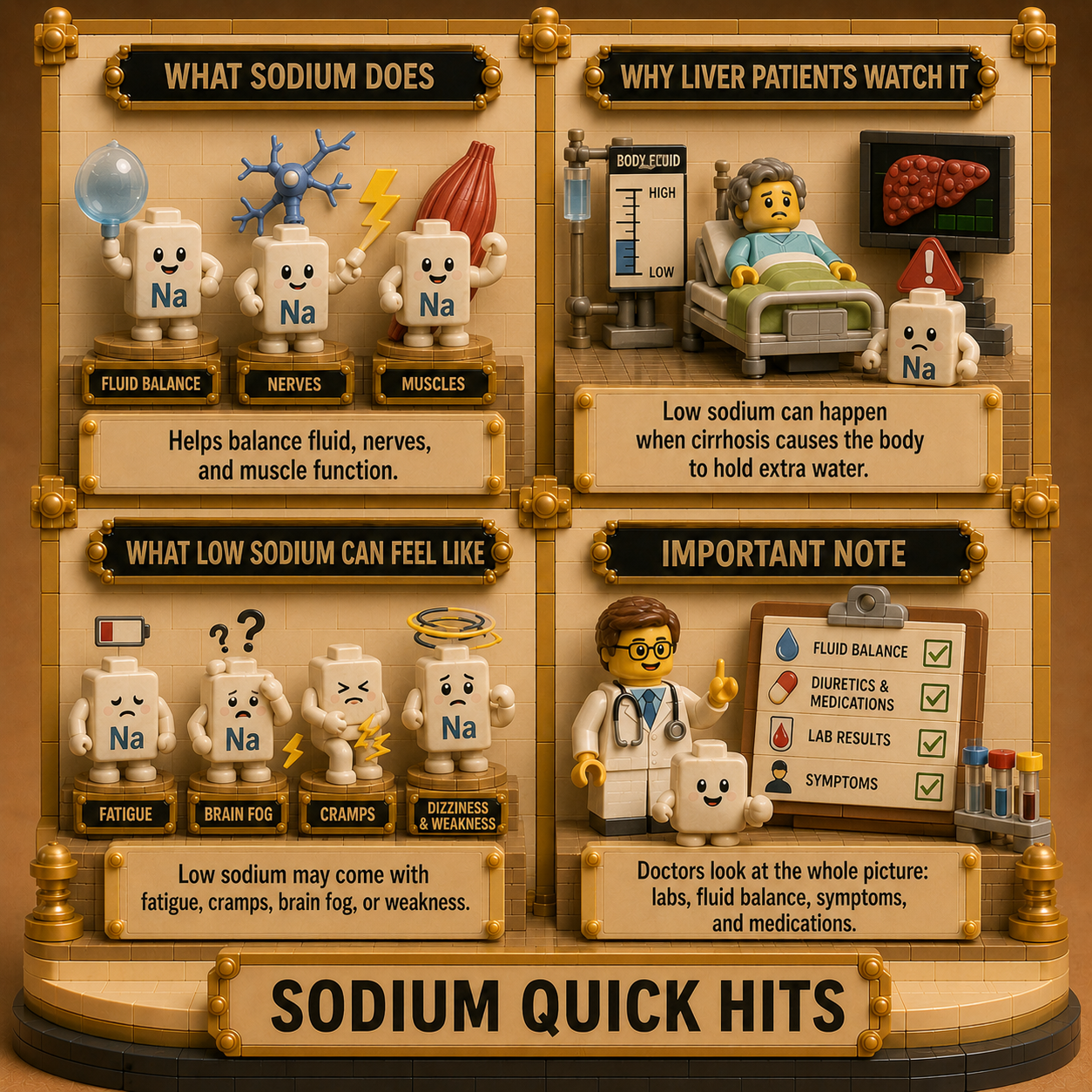
Top 4 Need to Knows
Important Medical Disclaimer: I am Angie, a cirrhosis patient sharing my personal lifestyle, nutrition, and mindset journey. I am a data aggregator and community builder, not a licensed medical professional, doctor, or dietitian. Content on diagnosiscirrhosis.com is based solely on my personal experience living with advanced liver disease and is intended for informational and educational purposes only. It does not constitute medical advice or a substitute for professional medical care. Always follow the recommendations of your own healthcare team and consult your hepatologist or physician before changing your diet, medication, or lifestyle routine.
My Experience with It
By Angie from @Diagnosis_Cirrhosis on TikTok
Sodium is one of those labs that tricks you because the word feels too familiar. We all think we know sodium.
Or at least we know enough to be dangerous.
Sodium takes me right back to high school chemistry, where I had a very limited but deeply confident relationship with the periodic table. I was not exactly out here speaking fluent element. But I knew NaCl.
Sodium chloride…Salt. That one made sense.
It was chemistry you could picture. Chemistry you could touch. Chemistry that lived on pretzels, soup cans, french fries, and nutrition labels. It was one of the rare scientific combinations that felt almost domestic.
So the shortcut forms early: Sodium equals salt.
And in ordinary life, that shortcut works well enough.
But cirrhosis takes that shortcut and snaps it in half.
Dietary Sodium
Because the sodium on a nutrition label and the sodium on your CMP are connected, but they are not the same thing. They use the same word, which is exactly what makes the whole thing feel so deceptively simple.
Dietary sodium is what you eat.
Serum sodium is the concentration of sodium in the liquid part of your blood.
And once fluid balance gets involved, those two ideas stop lining up in the clean little way your brain wants them to.
Because I would see low sodium on my labs and think:
Sodium is salt.
More salt increases sodium.
Except I have cirrhosis.
And my sodium is low.
So do I need more sodium?
Or less sodium?
Or am I misunderstanding the entire premise?
That is the part no one explains clearly enough.
It feels like the antithesis of chemistry. Chemistry is supposed to be factual. Balanced. Predictable. Two elements come together, the equation behaves, and everyone moves on with their little goggles and Bunsen burners.
Serum Sodium
But serum (from your blood) sodium in cirrhosis does not feel like that.It feels like the equation suddenly refuses to solve.

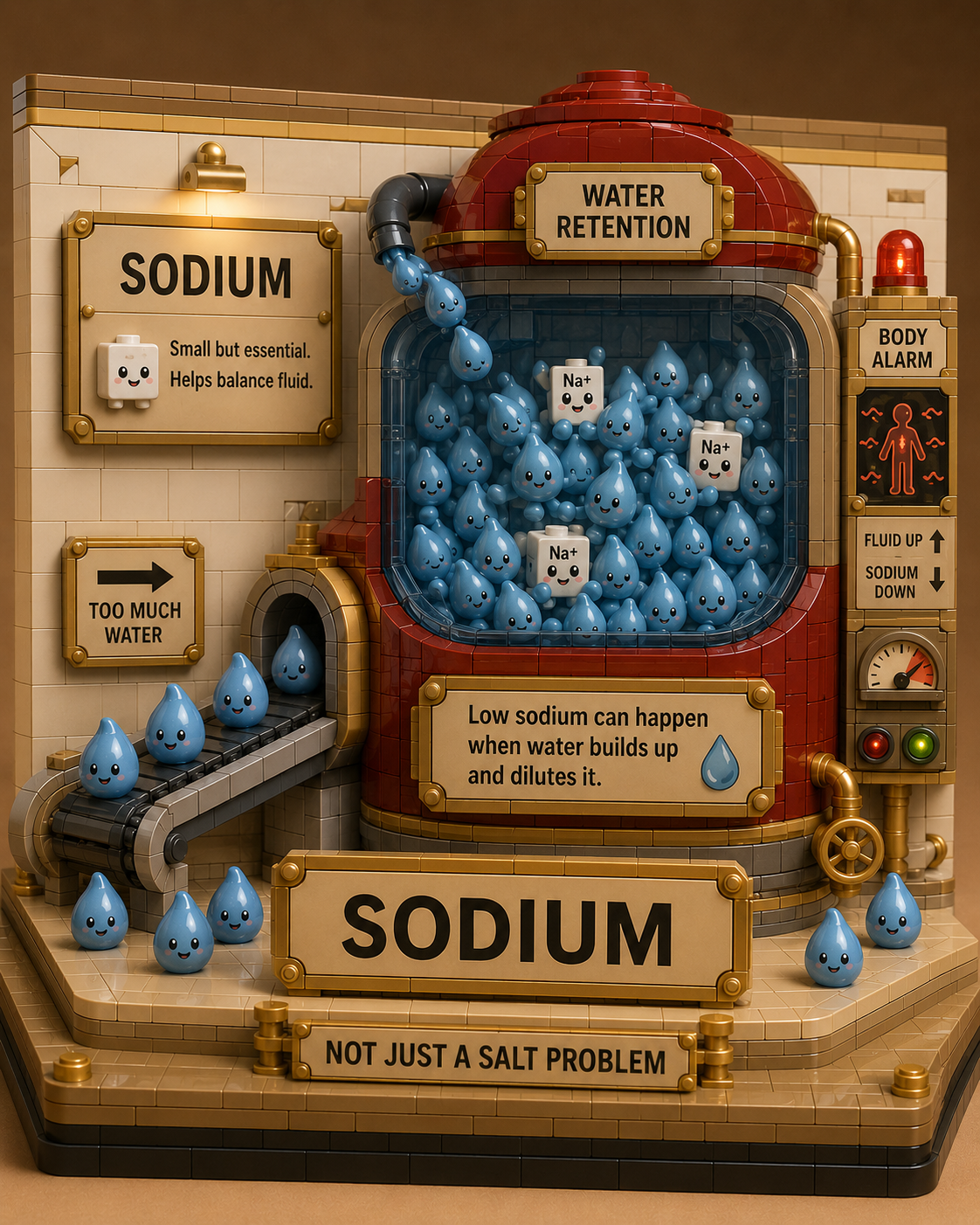
Because low serum sodium is not always about too little salt coming in. In cirrhosis, it can be about too much water being held in the body, which dilutes the sodium in the blood. The issue may not be that there is no sodium.
The issue may be that the sodium is spread through too much fluid.
And it is why the obvious answer — “just eat more salt” — is not necessarily the answer at all.
For me, that was the aha moment.
The Bottom Line
Sodium was not just a salt problem. It was a concentration problem.
A dilution problem. A fluid-balance problem.
A kidney-signal, hormone-response, cirrhosis-chaos problem.
And until I understood that, the whole thing felt psychologically impossible. I was reading labels, restricting sodium, trying to follow instructions, and then staring at a low serum sodium result like my body had handed me a contradiction in writing.
That is why this lab deserves more explanation. Because sodium looks like the easiest number on the page.
Sodium is where grocery-store logic crashes into blood chemistry. The word you thought you understood splits into two meanings, and suddenly salt is not the answer to every sodium question.
Sometimes the question is not: How much salt did I eat?
Sometimes the question is: How diluted is the blood, how much water is the body holding, and what is the liver-kidney-hormone circus doing now?
Why Is It in the MELD ?
@diagnosis_cirrhosis 🚨📊 MELD update… and yes, my liver brought the panel 😅🎭 We ran the numbers and landed at a MELD 15 📈 For anyone wondering what a MELD score is, it’s the number doctors use to estimate mortality risk and help determine liver transplant priority 🏥⏳ It’s calculated from blood work and labs like: 👉 Bilirubin 🟡 👉 INR 🩸 👉 Creatinine ⚙️ 👉 Sodium 💧 👉 Albumin 🧱 So no… not random and definitely not vibes 😅 just math 🧠📊 Higher MELD = higher urgency 🚨⬆️ But here’s the part people don’t always realize 👇 👉 it reflects risk of mortality, not always how you feel day to day 😵💫 And liver disease can come from a LOT of places… autoimmune hepatitis 🛡️🔥, MASLD / NAFLD (fatty liver) 🍩, MASH / NASH 🧪, alcohol-related liver disease 🚫🍷, hepatitis B 🦠, hepatitis C 🦠, PBC 🧬, PSC 🧬, hemochromatosis ⚙️, Wilson’s disease 🪙, alpha-1 antitrypsin deficiency 🧩, drug-induced liver injury 💊, cryptogenic cirrhosis ❓… or any other cause 👉 Fatty liver and fibrosis can progress to cirrhosis… but they don’t always — they can be reversible if caught early 💡✨ So for now… we’re at 15 and we keep going 💪💚 Always talk to your doctor or hepatologist about your labs and what they mean for YOU 👩⚕️🩺 #livertransplant #liverhealth #medicaltiktok #nursingschool #chronicillnessawareness ♬ original sound - diagnosis cirrhosis
Sodium is not just a high-priority electrolyte on a metabolic panel; it is a foundational, heavily weighted mathematical variable inside the MELD score calculation. While markers like creatinine measure kidney waste, the addition of sodium to the national transplant formula revolutionized how the medical community measures a liver patient’s immediate short-term mortality risk.
The Mirror of Volume Overload and Portal Pressure
The primary reason sodium is cemented into the MELD calculation is that it serves as an un-fakable, objective mirror for advanced fluid retention and systemic circulatory collapse.
An Index of True Physiological Frailty: When a cirrhotic liver can no longer handle the blood pressure backing up into the abdomen, it triggers a hormonal crisis that forces the body to hold onto massive amounts of pure water.
Calculating the Transplant Urgency: Because international clinical data proves that a patient's risk of dying within a 90-day window scales exponentially higher the lower their serum sodium drops, your exact sodium value is plugged directly into the formula to drive up your priority ranking on the national transplant waitlist.
Preventing Deceptive Waitlist Placement
If sodium were excluded from the allocation math, the system would remain completely blind to a patient’s most dangerous fluid boundaries.
The Illusion of Health: A patient with advanced liver failure might show a stable total bilirubin or a borderline creatinine reading. However, if their serum sodium is crashing into the 120s, it proves their body is actively drowning in its own trapped fluids. Including sodium ensures that this severe, life-threatening volume crisis is accurately calculated, protecting critically ill patients from being skipped over on the list.
Read more about what else is included in the MELD 3.0:
Key Takeaways:
Find Out More
What the Procedure Is
The serum sodium test is a routine venipuncture blood draw that measures the exact concentration of sodium ions circulating in the fluid portion (plasma) of your blood [3].
In clinical human biology, sodium represents the dominant extracellular cation:
The Extracellular Anchor: Sodium is the most abundant positively charged mineral outside your cells, acting as the primary chemical anchor that dictates how water moves across your tissues [3].
The Concentration Ratio: The lab does not count your body's total pounds of salt; instead, it measures a strict ratio of sodium molecules to fluid volume inside a specific vial of blood plasma [1, 3].
Why This Procedure May Be Recommended
Hepatologists and clinical teams monitor serum sodium levels with absolute, intense frequency because it serves as a real-time warning radar for systemic fluid shifts [2, 4]. A doctor will prioritize tracking this marker to:
Fine-Tune Powerful Diuretic Regimens: The heavy water pills prescribed to clear fluid buildup (like spironolactone and furosemide) aggressively manipulate your kidneys, making tracking mandatory to ensure your medications aren't accidentally destroying your mineral balance [4, 5].
Screen for Dilutional Hyponatremia: Cirrhosis forces the body to retain excess water; tracking sodium helps doctors catch when your blood is becoming dangerously watered down [2, 5].
Monitor Neurological Safety Thresholds: Severe drops in blood sodium concentration cause water to rush into brain cells, making tracking vital to prevent neurological swelling, severe confusion, or seizures [1, 5].
Calculate Real-Time MELD Scores: Continuous tracking of sodium is required by law to run the mathematical allocation formulas that determine your position on the national liver transplant waitlist [4]. Monitor drug safety to ensure your liver isn't being silently damaged by toxic reactions to prescriptions or heavy over-the-counter medication use [5].
@diagnosis_cirrhosis 🧪🩸 First bloodwork trip since becoming immunocompromised 😷🧬 Today was my first trip to the lab since starting medications that make me immunocompromised. That word gets used a lot, but what it actually means is pretty simple: My immune system — the thing that normally fights off viruses, bacteria, and infections — is intentionally suppressed. 🛡️⬇️ Why would doctors do that? Because in autoimmune hepatitis, the immune system mistakenly attacks the liver itself. 🔥🫀 So medications like immunosuppressants are used to slow that attack and protect the liver from further damage. 💊🧬 The trade-off is that when your immune system is dialed down, it can’t fight infections as easily. That’s why precautions matter more now: 😷 wearing a mask in medical settings 🧼 frequent hand washing 🚶♀️ avoiding unnecessary exposure to illness 🏥 being cautious in crowded healthcare spaces like labs and waiting rooms It might look like overkill to some people, but when your immune defenses are lowered, a routine infection can become much more serious. One thing many people don’t realize is that some liver diseases require immunosuppressive treatment long before transplant is ever part of the conversation. Autoimmune hepatitis is one of them. 🛡️🔥 The treatment itself requires calming the immune system, which means patients may already be immunocompromised years before transplant is even considered. Many other causes of cirrhosis — like MASLD/NAFLD 🍩, alcohol-related liver disease 🚫🍷, hepatitis B or C 🦠, or genetic conditions 🧬 — don’t require immune suppression as part of treatment. Different diseases. Different treatments. Different risks. So if you see someone masking at the lab, the pharmacy, or the doctor’s office… sometimes it’s not about fear. It’s just about protecting the immune system they have left. 💚😷 #autoimmune #bloodwork #adayinthelife #liverdisease #chronicillnesswarrior ♬ original sound - diagnosis cirrhosis
What Doctors Are Trying to Learn
When interpreting your sodium levels, a physician is looking past your dietary habits to evaluate Vasopressin Hypersecretion and Dilutional Hemodilution Mechanics [2, 5]. This solves the exact mystery of what dilution actually means [1].
When advanced cirrhosis blocks blood flow through your liver, your body’s blood vessels widen abnormally, causing your blood pressure to plunge [2]. Your brain interprets this drop as an emergency, thinking you are actively bleeding to death, and panics [2, 5]. It floods your system with an emergency hormone called vasopressin (Anti-Diuretic Hormone) [2].
Vasopressin orders your kidneys to stop producing urine and to pull every single drop of raw, pure water back into your bloodstream [2]. This creates a massive dilution effect [2]: your body's total amount of physical salt stays completely normal, but your bloodstream is flooded with so much trapped water that your sodium molecules are completely overwhelmed and spread thin [2, 5]. Doctors analyze your serum sodium to measure this water flood—learning exactly how heavily your failing liver is scrambling your hormones and drowning your vascular system from the inside out [5].
How to Prepare
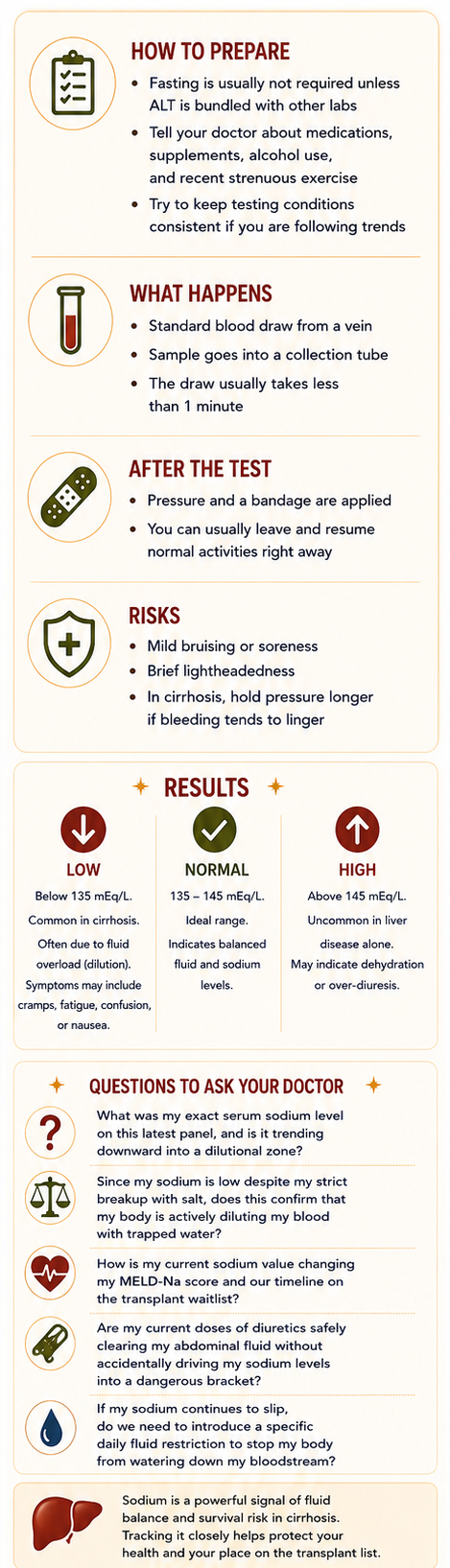
Ensuring an accurate diagnostic baseline for your sodium test requires following standard laboratory preparation guidelines:
Confirm Fasting Panel Layouts: While a standalone sodium test does not strictly require an empty stomach, it is almost always wrapped into blood draws alongside a fasting Comprehensive Metabolic Panel (CMP), requiring zero calories for 8 to 12 hours before entering the lab [1].
Maintain Steady and Uniform Hydration: Do not try to "fix" your low sodium by severely restricting water right before the draw, or over-consuming fluid, as sudden shifts in water intake will artificially distort your baseline concentration percentages [1, 3].
Disclose Specialized Medication Doses: Provide an exact list of your daily water pills, as the specific timing and dose of your diuretics are the primary drivers behind shifting sodium metrics in liver care [4, 5].
What Happens During and After
The blood collection follows standard, low-risk laboratory venipuncture protocols [3]. A phlebotomist applies a flexible tourniquet to your upper arm, thoroughly treats the skin surface with an antiseptic wipe, and inserts a small needle into a vein near the bend of your elbow to collect a single vial of blood in under a minute [3].
Once the collection is finished, a small gauze pad is pressed firmly over the puncture site and sealed with a standard adhesive bandage [3]. You can leave the laboratory facility immediately, drive yourself home, eat a normal meal to break your fast, and go about your daily routine without any required downtime [3].
Risks and What to Watch For
The physical risks of a standard electrolyte blood draw are minor and resolve quickly on their own [3]. You may experience a brief pinch from the needle, notice a tiny pinpoint bruise at the draw site, or feel a temporary wave of lightheadedness from morning fasting [3].
However, because a cirrhotic liver struggles to manufacture the essential proteins required for blood clotting—a structural vulnerability heavily compounded by the low platelet counts common in portal hypertension—careful post-care is mandatory [2, 5]. Ensure you apply firm, continuous manual pressure to the gauze pad for several minutes after the needle is removed to effectively prevent prolonged bleeding, localized hematomas, or deep bruising under the skin [2, 5].
What Results May Mean
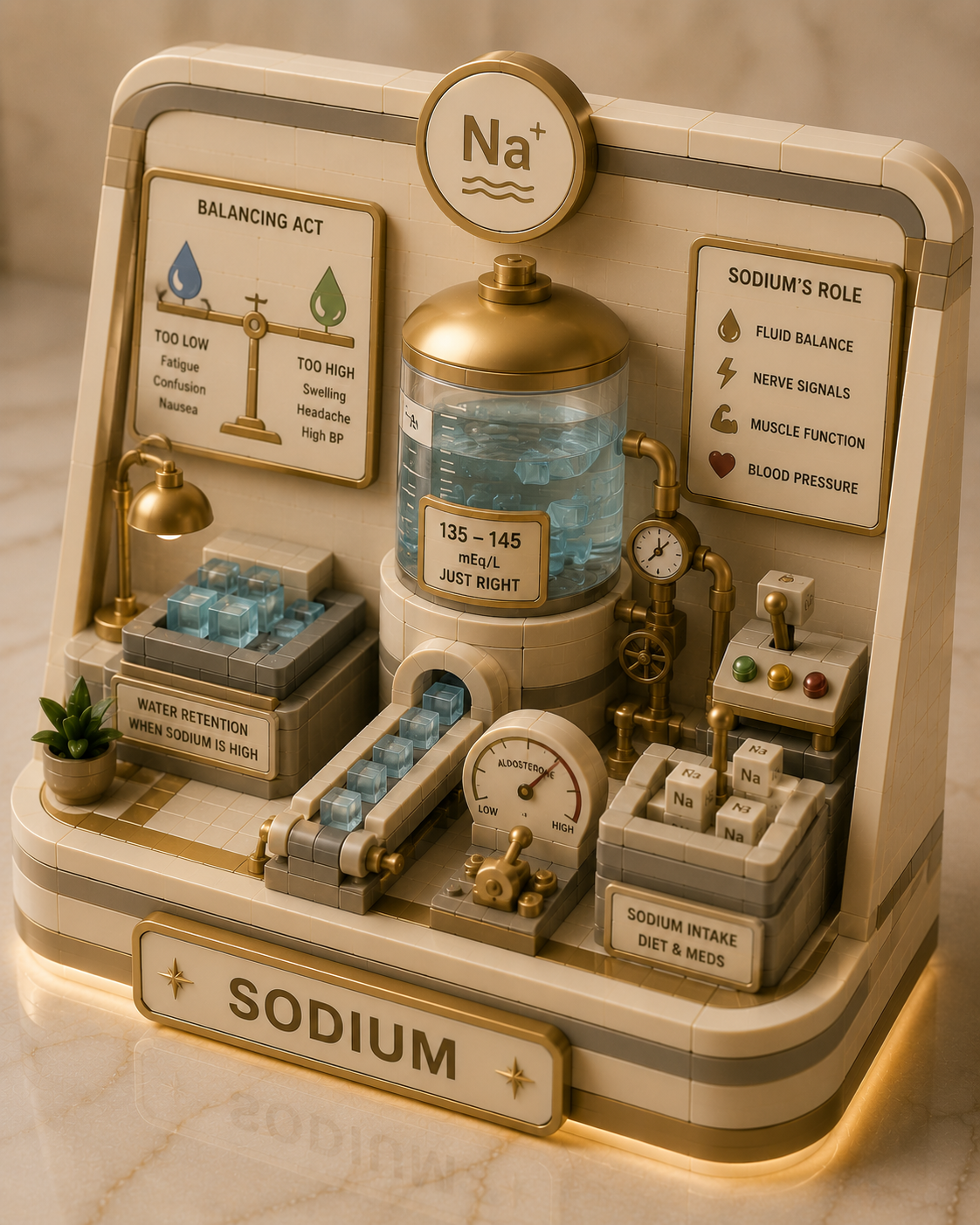
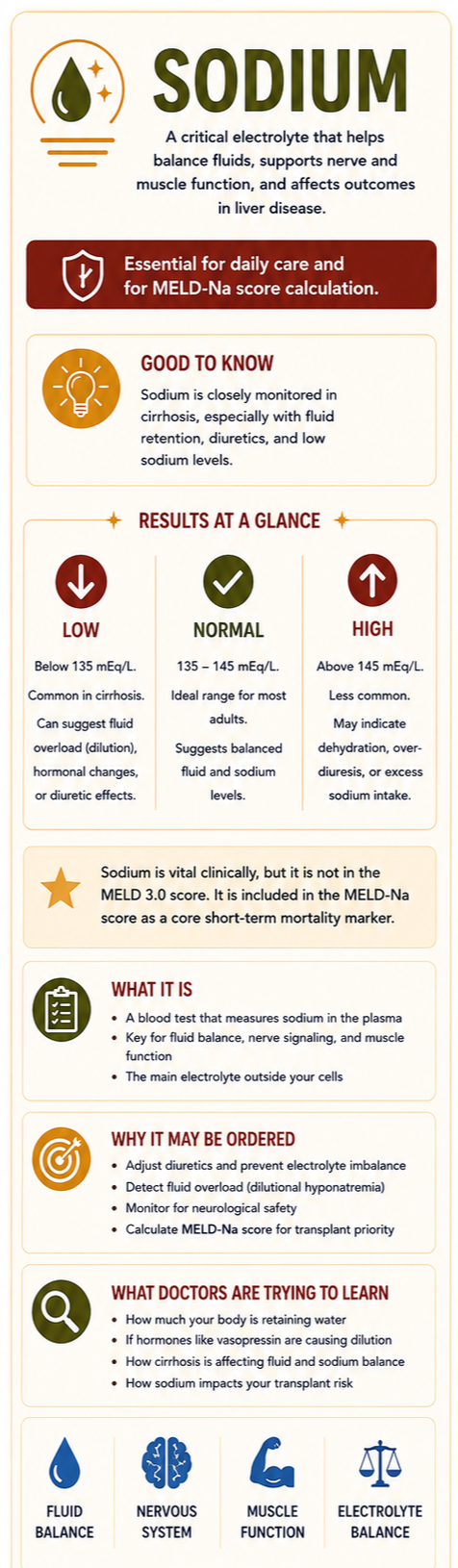
Standard reference ranges for adult serum sodium tightly hold between 135 and 145 mEq/L (milliequivalents per liter)[1].
Stable Normal Baseline (135 to 145 mEq/L): Falling cleanly within this reference range confirms that your body's water-to-salt ratio is well-regulated, your water pills are processing safely, and your hormone pathways are successfully maintaining equilibrium [2, 4].
Hyponatremia (Low Sodium <135 mEq/L): This is an incredibly common, high-stakes signature of advanced cirrhosis [2]. It warns doctors that your blood is actively facing dilutional hemodilution from trapped water [2, 5]. Mild drops (130–134) require careful fluid monitoring, while severe drops below 130 represent a critical emergency where water threatens to swell brain tissue, driving up your MELD priority points on the transplant list [4, 5].
Hypernatremia (High Sodium >145 mEq/L): High readings point to an over-concentration of minerals [1]. In liver care, this is rare unless a patient is facing severe, acute dehydration, or if an overdose of diuretic medications has flushed far too much pure water out of the body while leaving the salt behind [1, 5].
Questions to Ask Your Doctor
To take an active role in your care and confidently navigate your next clinical check-up, consider discussing these targeted questions with your medical team:
What was my exact serum sodium level on this latest panel, and is it trending downward into a dilutional zone [1, 3]?
Since my sodium is low despite my strict breakup with salt, does this confirm that my body is actively diluting my blood with trapped water [2, 5]?
How is my current sodium value changing my MELD-Na score and our timeline on the transplant waitlist [4]?
Are my current doses of diuretics safely clearing my abdominal fluid without accidentally driving my sodium levels into a dangerous bracket [5]?
If my sodium continues to slip, do we need to introduce a specific daily fluid restriction to stop my body from watering down my bloodstream [2, 5]?
Sources
[1] : Mayo Clinic Laboratories
Test Catalog: Mayo Clinic Laboratories Sodium Test Catalog & Reference Standards
Setup Guide: Mayo Clinic Laboratories Setup, Fasting, and Configuration Guide
[2]: World Journal of Gastroenterology
Pathophysiology Portal: World Journal of Gastroenterology Pathophysiology Review
Database Entry: PubMed Database Entry for Dilutional Hyponatremia Review
Lab Tests: MedlinePlus Comprehensive Metabolic Panel (CMP) Directory
Encyclopedia: MedlinePlus Medical Encyclopedia Venipuncture Protocols
[5] : The American Journal of Gastroenterology
