
Albumin
@diagnosis_cirrhosis 🧪📉 Albumin is not just “another lab” on your chart 👀📋 It is one of the main proteins made by the liver 🏭🧬 So when albumin starts dropping ⬇️ it can be a sign your liver is not working as well as it should ⚠️ Yes, albumin helps keep fluid where it belongs 💧➡️🩸 And when it gets low, fluid can start leaking into places it should not 😵💫 That can mean: ⚠️ swelling in the legs or feet 🦵 ⚠️ bloating 🤰 ⚠️ ascites 💧 ⚠️ feeling more run down or fragile 😞 But albumin is about more than fluid 👇 It also helps show how much liver function and support your body still has 🧠🫀🩸 That is part of why labs matter so much in advanced liver disease, cirrhosis, and liver failure 📊🩺 And it is also why newer scoring models like MELD 3.0 pay attention to albumin too 📉🧮 Your labs are not just numbers. They are clues 🕵️♀️✨ They help show what your liver is still able to do… and where it may be struggling 💛 Common causes of cirrhosis and chronic liver disease can include: alcohol-related liver disease 🚫🍷 fatty liver disease / NAFLD / MASLD 🍩🧈 NASH / MASH 🔥 hepatitis B 🦠 hepatitis C 🦠 autoimmune hepatitis 🛡️ primary biliary cholangitis 🧬 primary sclerosing cholangitis 🧬 hemochromatosis ⚙️ Wilson’s disease 🪙 alpha-1 antitrypsin deficiency 🧩 drug-induced liver injury 💊 and cryptogenic cirrhosis ❓ If you are living with cirrhosis, fibrosis, fatty liver, hepatitis, or unexplained symptoms, learning your labs matters 💡📚 Talk to your doctor or hepatologist if something feels off 👩⚕️👨⚕️🩺 #bloodwork #patienteducation #medschool #nursetok #liverhealth ♬ original sound - diagnosis cirrhosis
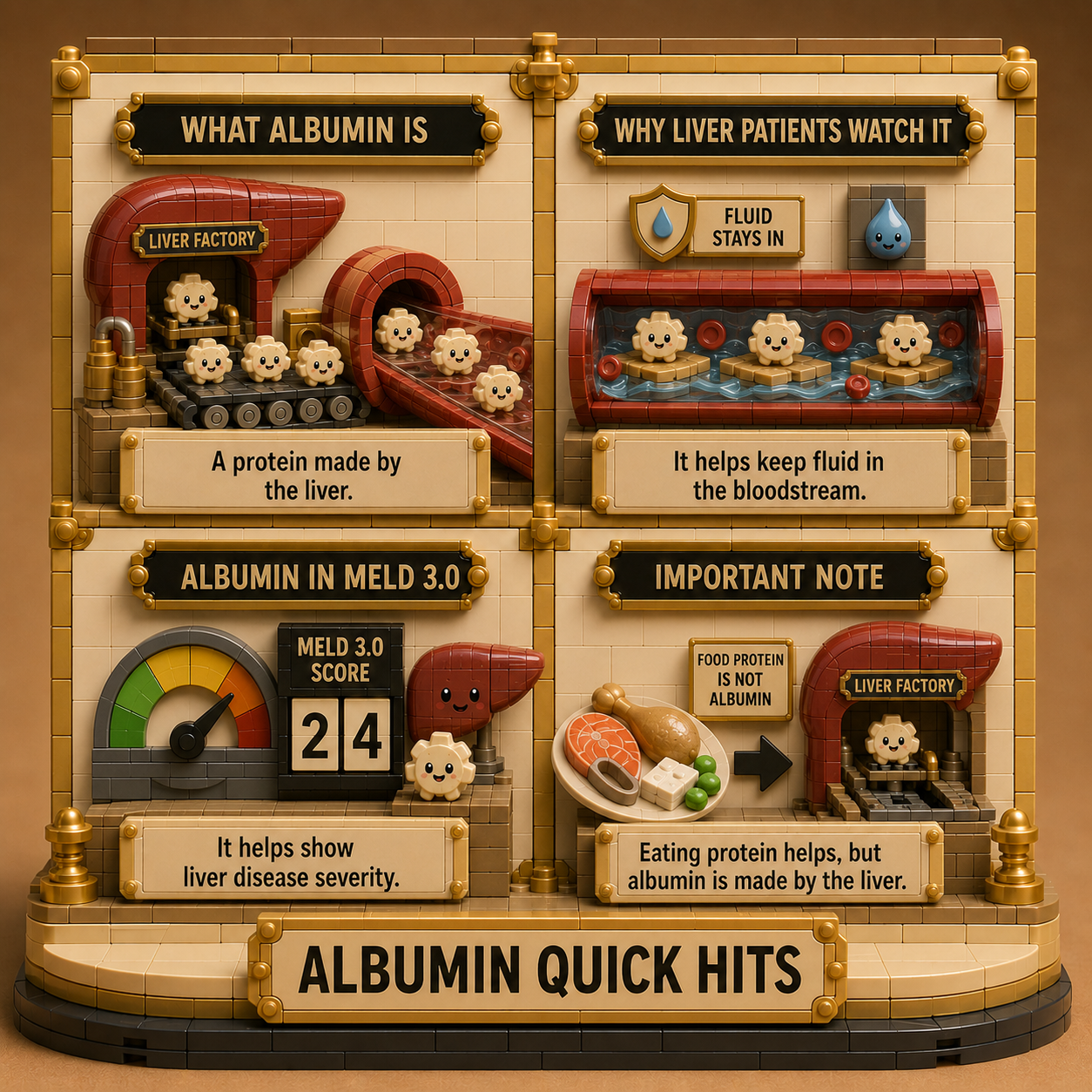
Top 4 Need to Knows:
Important Medical Disclaimer: I am Angie, a cirrhosis patient sharing my personal lifestyle, nutrition, and mindset journey. I am a data aggregator and community builder, not a licensed medical professional, doctor, or dietitian. Content on diagnosiscirrhosis.com is based solely on my personal experience living with advanced liver disease and is intended for informational and educational purposes only. It does not constitute medical advice or a substitute for professional medical care. Always follow the recommendations of your own healthcare team and consult your hepatologist or physician before changing your diet, medication, or lifestyle routine.
My Experience with It
By Angie from @Diagnosis_Cirrhosis on TikTok
Albumin and I are relatively new friends.
It entered the vernacular before it was fluent in my newly acquired vascular vocabulary. I knew it was one of the numbers people cared about. I knew it was tied to how sick I was. I knew mine was bad.
But I did not yet understand that albumin was not just “protein” in the casual, chicken-breast-and-Greek-yogurt sense. I did not understand that it is one of the clearest windows into whether my liver was still able to manufacture what my body needed.
My first albumin was somewhere around 1.8 or 1.9, when the lower end of the standard normal range usually hangs around 3.4.So, in other words, not exactly a number that was out here inspiring confidence.
@diagnosis_cirrhosis 🧪🧬 What does albumin actually tell you? Why is it so important in cirrhosis? Albumin is one of the most important proteins your liver makes. It is not something you eat directly. It is not something your liver stores. It is a protein your liver manufactures using amino acids from the protein in your diet. So albumin reflects two things at once: 🏭 whether your liver can still manufacture proteins your body needs 🍽️ whether your body has the nutrition and building blocks to make them If you have ever wondered what albumin means in liver disease, why albumin is low with cirrhosis, can albumin improve during recompensation, what foods help albumin, or why albumin is included in MELD 3.0, this is the basic idea: Albumin is one of the clearest clues about liver function, nutrition, inflammation, fluid balance, and reserve. — 🏭 Think of your liver like a factory. Protein from food is broken down into amino acids. Those amino acids travel to your liver. Your liver assembles them into albumin and releases albumin into your bloodstream. If the factory has enough raw materials but damaged machinery, production can slow. If the machinery works but there are not enough raw materials, production can slow too. That is why albumin is influenced by both liver function and nutrition. — 💧 Why is albumin important? Most people hear “low protein.” But albumin does far more than that. Albumin helps keep fluid inside your blood vessels instead of leaking into surrounding tissues. When albumin is low, people may be more likely to develop or worsen: 💧 ascites 🦵 leg swelling / edema 🫁 fluid around the lungs in some cases Albumin also transports medications, hormones, fatty acids, minerals, and other important substances through the bloodstream. It is one of the hardest-working proteins your liver makes. — 📈 What does albumin tell doctors during recovery or recompensation? Recompensation means complications from decompensated cirrhosis have become controlled again. Not cured. Not scar-free. But more stable. If the underlying liver injury is controlled and the body stabilizes, albumin may slowly rise over time. Not because scar tissue disappeared. Because the remaining working liver tissue may be functioning better. An improving albumin trend may suggest: ✅ better liver synthetic function ✅ improved nutrition ✅ less inflammation ✅ better physiologic reserve ✅ more stable fluid balance Albumin usually does not change overnight. It has a half-life of about three weeks, so meaningful changes often take weeks to months. That is why the trend matters more than one isolated number. — 🥩 Can diet improve albumin? Nutrition matters. Your liver cannot manufacture albumin without amino acids. Adequate protein and calories give your body the building blocks it needs. But eating more protein does not automatically raise albumin. If liver synthetic function is reduced, inflammation is high, infection is present, kidney disease is causing protein loss, fluid overload is diluting labs, or total calorie intake is too low, albumin may stay low. So albumin is not just a nutrition score. It is a whole-body clue. — 🧮 Why is albumin in MELD 3.0? Older MELD and MELD-Na formulas did not include albumin. MELD 3.0 includes bilirubin, INR, creatinine, sodium, albumin, and sex. Albumin was added because it improves prediction of short-term mortality and transplant urgency. Low albumin can reflect reduced liver synthetic function, poor reserve, inflammation, nutrition issues, and fluid balance problems. 🧬 Chronic liver disease, liver damage, fibrosis, cirrhosis, and fatty liver disease may result from autoimmune hepatitis 🔥 fatty liver disease / MASLD / NAFLD / MASH / NASH 🍩 alcohol-related liver disease 🚫🍷 hepatitis B 🦠 hepatitis C 🦠 PBC 🧬 PSC 🧬 hemochromatosis ⚙️ Wilson’s disease 🪙 alpha-1 antitrypsin deficiency 🧩 drug-induced liver injury 💊 or many other liver diseases. #livehighlights #tiktoklive #liverdisease #liverhealth #bloodwork ♬ Coastline Drive - Nick Petrov
One of the stranger memories from those early days is how many doctors looked directly at me and said some version of:
“You will never be north of 3.0 again.”
Casually.
As if they were telling me the soup of the day.
And to be fair, they had reasons. At that point, my liver was not exactly submitting strong evidence in its own defense. But albumin is also one of those labs that people understandably misunderstand, because it sounds like eating more protein should fix it quickly.
And listen, protein intake matters. Nutrition matters. Preserving muscle matters. Please do not hear me saying otherwise.
But eating chicken breast does not immediately march into your bloodstream wearing a little albumin costume. That distinction matters because it keeps people from blaming themselves when albumin does not bounce back just because they are “doing everything right.” Yes, nutrition is part of the story. It is not the whole mechanism.
In my case, I have been incredibly fortunate. The number doctors warned me might never get above a 3 eventually climbed. Through stabilization, medication, time, and massive lifestyle changes, my albumin is recently north of 4.0.
For someone who started this journey with a MELD score around 30, that is not a small thing.
But it was not quick. It was not immediate. It was not a neat little reward sticker for eating enough protein.
It took a long, long time.
And even now, I try to remember that a 4 is not a guaranteed forever 4. Albumin can improve, but it can also move with illness, inflammation, fluid shifts, nutrition, kidney issues, and changes in liver status.
Why Albumin Matters in MELD 3.0
Albumin matters in MELD 3.0 because it helps show something bilirubin, INR, creatinine, and sodium do not fully capture on their own: whether the liver is still able to manufacture one of the major proteins the body depends on to keep fluid where it belongs [1].

The Correction of a Historical Blind Spot
For decades, the traditional MELD and MELD-Na scores left albumin out of the core mathematical formula [4]. However, transplant committees rolled out MELD 3.0 specifically to integrate albumin as an independent variable to predict short-term mortality with high precision [4].
An Objective Measure of Survival: When a liver enters advanced, end-stage failure, its cells lose the physical capability to manufacture proteins [2]. Because a drop in serum albumin directly correlates with an exponential increase in 90-day mortality risks, your exact albumin number is plugged into the formula to ensure your waitlist priority matches your actual degree of sickness [4, 5].
Leveling the Equity Playing Field: Clinical data proved that leaving albumin out of the old formulas disproportionately penalized female patients and individuals with severe, chronic wasting [4]. Integrating albumin into the MELD 3.0 score ensures that a patient's true physical fragility and fluid retention risks are accurately calculated, protecting critically ill patients from being skipped over on the national transplant list [4].
What If Albumin Were Excluded?
The Illusion of Stability: A patient with advanced cirrhosis might show a deceptively low or stable creatinine number because their muscle mass has completely wasted away [2, 4]. Without albumin, the scoring system would look at that low creatinine and falsely suggest they are stable [4]. Including albumin ensures that the system catches the underlying reality of progressive liver failure, accurately capturing their short-term mortality risk [4, 5].
Read more about what else is included in the MELD 3.0:
Key Takeaways:
Find Out More
What the Procedure Is
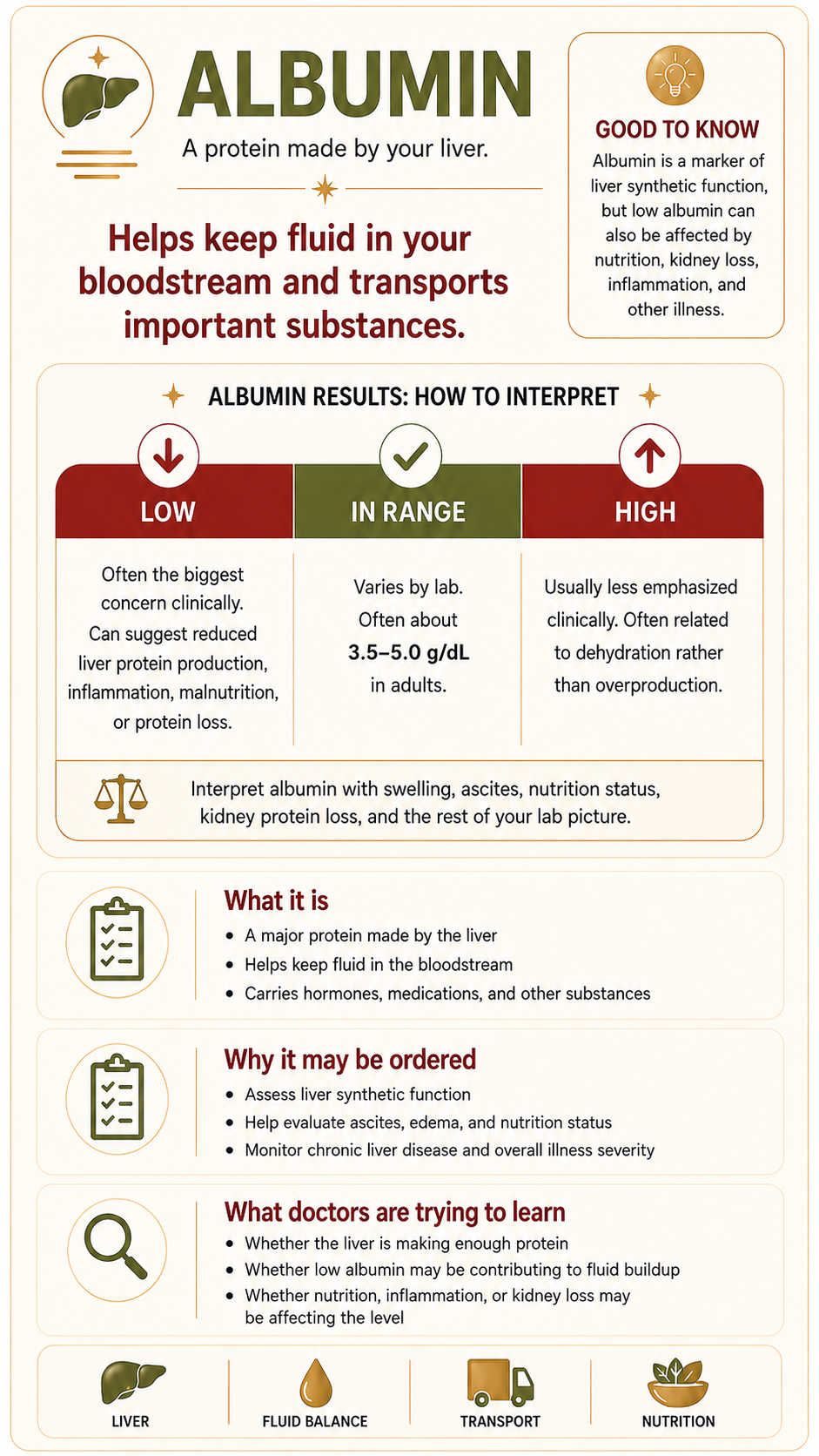
The serum albumin test is a routine venipuncture blood draw that measures the exact concentration of this single, massive protein circulating in your blood plasma [3]. In clinical human biology, albumin represents a monumental physiological pillar:
The Dominant Blood Protein: Albumin is the most abundant protein in human blood plasma, typically making up roughly 50% to 60% of your body's entire circulating protein profile [1, 3].
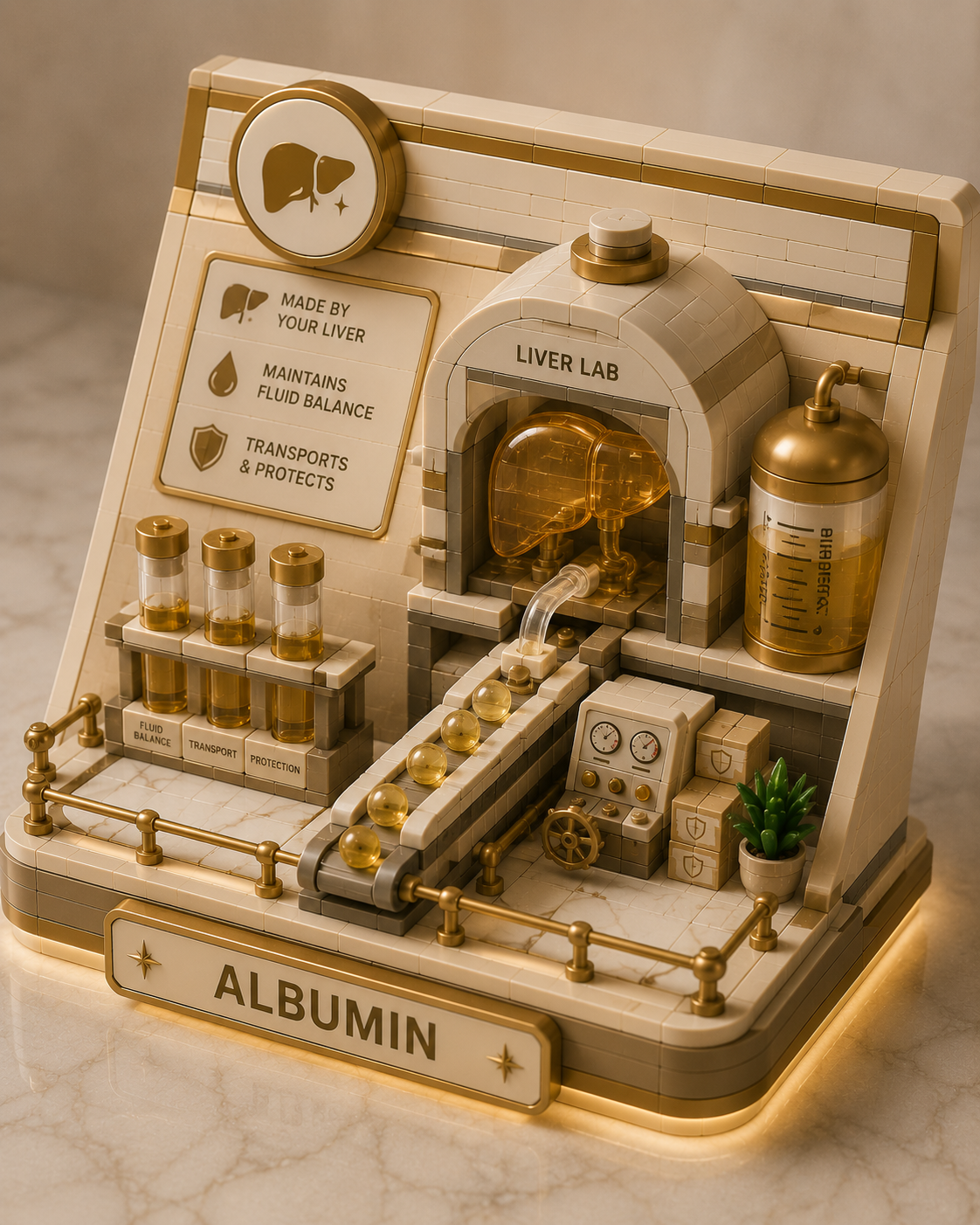
The Liver's Exclusive Creation: This protein is manufactured exclusively by healthy liver cells, called hepatocytes [2, 3]. It is dumped directly into the vascular highway to perform two vital systemic jobs: transporting vital molecules and regulating oncotic fluid pressure [3, 5].
Why This Procedure May Be Recommended
Hepatologists and clinical teams monitor albumin levels with intense frequency to track the long-term manufacturing strength and fluid boundaries of your body [2, 4]. A physician will utilize this marker to:
Evaluate Real-Time Synthetic Function: Tracking albumin provides an undisputed look at your liver's remaining capability to synthesize essential biological blocks [2].
Gauge the Risk of Ascites and Edema: Lower albumin levels weaken your blood's fluid boundaries; tracking this score helps doctors forecast when fluid is likely to start leaking into your tissues [5].
Monitor Nutritional and Wasting Baselines: Advanced cirrhosis destroys your body's ability to process proteins; tracking albumin serves as a sensitive timeline for sarcopenia, or severe muscle wasting, and malnutrition [4].
Calculate MELD 3.0 Allocation Ranks: Continuous tracking of albumin is mandatory to run the updated mathematical formulas that dictate your exact priority position on the national transplant waitlist [4].
What Doctors Are Trying to Learn
When interpreting your albumin levels, a physician is investigating Hepatic Ribosomal Translation Efficiency and Plasma Colloid Oncotic Pressure [2, 5]. This solves the exact medical mystery of why this "knight in shining armor" protein rules the roost [1].
Doctors look at albumin to judge a force called colloid oncotic pressure—the microscopic magnetic pull that keeps water locked inside your blood vessels [3, 5].
Think of albumin molecules like tiny, biological sponges floating in your blood stream [3]. Because they are large, they cannot squeeze through the microscopic walls of your capillaries [3]. Their constant presence inside your veins creates a strong chemical pull that sucks water inward, keeping your blood volume perfectly balanced [3, 5].
When advanced cirrhosis destroys your liver's protein assembly lines, your Serum Albumin drops [2]. Suddenly, your blood stream loses its magnetic sponge power, and raw water begins to escape through your vessel walls [5]. Gravity pulls this loose fluid into your ankles, which is edema, or leaks it directly into your abdominal cavity, triggering a massive accumulation of ascites fluid [5]. Doctors analyze your albumin numbers to calculate this tipping point, helping them determine when to adjust your diuretics or order a therapeutic paracentesis, or fluid tap, to keep your body safely balanced [5].
How to Prepare
Ensuring an accurate diagnostic baseline for your albumin test requires following standard laboratory preparation guidelines:
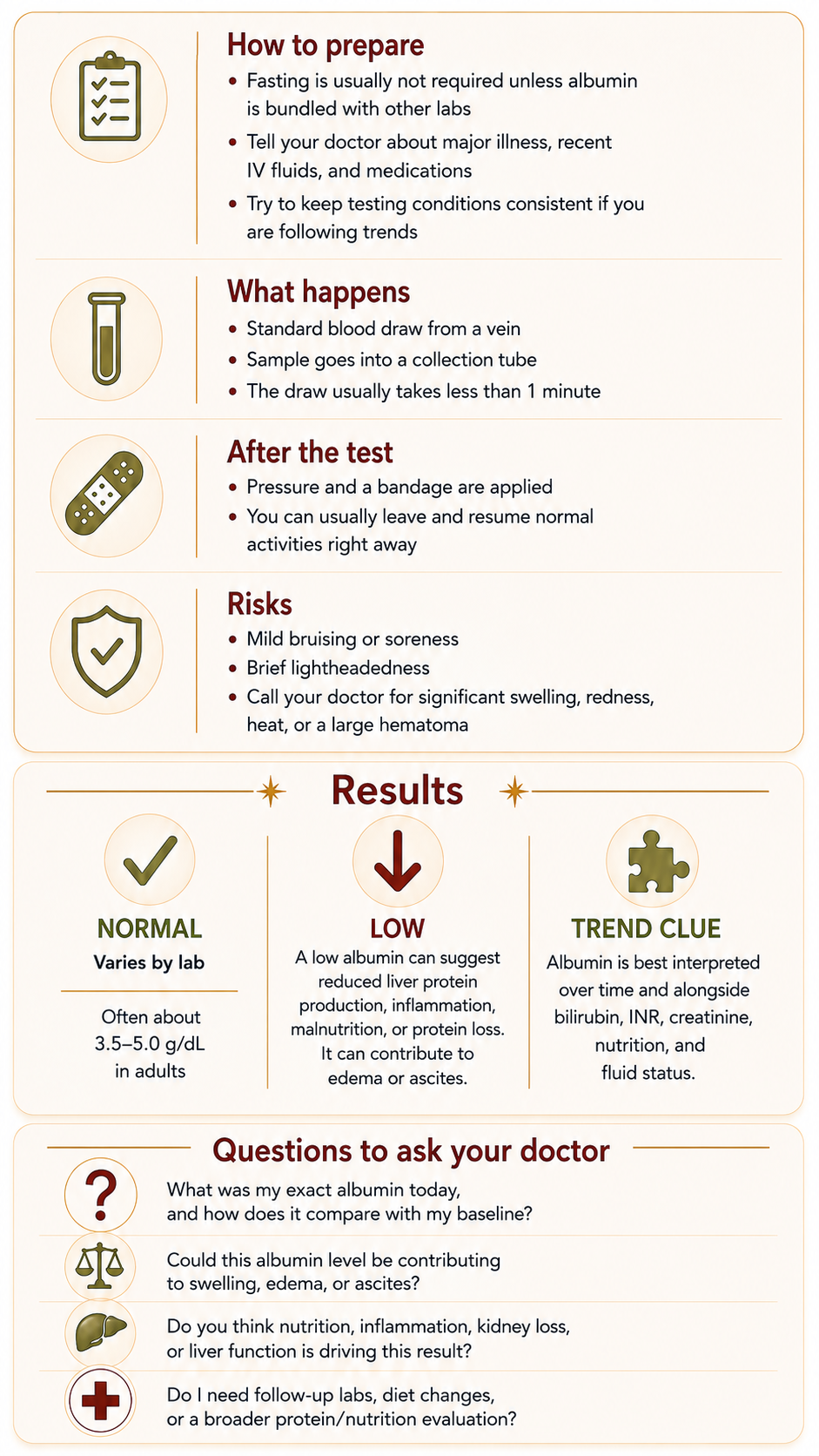
Confirm Fasting Panel Layouts: While a standalone albumin test does not strictly require an empty stomach, it is routinely bundled into blood draws alongside a fasting Comprehensive Metabolic Panel, or CMP, or Liver Function Test, or LFT, requiring zero calories for 8 to 12 hours before entering the lab [1].
Maintain Steady and Uniform Hydration: Do not severely restrict or over-consume water before your blood test; entering the lab severely dehydrated reduces your blood's liquid volume, artificially concentrating your sample and making a low, dangerous albumin level appear deceptively normal on your chart [1, 3].
Disclose Specialized IV Treatments: Inform your laboratory technician if you have recently received an intravenous infusion of human albumin or blood products, as these temporary interventions flood your system with donor proteins and mask your liver's true underlying manufacturing baseline [4, 5].
What Happens During and After It
The blood collection follows standard, low-risk laboratory venipuncture protocols [3]. A phlebotomist applies a flexible tourniquet to your upper arm, thoroughly treats the skin surface with an antiseptic wipe, and inserts a small needle into a vein near the bend of your elbow to collect a single vial of blood in under a minute [3].
Once the collection is finished, a small gauze pad is pressed firmly over the puncture site and sealed with a standard adhesive bandage [3]. You can leave the laboratory facility immediately, drive yourself home, eat a normal meal, and go about your daily routine without any required downtime [3].
Risks and What to Watch For
An albumin blood test carries an exceptionally low profile for clinical risk [1, 5]. Minor localized issues are temporary and may include [5]:
Slight bruising or light swelling at the exact point of the needle stick.
Brief dizziness or a mild vasovagal reaction during the active draw.
Complications to note: While vanishingly rare, if you experience spreading redness, intense heat, or throbbing pain around the vein puncture, contact your care team immediately to rule out localized infection [5].
What Results May Mean
While exact reference intervals vary slightly depending on the specific equipment your hospital or lab uses, standard normal ranges for serum albumin generally fall between 3.4 and 5.4 grams per deciliter (g/dL) [1, 2].
Normal Range (3.4 to 5.4 g/dL): Indicates that your liver possesses an adequate volume of healthy, unscarred parenchymal cells to synthesize vital proteins and maintain proper blood volume distribution [2, 3].
Elevated Levels (Above 5.4 g/dL): Are almost never caused by a hyper-functioning liver; instead, high albumin is a classic indicator of severe systemic dehydration [1, 2].
Low Levels / Hypoalbuminemia (Below 3.4 g/dL): Signal that the liver's manufacturing plant is falling behind due to structural damage [2, 4].
The Diet vs. Liver Reality: A common misconception among patients is that a low albumin level can be quickly fixed simply by eating more lean steaks or drinking protein shakes. In consensus guidelines published in the Journal of Hepatology, experts emphasize that in advanced cirrhosis, the bottleneck isn't a lack of dietary protein components coming in; it is that the liver's structural factory is heavily scarred and physically lacks the functional machinery to turn those amino acids into albumin [3]. When numbers drop to critical levels like 1.8 or 1.9, the blood loses its oncotic pressure, causing fluid to leak directly into the abdomen (ascites) or legs [1, 3].
Questions to Ask Your Doctor
To help track your personal baseline trends and advocate for your care at your next clinical visit, consider bringing these specific questions to your provider:
What was my exact albumin number today, and how does it compare to my baseline when I was first diagnosed?
Given that my albumin dropped/stalled, what does this tell us about the current structural factory capacity and synthetic function of my liver?
How is my direct albumin number interacting with my calculated globulin levels on my total protein panel?
Are my physical symptoms, like sudden ankle swelling or abdominal tightness, directly tied to my current albumin level dropping?
What lifestyle steps, medications, or monitoring can we implement to help support my liver tissue as we try to safely trend toward my target range?
Sources
[1] Mayo Clinic: Albumin Blood Test Overview, Clinical Application, and Fluid Regulation Roles
[2] Cleveland Clinic: Understanding Serum Albumin Levels, Total Protein Profiles, and Liver Health
[3] Journal of Hepatology: Official Journal of the EASL - Prognostic Significance of Albumin Synthesis and Portal Hypertension in Decompensated Cirrhosis
[4] The American Journal of Gastroenterology: ACG Clinical Guideline: Comprehensive Laboratory Assessment of Hepatic Function and Synthetic Staging
[5] National Institutes of Health (NIH) / MedlinePlus: Albumin Blood Test Protocol, Direct vs. Calculated Values, and Patient Safety
