
MELD 3.0
Important Medical Disclaimer: I am Angie, a cirrhosis patient sharing my personal lifestyle, nutrition, and mindset journey. I am a data aggregator and community builder, not a licensed medical professional, doctor, or dietitian. Content on diagnosiscirrhosis.com is based solely on my personal experience living with advanced liver disease and is intended for informational and educational purposes only. It does not constitute medical advice or a substitute for professional medical care. Always follow the recommendations of your own healthcare team and consult your hepatologist or physician before changing your diet, medication, or lifestyle routine.
@diagnosis_cirrhosis 💛 MELD might be the most misunderstood number in liver disease. Not because it’s complicated. Because almost everyone assumes it’s measuring the wrong thing. 🩸 When I was first diagnosed, I thought MELD was another blood test. It isn’t. Nobody draws a tube labeled “MELD.” It’s a calculation built from lab values that are probably already sitting on your blood work. If you’ve ever searched… ❓ What is a MELD score? ❓ What is MELD 3.0? ❓ How is MELD calculated? ❓ Why does creatinine matter so much? ❓ Does albumin affect MELD? ❓ Why are women scored differently in MELD 3.0? …you’re asking the exact same questions almost every cirrhosis patient asks. 💡 Here’s what I wish someone had told me from the beginning… MELD isn’t trying to measure how miserable you feel. 🚫 It isn’t a fatigue score. 🚫 It isn’t a pain score. 🚫 It isn’t a “how much has cirrhosis changed my life?” score. 📊 Instead, MELD estimates short-term mortality risk using objective lab values. That’s why someone can be living with… 💧 Ascites 🧠 Brain fog 😴 Crushing fatigue 💪 Muscle loss 🟡 Jaundice 😣 Itching 🦵 Muscle cramps …and still hear, 📈 “Your MELD is stable.” Those statements can both be true. They’re simply answering different questions. 🔬 So what actually goes into the calculation? 🟡 Bilirubin → How well your liver clears waste. 🩸 INR → How well your liver makes clotting proteins. 💧 Sodium → Changes in fluid balance that happen as liver disease progresses. 🚰 Creatinine → How well your kidneys are filtering, which becomes critically important in advanced cirrhosis. 🧪 Albumin → Added in MELD 3.0 to improve how accurately the model predicts risk. 👩 One of the biggest updates in MELD 3.0 addressed something many patients never hear about. Women naturally tend to have lower creatinine levels because, on average, they have less muscle mass. That can make kidney function appear better than it actually is. ⚖️ Including sex in the updated calculation helps improve the score’s accuracy and reduce that bias. ❤️ Even then… MELD is incredibly important. But it isn’t everything. 🚫 It doesn’t directly score hepatic encephalopathy. 🚫 It doesn’t measure how uncomfortable your ascites is. 🚫 It doesn’t know if you’ve lost muscle, can’t sleep, or had to rebuild your entire life around liver disease. 🩺 It’s one of the most important tools in hepatology. It just isn’t meant to tell your whole story. 🧬 Cirrhosis can develop from MASLD (fatty liver disease), MASH, autoimmune hepatitis 🔥, alcohol-related liver disease 🚫🍷, hepatitis B 🦠, hepatitis C 🦠, primary biliary cholangitis (PBC) 🟢, primary sclerosing cholangitis (PSC) 🔵, hemochromatosis ⚙️, Wilson disease 🪙, alpha-1 antitrypsin deficiency 🧩, drug-induced liver injury 💊, vascular liver disease 🫀, and many other chronic liver conditions. 👩⚕️👨⚕️🩺 Talk with your hepatologist about your MELD score, whether MELD 3.0 applies to you, and how your bilirubin, INR, sodium, creatinine, and albumin work together. Understanding what MELD does measure—and just as importantly, what it doesn’t—can make those conversations a whole lot less confusing. #liverhealth #livertransplant #cirrhosis #liverdisease #fattyliver ♬ original sound - World Hair
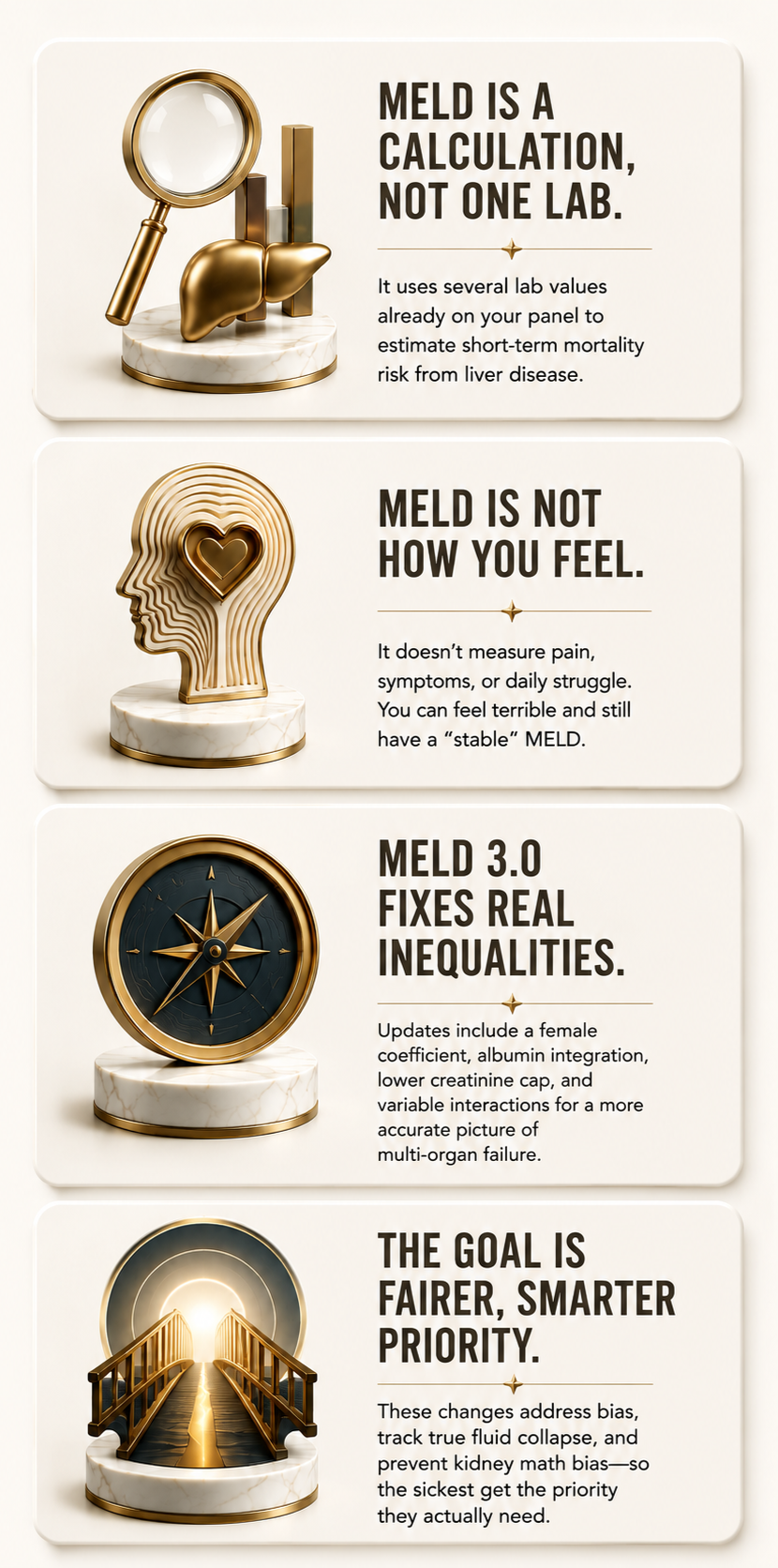
MELD is a lab-based scoring system
used to estimate short-term mortality risk
and help prioritize candidates for liver transplantation.

The Math of Mortality
By Angie from @diagnosis_cirrhosis on TikTok
MELD is one of those words that sounds like it should come with a laminated badge, a locked filing cabinet, and someone named Linda from transplant administration.
It does not sound like something you, an actual human being with laundry and symptoms and a portal password you hate, are supposed to understand.
There Are Former Iterations of MELD
MELD score. MELD-Na. MELD 3.0. Transplant score. Allocation score. Priority score.
MELD-NA was the previous version. It did not include albumin.
Fun fact: The original MELD score was developed in 2001 by researchers at the Mayo Clinic. Surprisingly, it wasn't created for organ transplants; it was designed to predict the short-term survival of patients undergoing a specific medical procedure called a TIPS (Transjugular Intrahepatic Portosystemic Shunt). Doctors quickly realized the formula was highly accurate at predicting 90-day mortality for all patients with advanced cirrhosis, prompting its broader adoption for liver transplant allocation.
It Is Not One Lab
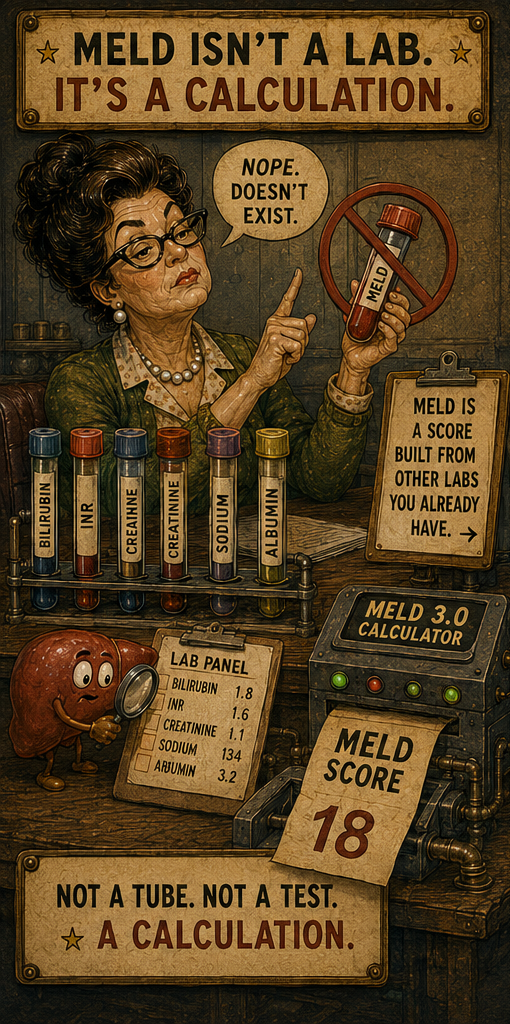
MELD is not one lab. It is not a single blood test. Nobody draws a tube labeled “MELD” and sends it down the chute. MELD is a calculation.
It is a score built from other numbers that are mostly already sitting on your lab panel, staring at you like they know something you do not.
It Does Not Measure Your Quality of Life
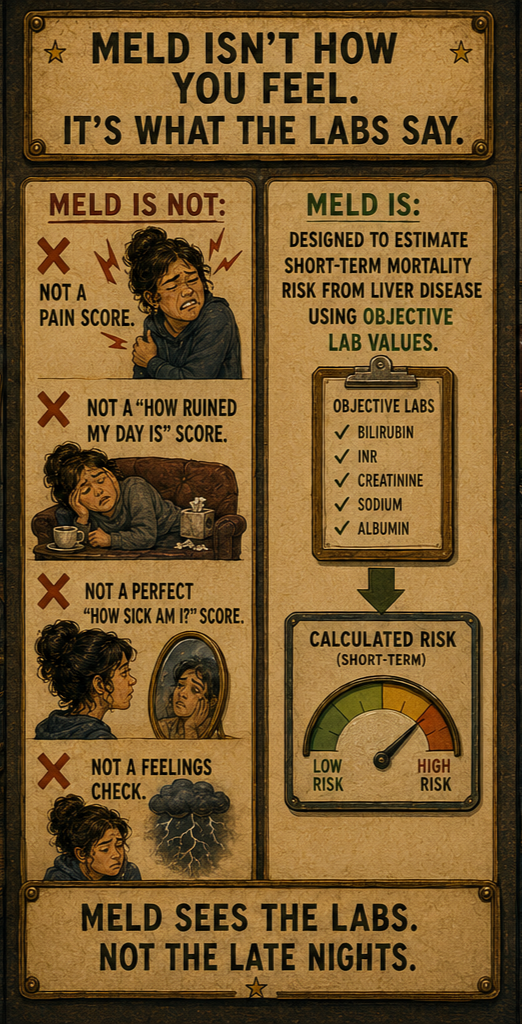
The biggest thing I wish I understood earlier is that MELD is not trying to measure how miserable you feel.
It is not a pain score. It is not a “how much has this disease ruined my day?” score.
MELD is specifically designed to estimate short-term mortality risk from liver disease using objective lab values.
That distinction matters because you can feel absolutely demolished and still have a MELD that does not look dramatic.
Stable can still feel like being trapped in a house that is technically not on fire anymore but still smells like smoke.
The evolution from the original MELD score to MELD 3.0 represents a high-stakes, data-driven update to the math governing liver transplantation [1, 2]. For over a decade, the medical community relied on a standard calculation that, while revolutionary, contained critical structural blind spots. MELD 3.0 updates the logarithmic formula to fix systemic inequalities and capture a more accurate picture of multi-organ failure [1].
Learn more about the portions of the MELD 3.0 score calculation:
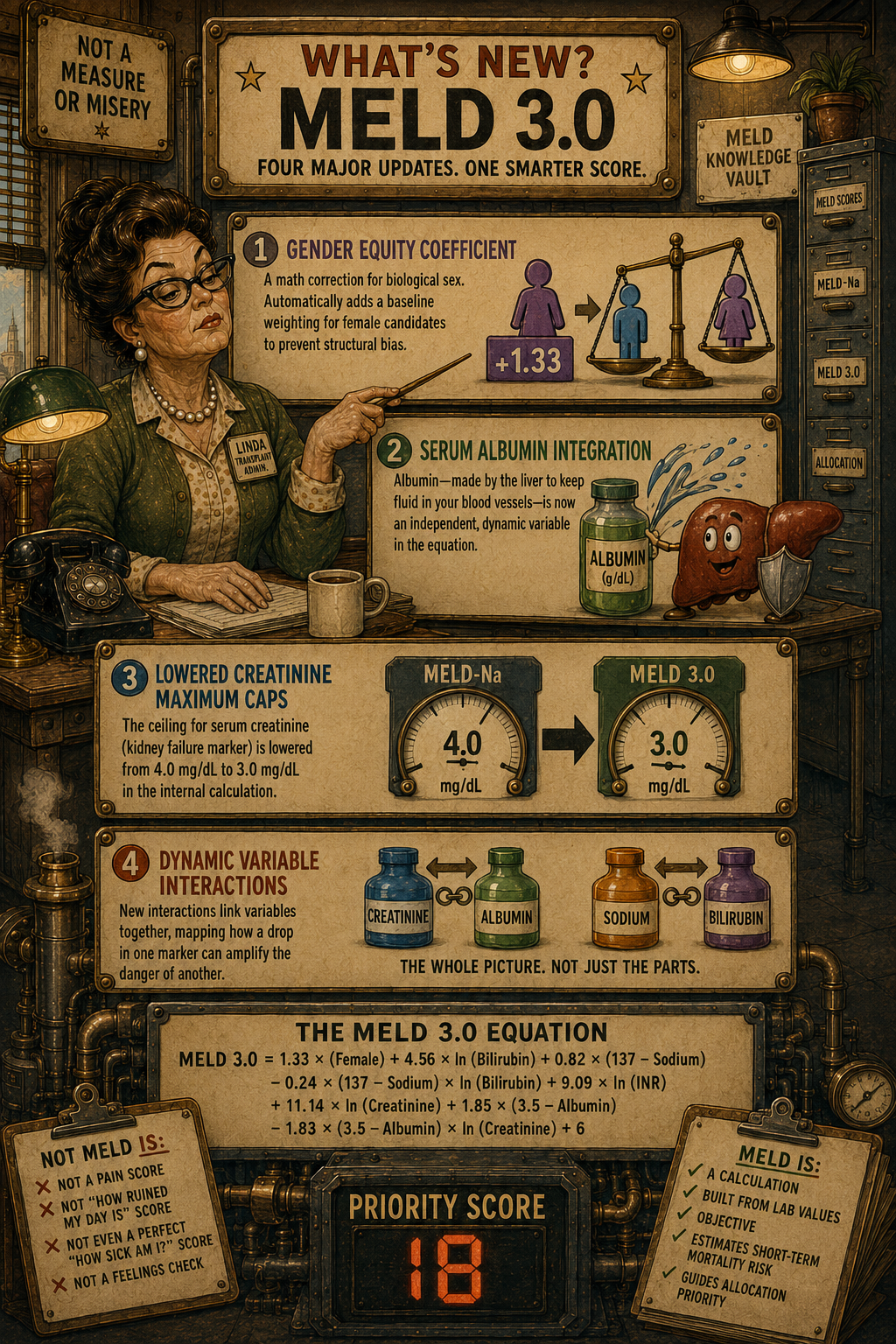
What’s New MELD 3.0 introduces three specific mathematical and variable updates to the calculation: [1]
The Gender Equity Coefficient: The updated formula applies a specific math correction to account for a patient’s biological sex. This variable automatically adds a baseline weighting coefficient (+1.33 points) for female candidates to prevent them from being structurally penalized by standard lab measurements.
The Serum Albumin Integration: albumin—a primary protein manufactured by the liver to keep fluid from leaking out of blood vessels—is now explicitly woven into the equation as an independent, dynamic variable.
Lowered Creatinine Maximum Caps: The mathematical ceiling for serum creatinine (the kidney failure marker) has been lowered from 4.0 mg/dL down to 3.0 mg/dL within the internal calculation.
Dynamic Variable Interactions: The model introduces interactive terms that link variables together, specifically mapping the interplay between creatinine and albumin, as well as sodium and bilirubin. This accounts for how a drop in one marker severely amplifies the danger of another [1, 2].
Learn more about your MELD score:
Why It Matters These statistical adjustments address severe, real-world disparities in how organs were distributed:
Fixing the Muscle Mass Bias:
The original MELD score relied heavily on creatinine to measure kidney health. Because creatinine is a byproduct of muscle breakdown, women—who generally possess less muscle mass than men—frequently showed lower creatinine levels on paper despite having identical, severe kidney impairment.This statistical bias meant women routinely received lower MELD scores, experienced higher death rates while waiting on the list, and had a lower chance of receiving a transplant[1, 2]. The female sex variable directly levels this playing field.
Tracking the True Fluid Collapse:
Incorporating albumin provides an immediate, objective tracking metric for severe nutritional wasting (malnutrition) and fluid retention[1]. By pairing albumin with sodium, the score accurately identifies patients who are physically drowning in their own ascites fluid, even if their traditional blood-clotting markers appear temporarily stable.
Preventing the Kidney Math Bias: In the older MELD formula, once a patient's kidney failure caused their creatinine to hit 4.0 mg/dL, the calculation hit a hard limit. MELD 3.0 recognizes that severe kidney injury begins causing catastrophic systemic damage much earlier. Lowering the cap to 3.0 mg/dL ensures that early-stage kidney failure gives patients the appropriate priority boost on the waitlist before their entire body suffers irreversible shock [1].
The official legal and regulatory transition mandating all transplant clinics across the United States to collect and submit these expanded matrices was finalized by national policy updates [3]
Read about My Experience
Sources

The Validation Study: Kim, W. R., Mannalithara, A., Heimbach, J. K., Kamath, P. S., Asrani, S. S., Biggins, S. W., Wood, N. L., Gentry, S. E., & Kwong, A. J. (2021). MELD 3.0: The Model for End-Stage Liver Disease updated for the modern era. Gastroenterology, 161(6), 1887–1895. View in Gastroenterology Journal.
The Open Access Track: Kim, W. R., Mannalithara, A., Heimbach, J. K., Kamath, P. S., Asrani, S. S., Biggins, S. W., Wood, N. L., Gentry, S. E., & Kwong, A. J. (2021). MELD 3.0: The Model for End-stage Liver Disease Updated. National Institutes of Health PMC Archive, PMC8608337. Read Free via NIH PubMed Central.
The Regulatory Policy: Organ Procurement and Transplantation Network. (2023). Improving liver allocation: MELD, PELD, Status 1A, Status 1B policy. Health Resources and Services Administration. Review the Official OPTN Implementation Guidance.

It is incredibly easy to get sucked into the strange social shorthand of liver disease—treating your blood work like a daily sports scoreboard or sorting yourself into brackets based on your peak bilirubin levels. But a collection of numbers typed into an online calculator will never be able to measure the sheer amount of grit it takes to move through the day with muscle wasting, navigate the haze of brain fog, or wake up every morning to look uncertainty dead in the eyes.
A lower number is an excellent sign of stability, but it isn't an automated pass that means you're suddenly symptom-free or "not sick anymore." And a higher number isn't a failure—it's just your body's way of raising a flag so your medical team knows exactly when to step in with reinforcement. Don't let a four-letter acronym flatten your humanity.