
Fluid Restriction
Important Medical Disclaimer: I am Angie, a cirrhosis patient sharing my personal lifestyle, nutrition, and mindset journey. I am a data aggregator and community builder, not a licensed medical professional, doctor, or dietitian. Content on diagnosiscirrhosis.com is based solely on my personal experience living with advanced liver disease and is intended for informational and educational purposes only. It does not constitute medical advice or a substitute for professional medical care. Always follow the recommendations of your own healthcare team and consult your hepatologist or physician before changing your diet, medication, or lifestyle routine.
@diagnosis_cirrhosis 🚨💧 Fluid restriction with cirrhosis is NOT a suggestion… it’s a full-time job 😅📏 🎥 Live highlight 🎥 Ever wonder why fluid restriction is even a thing with cirrhosis? 🤔💧 It’s not for everyone—but when it’s part of the plan, it is INTENSE 😅 When the liver is struggling, pressure builds up (portal hypertension) 🩸⬆️ and the body starts holding onto salt 🧂 and water 💧 like a sponge This can lead to: 👉 Ascites (fluid buildup in the belly) 💧 👉 Hyponatremia (low sodium levels) ⚖️ And here’s the part people don’t always realize 👇 When sodium drops… it can make hepatic encephalopathy (HE) worse 🧠😵💫 → more confusion → more brain fog → more “what was I just doing??” moments 😅 So doctors might say: 👉 “Limit your fluids to X amount” 😬 to help keep sodium stable and prevent more fluid buildup But here’s the twist… 🌀 If you’re dealing with HE 🧠😵💫 tracking anything becomes a game of: “wait… did I already drink that?” 😅 So yes… I am out here using an abacus to track my fluids 🧮😂 Because: • Brain fog is REAL 🌫️ • Memory gaps are scary 🧠❓ • Counting ounces all day = a full-time job 😵💫 It is quite the COMBO 😅 💡 Quick breakdown: • Cirrhosis → Portal hypertension + fluid retention 💧 • Ascites risk → fluid leaking + buildup 💧 • Low sodium → can worsen HE/confusion 🧠💥 • Fluid restriction → helps manage balance ⚖️ • Me → 🧮 using an abacus because I literally can’t remember lunch 😂 📌 How people get here (for anyone searching): Fatty liver can progress over time ➡️ fibrosis ➡️ advanced fibrosis ➡️ cirrhosis 🔄 Common causes of cirrhosis and liver disease include: • Fatty liver 🍩 • Nonalcoholic fatty liver disease • NAFLD • Metabolic dysfunction associated steatotic liver disease • MASLD • Metabolic dysfunction associated steatohepatitis • MASH • Nonalcoholic steatohepatitis • NASH • Alcohol related liver disease 🚫🍷 • Hepatitis B 🦠 • Hepatitis C 🦠 • Autoimmune hepatitis 🛡️🔥 • Primary biliary cholangitis 🧬 • Primary sclerosing cholangitis 🧬 • Hemochromatosis ⚙️ • Wilson’s disease 🪙 • Alpha 1 antitrypsin deficiency 🧩 • Drug induced liver injury 💊 • Cryptogenic cirrhosis ❓ If you’re on a fluid restriction, talk to your doctor about your specific goals and “dry weight” 👩⚕️👨⚕️🩺 It’s definitely NOT one-size-fits-all And if you’ve ever lost track of your intake halfway through the day… you’re not alone 😅💚 ✨ Share your story on LIVE via the link below ⬇️ No matter what it is, you would be surprised at how many will be inspired and/or have a similar experience. Give it a shot! ⭐️💫 #livehighlights #tiktoklive #liverhealth #symptoms #watertok ♬ Radiant Streets - Nostalgia Waves
The Solution to Dilution
by Angie from @Diagnosis_Cirrhosis on TikTok
Water, Water Everywhere but Not Allowed to Drink It
Dont’ drink alcohol. Duh.
Don’t drink soda or juice. Ok fine.
Don’t drink water? …. WHAT?!?!
Don’t drink water?… Excuse me?
This was my exact response to the fluid restriction the first time it was imposed.
Fluid restriction is one of those cirrhosis instructions where, for the first time, I found myself wondering whether doctors maybe needed a few more years added to that MD runway.
For years, “drink more water” sits at the top of every health commandment like it was carved into stone somewhere between “eat vegetables” and “get more sleep.”
Then suddenly your sodium drops, your labs start looking dramatic, and the same body you were trying to hydrate becomes a suspicious little aquarium with rules.
Because with decompensated liver disease,fluid is not always about thirst. Sometimes it becomes math. Sometimes it becomes sodium. Sometimes it becomes a measuring cup, a countdown, and the cruel realization that even water can become conditional.[1]
What It Is
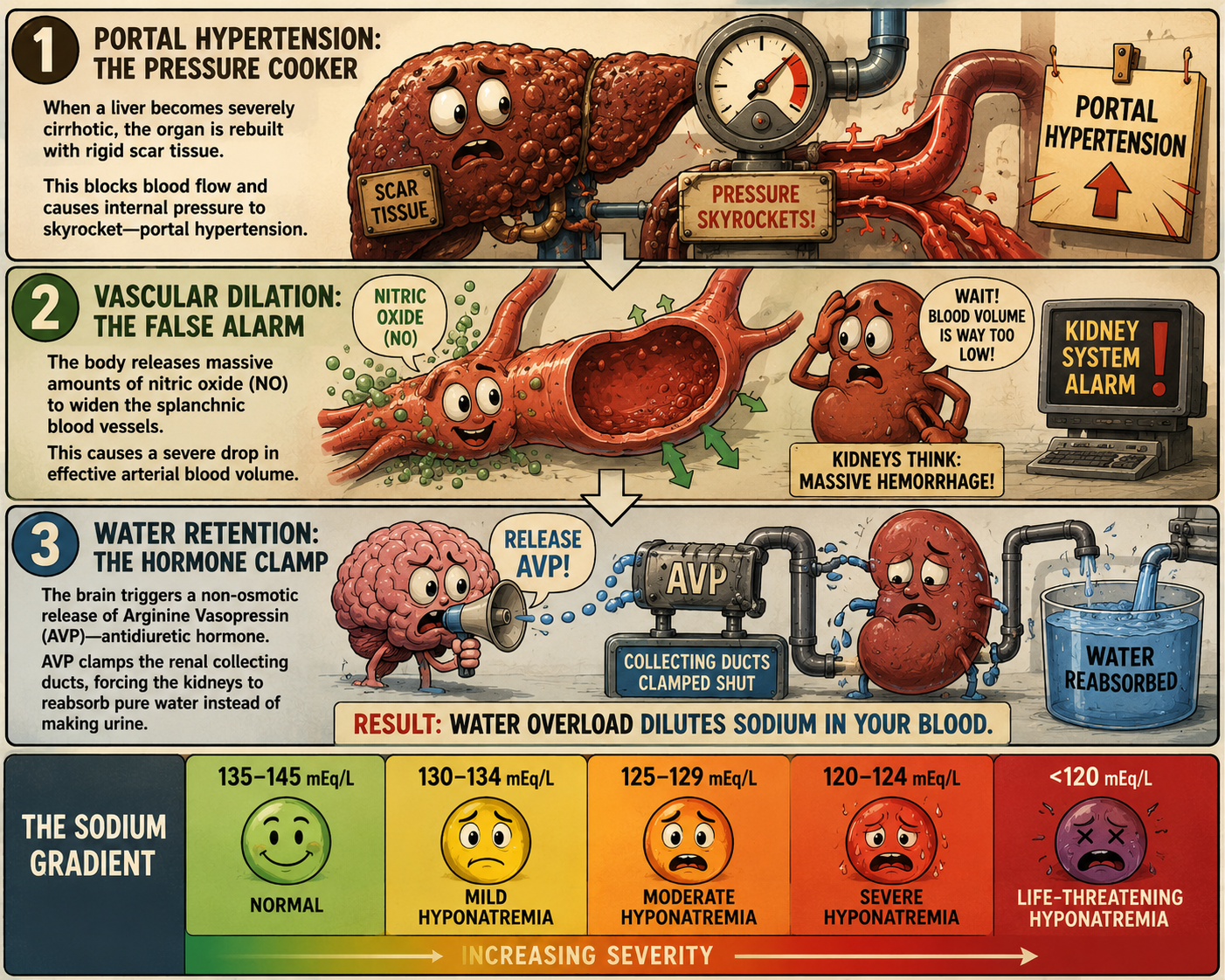
When a liver becomes severely cirrhotic, the physical layout of the organ collapses into rigid bands of scar tissue. This structural blockage forces internal blood pressure to skyrocket, a state known as portal hypertension…. click to learn more[1]
To cope with this pressure, the body releases massive amounts of nitric oxide to dilate the splanchnic blood vessels. As explained in the AASLD Liver Fellow Network Outpatient Management Profile, this massive widening of the blood vessels causes a severe drop in the body's effective arterial blood volume. The kidneys mistake this widened, lower-pressure system for a massive, life-threatening hemorrhage. [1]
To save you, the brain triggers a non-osmotic release of Arginine Vasopressin (AVP), also known as antidiuretic hormone. This hormone acts as a molecular clamp on the renal collecting ducts. Instead of filtering waste and creating urine, the kidneys are forced to reabsorb vast amounts of pure, solute-free water back into the bloodstream. This creates a severe water overload that actively dilutes the sodium in your blood, dropping your levels across a strict medical gradient:
Serum (blood) Sodium Levels
Normal Serum Sodium (135–145 mEq/L): The body's fluid and salt ratios are balanced. Even if a patient has severe ascites, Dr.Oracle Clinical Decision Support Data shows that no fluid restriction is needed.
Mild Hyponatremia (126–130 mEq/L): The blood is becoming mildly diluted. Doctors will closely monitor labs and look to optimize diuretic doses, but routine free-water restriction remains unnecessary.
Severe Dilutional Hyponatremia (125 mEq/L): The critical tipping point. The blood is dangerously diluted. According to the Gut Journal British Society of Gastroenterology Management Guidelines, a strict fluid restriction of 1 to 1.5 Liters per day must be implemented to stop the water from overwhelming the remaining salt in the bloodstream. [1, 2]
What It Feels Like
And this is where fluid restriction becomes exactly what it sounds like: water, water everywhere, but not a drop allowed to drink it.
If you ever need a literal, literary, lived-in moment, there is nothing purer than the point at which you are handed one little hospital jug and suddenly the most basic human need becomes a nice-to-have.
Thirst becomes inventory. Water becomes permission-based.
Your mouth is dry, your brain is panicking, and every ice chip starts looking like contraband. And everyone has a fluid restriction story. Everyone.
Bribing nurses for a few extra ice chips. Staring at the bathroom sink like it is a moral test. Wondering whether cupping a handful of water under fluorescent hospital lighting counts as desperation, rebellion, or simply the human body filing an appeal.
Because there is
On one side, you are terrified your body is going to dehydrate because every health message you have ever heard has trained you to believe water is always the answer.
On the other side, you are terrified the thirst will never stop. That this insatiable, primal, mouth-dry panic is now another thing your body has broken.
And somehow, even water has become conditional.
During the Standard Baseline (No Fluid Restriction), you feel:
A natural ability to manage thirst by drinking water, tea, or juices normally throughout the day.
The baseline physical comfort of knowing you can take your numerous liver medications with a full glass of water without tracking the ounces.
When labs slide below 125 mEq/L and a Severe Fluid Restriction is forced, you experience: [1]
A savage, unquenchable thirst driven by high levels of circulating vasopressin, leaving your mouth, tongue, and throat feeling completely parched and sticky.
An intense, hyper-focused anxiety regarding any liquid, where you find yourself constantly counting fluid ounces, checking ice cube sizes, and watching the clock.
The overwhelming physical frustration of having to swallow large, chalky lactulose doses or multiple diuretic pills with only a tiny, measured sip of water.
The Crossover Point: The Shift to Cellular Brain Swelling
The transition from a normal blood sodium level to a severe hyponatremic state marks a dangerous clinical "crossover point." This is the exact moment where the fluid overload stops being just a localized problem in your abdomen and turns into an active neurological crisis known as Hyponatremic Encephalopathy.
To visualize this crossover point, think of three concrete examples:
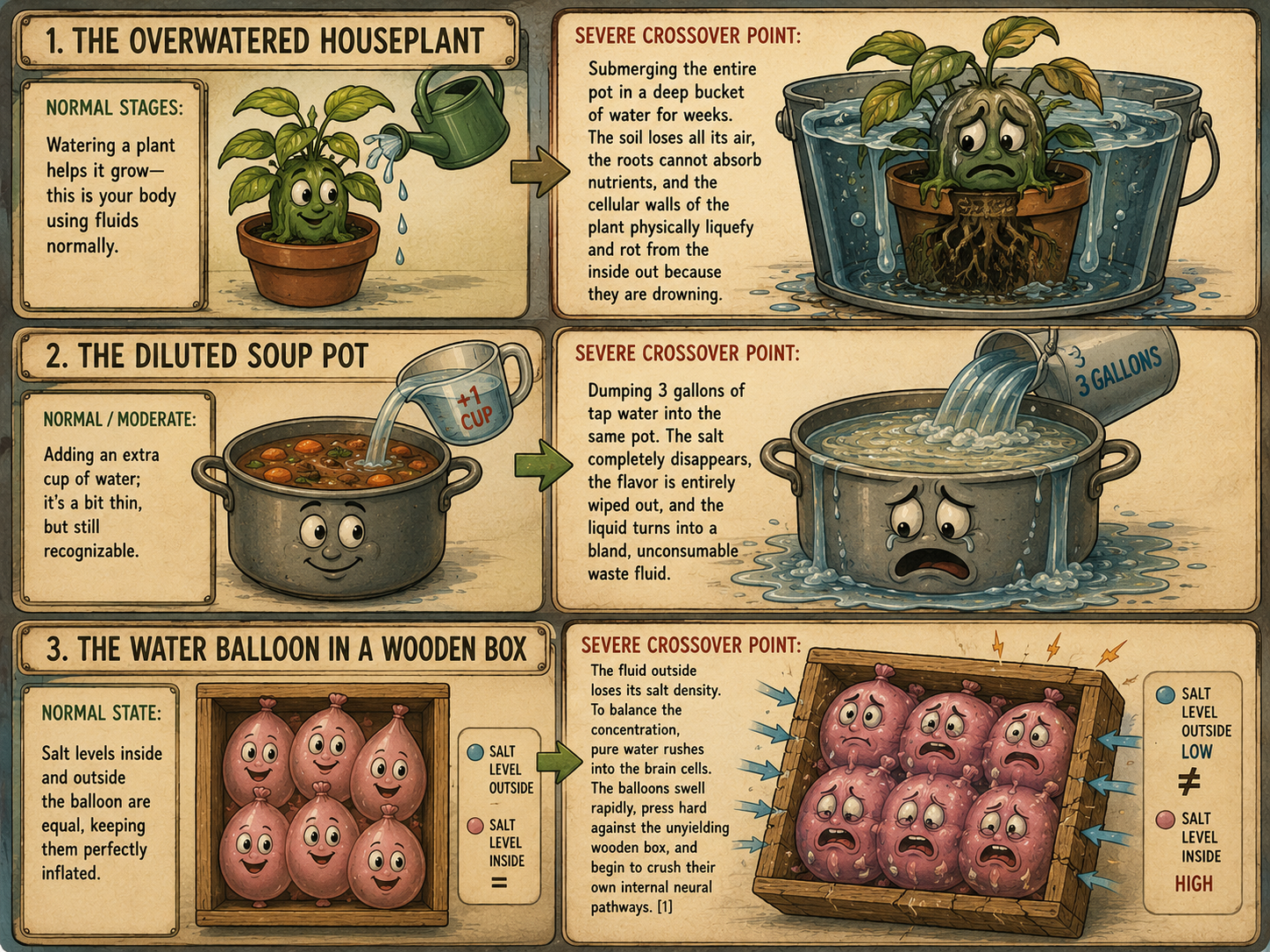
The Overwatered Houseplant: In normal stages, watering a plant helps it grow—this is your body using fluids normally. The severe crossover point is like taking a potted plant and submerging the entire pot in a deep bucket of water for weeks. The soil loses all its air, the roots cannot absorb nutrients, and the cellular walls of the plant physically liquefy and rot from the inside out because they are drowning.
The Diluted Soup Pot: Imagine making a rich, savory beef stew that requires a specific amount of salt to taste right. A moderate fluid load is like adding an extra cup of water; it’s a bit thin, but still recognizable. The severe crossover point is equivalent to taking that exact same soup pot and dumping 3 gallons of tap water into it. The salt completely disappears, the flavor is entirely wiped out, and the liquid turns into a bland, unconsumable waste fluid.
The Water Balloon in a Wooden Box: Think of your brain cells as flexible water balloons packed tightly inside a rigid wooden box (your skull). In a normal state, the salt levels inside and outside the balloon are equal, keeping them perfectly inflated. At the severe crossover point, the fluid outside the balloons loses its salt density. To balance the concentration, pure water physically rushes into the brain cells. The balloons swell rapidly, press hard against the unyielding wooden box, and begin to crush their own internal neural pathways. [1]
As documented in a clinical review by the World Journal of Gastroenterology, crossing this threshold causes a dangerous mental shift. The brain cell swelling leads to profound lethargy, severe gait instability (unsteady walking), a high risk of falls, and a major worsening of baseline confusion.
Things Nobody Explains
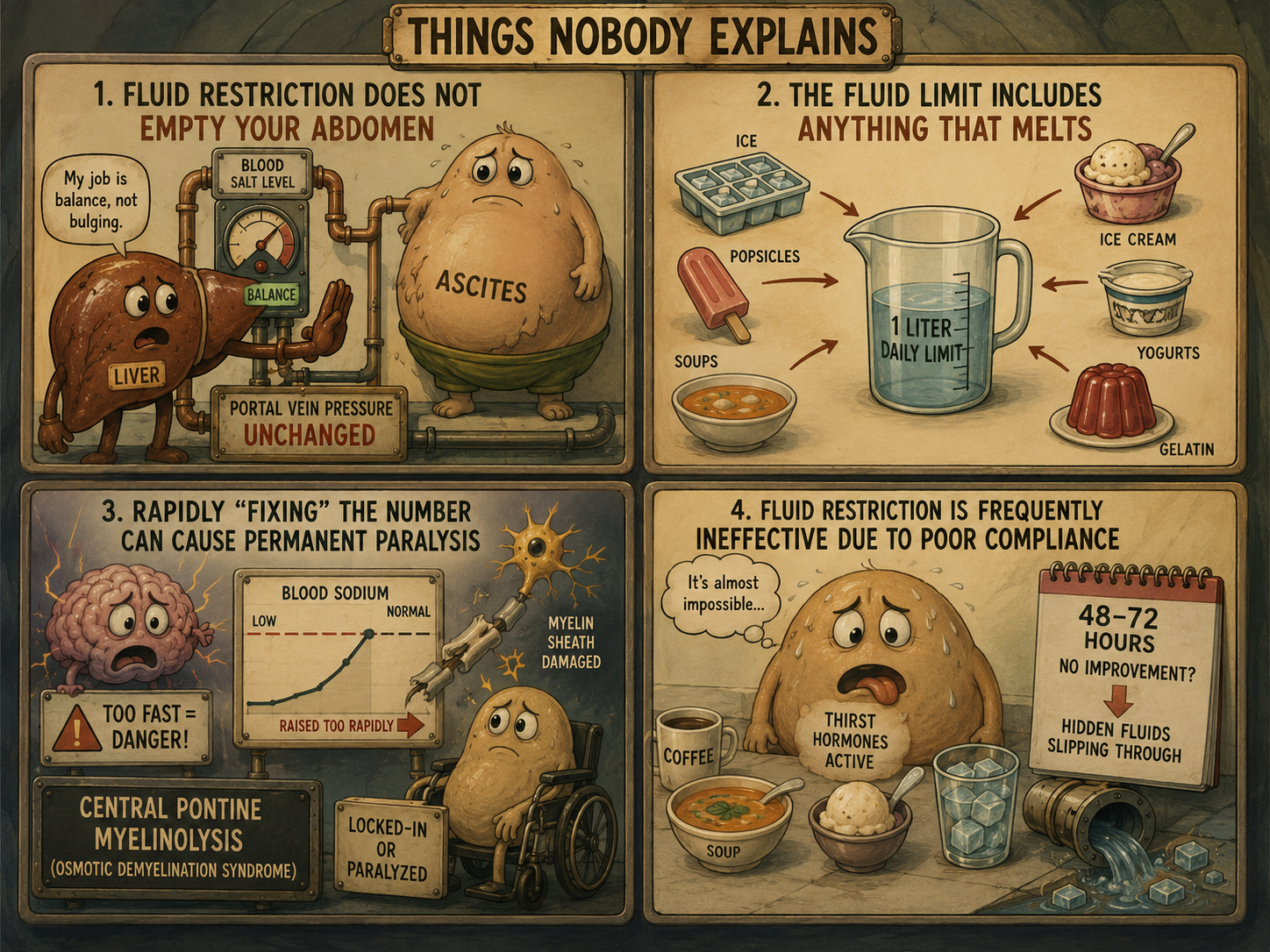
1. Fluid Restriction Does Not Empty Your Abdomen [1]
Many patients assume that if they stop drinking water, their bodies will naturally pull fluid out of their swollen abdomen to compensate. Nobody explains that fluid restriction is designed only to fix the chemical concentration of salt in your blood, not to reduce your physical weight or clear your ascites. As noted in the Hepatology Communications Journal Analysis, a fluid restriction does absolutely nothing to lower portal vein pressure. [1, 2]
2. The Fluid Limit Includes Anything That Melts
When a doctor writes a script for a "1-liter fluid restriction," patients often think it only applies to glasses of drinking water. It is rarely explained that this limit includes anything that turns to liquid at room temperature. Ice cubes, popsicles, gelatin, ice cream, yogurts, and even heavy soups must be meticulously measured and subtracted from your daily allowance.
3. Rapidly "Fixing" the Number Can Cause Permanent Paralysis [1]
If a patient has severe hyponatremia, a natural instinct is to try and raise the blood sodium level as fast as possible using IV salt solutions. This is a critical medical hazard. If sodium levels are raised too rapidly, it causes a catastrophic neurological emergency called Central Pontine Myelinolysis (or Osmotic Demyelination Syndrome). The rapid shift rips the protective myelin sheaths off the brain stem nerves, leaving the patient permanently "locked-in" or paralyzed. Doctors must correct the number incredibly slowly.[1, 2]
4. The Fluid Restriction is Frequently Ineffective Due to Poor Compliance [1]
In a hospital setting, healthcare teams can lock down water pitchers. At home, however, the intense, hormone-driven thirst makes staying under 1,000 mL almost impossible to maintain over long periods. As highlighted in the Evidence-Based Hyponatremia Management Guide, if your blood sodium numbers do not show a noticeable rise within 48 to 72 hours, it almost always means hidden fluids are slipping through the restriction.
Pro Tips from a Patient
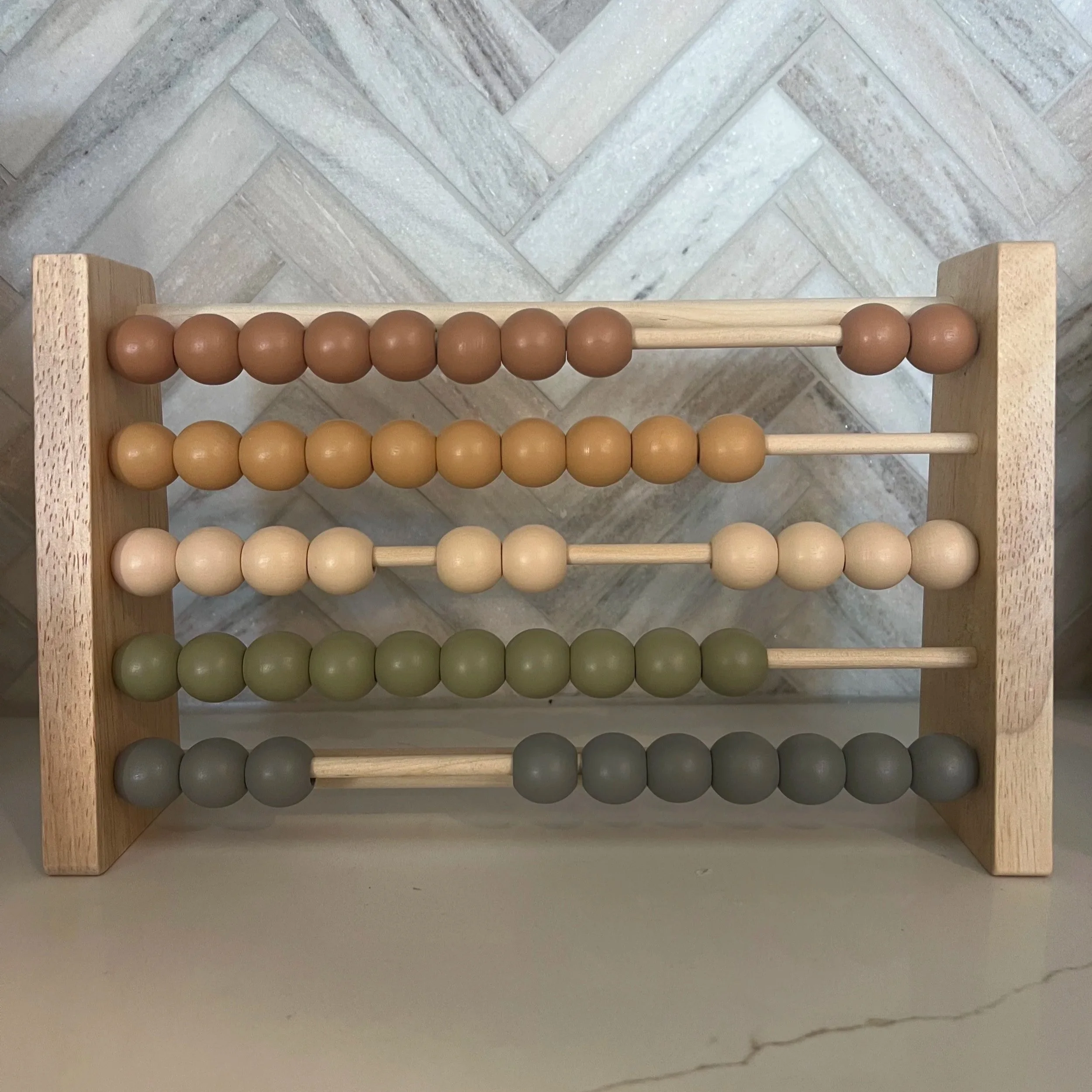
This is the abacus - a repurposed child’s toy used to track liquid oz. It was a visual reminder and a mechanism to monitor how much was consumed and available. This unfortunate array was right after my cat had a fun time rearranging the beads which wrecked my count for that day.
Fluid restriction is easier to tolerate when you understand why it is there. Otherwise, it feels like punishment. Ask your care team what number they are watching, what your daily limit is, and what the restriction is meant to prevent. A few things that I learned:
Use a visual tracker. One bottle or pitcher with measurement marks can be easier psychologically than refilling the same cup four times. You can actually see what is left and pace yourself.
Ice chips are real. They can help, but they are not magic. Ice melts, and melted ice counts as fluid. An insulated cup helps stretch cold drinks longer without making every sip feel wasted.
Think beyond liquid nutrition. This is hard, especially if you rely on protein shakes. But during restriction, a cup of beans may “cost” less fluid than half a smoothie. Protein still matters; the format may need to change.
Popsicles can help. They feel like more than a sip and can make restriction less miserable. Just remember they still count.
Watery foods count too. Watermelon, soups, smoothies, gelatin, ice, and very juicy fruits can all add up. Fluid restriction is not just about what you drink.
The whole thing becomes a psychological long game: pace, measure, stretch, and protect every ounce like it matters — because for that season, it does.
What Helps: Clinical Optimization Strategies
The Equal-Volume Ice Jug Technique: To keep a flawless, visual log of your fluid limits without constant math, fill an empty milk jug with the exact amount of water matching your daily restriction (e.g., 1,000 mL). For every cup of water, coffee, or broth you consume throughout the day, pour that identical amount out of the jug. The remaining water in the jug shows you exactly how much fluid you have left until midnight [1.1.5].
Thirst Mitigation Triggers: To quench intense thirst without swallowing ounces of fluid, patients use targeted sensory tricks. Sucking on sharp lemon slices, chewing sugar-free mint gum, or using a fine-mist spray bottle to lightly coat the inside of the mouth stimulates immediate salivary flow, tricking the brain's thirst center into feeling relief [1.1.5].
The Medication-Applesauce Bridge: Taking pills with large gulps of water can easily consume half of a strict daily fluid allowance. Clinical dietitians recommend swallowing large capsules or tablets using a single spoonful of smooth, cold apple sauce or pureed fruit [1.1.5]. This lubricates the throat and allows the pills to pass seamlessly without requiring a drop of liquid. [1]
Sources
[1] British Society of Gastroenterology / Gut Journal:Guidelines on the management of ascites in cirrhosis.PMC7788190
[2] Dr.Oracle Clinical Insights Data:Water Restriction Guidelines in Chronic Liver Disease with Ascites.Dr.Oracle
[3] AASLD Liver Fellow Network Core Series:Back to Basics: Outpatient Management of Cirrhosis.AASLD
[4] World Journal of Gastroenterology:Hyponatremia in cirrhosis: Pathophysiology and management.PMC4363748
[5] Milton Keynes University Hospital Clinical Framework:Patient Information Leaflet: A Guide to Fluid Restriction. Milton Keynes University Hospital
[6] Annals of Medicine / PubMed Central (PMC):Evidence-based hyponatremia management in liver disease. PMC10577348
[7] American Gastroenterological Association:Management of ascites, volume overload, and hyponatremia in cirrhosis.AGA / Gastroenterology
Medical Disclaimer & General Guidance
The information provided across these resources is for educational and informational purposes only. It is not intended to be a substitute for professional medical advice, diagnosis, or treatment. Severe dilutional hyponatremia, fluid shifts, and electrolyte imbalances are volatile complications of end-stage liver disease that require direct, careful management by a board-certified hepatologist or gastroenterologist. Always seek the direct advice of your physician before implementing an aggressive fluid cap, altering your diuretic schedule, or trying to manage neurological symptoms at home.

Navigating the hidden fallout of advanced fluid retention is the ultimate exercise in physical vulnerability. It strips away your structural comfort, hijacks your body's plumbing baseline, and forces you to play a high-stakes guessing game against an internal tsunami that is actively expanding behind your back.