
Why Did I Need a Wheelchair for Liver Failure and Cirrhosis?
Important Medical Disclaimer: I am Angie, a cirrhosis patient sharing my personal lifestyle, nutrition, and mindset journey. I am a data aggregator and community builder, not a licensed medical professional, doctor, or dietitian. Content on diagnosiscirrhosis.com is based solely on my personal experience living with advanced liver disease and is intended for informational and educational purposes only. It does not constitute medical advice or a substitute for professional medical care. Always follow the recommendations of your own healthcare team and consult your hepatologist or physician before changing your diet, medication, or lifestyle routine.
@diagnosis_cirrhosis ♿️Liver failure, cirrhosis, and mobility changes are WAY more connected than people realize 👀✨ Did you know that advanced liver disease can affect how far you can walk, how long you can stand, or how much energy it costs just to get through the day 😮💨 So if you’ve ever been searching at 2am like… 👉 “Why are my legs suddenly weak?” 🦵 👉 “Can cirrhosis affect mobility?” 👉 “Why do people with liver failure use wheelchairs?” ♿️ 👉 “Can liver disease cause muscle wasting?” 💪📉 👉 “Why am I exhausted after walking short distances?” 😴 👉 “Can ascites make it hard to walk?” 💧 👉 “Can hepatic encephalopathy affect balance?” 🧠 👉 “Why am I dizzy every time I stand up?” 🌀 👉 “Can diuretics make you dizzy?” 💊 👉 “Can beta blockers lower blood pressure?” 🩸 👉 “Can portal hypertension medicine make you weak?” 👉 “Can being bed bound cause muscle loss?” 🛏️ 👉 “Can cirrhosis cause falls?” ⚠️ 👉 “Why do my legs feel heavy?” 👉 “Why does walking suddenly feel impossible?” 👉 “Why do I suddenly need a cane, walker, or wheelchair?” 🦯🚶♿️ You are not crazy. This can happen. And at the hospital you might get a bracelet that says “fall risk” 🫶 Advanced liver disease can affect: ⚡ energy 💪 muscle 🧠 coordination 🫁 breathing 🩸 circulation 🦴 stability 🚶 mobility overall WHY it happens can include: 💪 sarcopenia / muscle wasting This is a HUGE part of cirrhosis. Muscle loss can make walking, standing, climbing stairs, showering, traveling, and even getting out of bed feel harder than it “should.” 🛏️ being bed bound or hospitalized When you’re stuck in bed, your muscles can decondition quickly. Add chronic illness on top of that, and rebuilding strength can take time. 💧 ascites + fluid retention A swollen abdomen can change your balance, breathing, posture, stamina, and how your body moves. 🦵 edema Fluid in the legs can make them feel heavy, tight, painful, or harder to lift. 💊 diuretics Diuretics help remove fluid, but they can also contribute to dizziness, dehydration, electrolyte changes, weakness, or feeling unstable if the balance is off. 🩸 beta blockers for portal hypertension Nonselective beta blockers are often used to reduce portal hypertension/variceal bleeding risk, but they can also lower blood pressure and heart rate. For some people, that can mean dizziness, fatigue, lightheadedness, or feeling weak. 🧠 hepatic encephalopathy HE can affect thinking, reaction time, coordination, balance, and confidence moving through space. 🍽️ malnutrition + low intake If you are under-eating, losing muscle, or not getting enough protein, mobility can take a hit fast. 🌀 low blood pressure / orthostatic hypotension. Standing up and suddenly feeling dizzy, shaky, or like you might fall is not something to ignore. Sometimes the issue is not: ❌ “I physically cannot move my legs.” It’s: ⚠️ walking drains everything ⚠️ standing feels unsafe ⚠️ long distances are unrealistic ⚠️ exertion wipes you out afterward ⚠️ you are trying not to fall ⚠️ you are trying to conserve enough energy to function later Mobility aids can include: ♿️ wheelchairs 🦯 canes 🚶 walkers 🪑 shower chairs 🛏️ bedside supports 🧬 causes of cirrhosis include autoimmune hepatitis 🔥 MASLD / NAFLD / MASH / NASH 🍩 alcohol-related liver disease 🚫🍷 hepatitis B 🦠 hepatitis C 🦠 PBC 🧬 PSC 🧬 hemochromatosis ⚙️ Wilson’s disease 🪙 alpha-1 antitrypsin deficiency 🧩 drug-induced liver injury 💊 cryptogenic cirrhosis ❓ or other causes. Always talk to your doctor, hepatologist, transplant team, physical therapist, neurologist, or another qualified physician about any concerns 🩺💚 🔎 cirrhosis wheelchair 🔎 liver failure mobility problems 🔎 liver disease weakness 🔎 sarcopenia cirrhosis 🔎 muscle wasting cirrhosis 🔎 ascites walking difficulty 🔎 edema walking problems🔎 hepatic encephalopathy balance issues 🔎 diuretics dizziness 🔎 nadolol dizziness cirrhosis 🔎 carvedilol low blood pressure cirrhosis 🔎 propranolol portal hypertension fatigue 🔎 bed bound muscle wasting #symptoms #sideeffects #liverhealth #cirrhosis #mobility ♬ Refreshing and light indie pop(1552207) - Cheng Lee
Video Transcript & Key Points:
The Hidden Side of Advanced Liver Disease: Nobody tells you that advanced liver disease can affect how far you can walk, how long you can stand, or how much energy it costs just to get through the day.
The "Fall Risk" Reality: You are not crazy. This can happen. And at the hospital, they will probably give you a fancy wristband dubbing you a "fall risk." 🫶
The Reality of Mobility Aids: Sometimes the issue is not that you physically cannot move your legs. It’s that walking drains everything, standing feels unsafe, long distances are unrealistic, exertion wipes you out afterward, you are trying not to fall, and you are trying to conserve enough energy to function later.
Redefining Independence: Mobility aids are not only for people who cannot walk at all 👀 Sometimes they are about conserving energy, preventing falls, staying safe, and keeping independence. Because sometimes the goal is not proving you CAN walk—it’s surviving the rest of the day after you do.
Why Did I Need a Wheelchair for Liver Failure and Cirrhosis?
Understanding the Hidden Link Between Hepatic Stress, Medications, and Mobility Decline By Angie from @diagnosis_cirrhosis
Before I needed a wheelchair, I thought mobility aids were reserved for people who could not walk at all. In my head, a wheelchair belonged to an entirely different category of illness. A different kind of life. Certainly not something that belonged next to the phrase “liver failure.”
But one of the strangest things about advanced chronic liver disease is how quickly it teaches you that the body does not divide symptoms into neat little categories. Your liver fails, and suddenly your muscles weaken, your blood pressure drops, your balance changes, your stamina disappears, walking becomes expensive, standing becomes strategic, and existing becomes absolute energy management. And nobody really prepares you for that part.
The Moment My Reality Record-Scratched
When my husband came home with the wheelchair, I cried. Not polite little tears. Full shock.
I remember looking at it and feeling completely baffled by the fact that this was not only becoming part of my current reality, but potentially part of my future. Part of my forever. It felt impossible that “simple liver failure” could somehow collide with something as psychologically massive as needing a wheelchair. But chronic illness has a way of widening your aperture whether you are emotionally prepared for it or not.
To say empathy was struck within me in that moment is the understatement of the century. Because suddenly I understood mobility differently. I understood that disability is not always, "I physically cannot move."Sometimes it is, "Moving costs more than my body can sustainably pay." That is a completely different thing. And once you understand that, you start seeing the world differently.
The New Year’s Eve I Will Never Forget
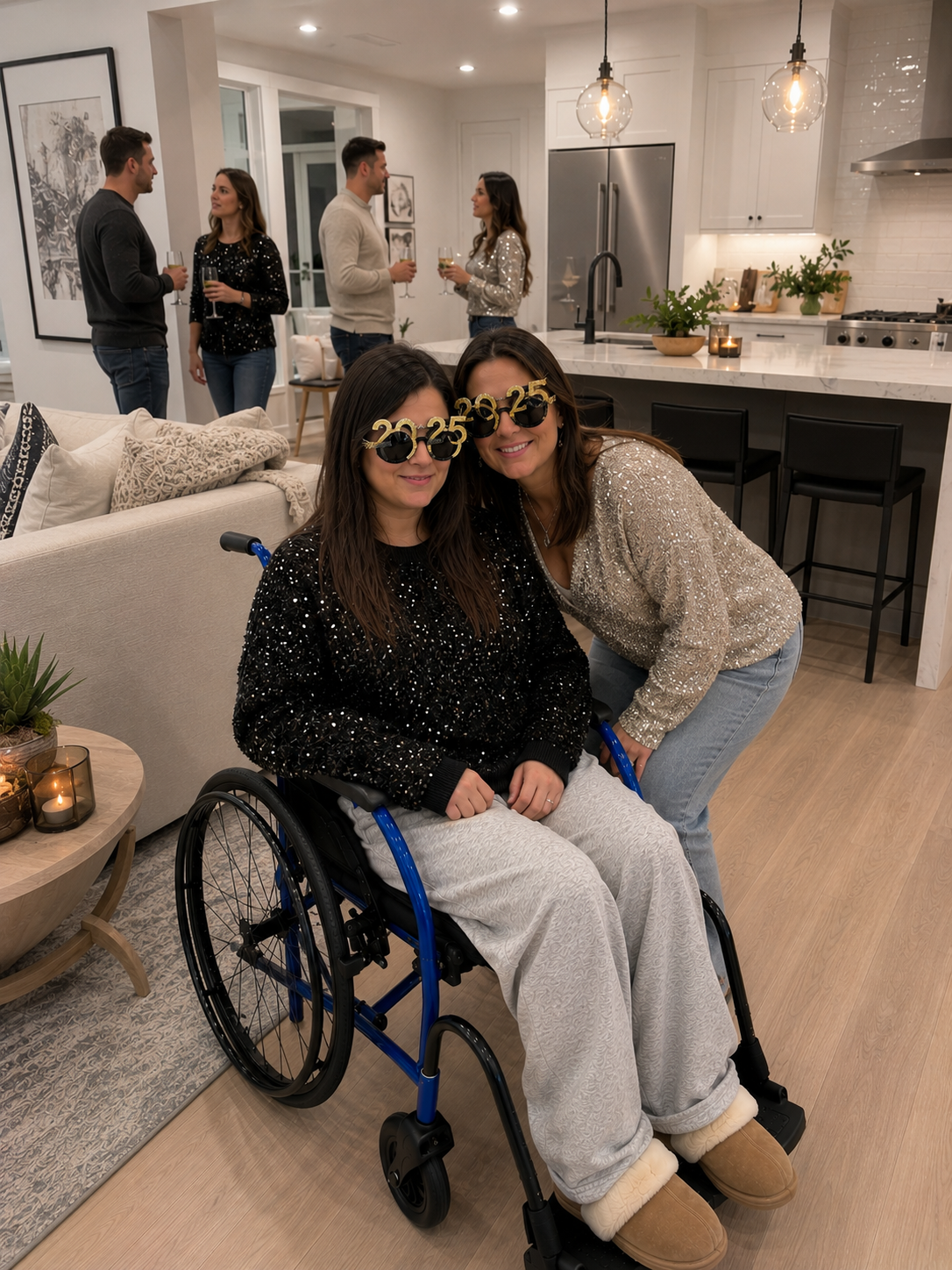
I will never forget New Year’s Eve 2024. Earlier that day, I had undergone a paracentesis to drain excess fluid. By that evening, I wheeled myself down to my friend’s house around the corner. It was one of the physically shortest trips I had ever taken and somehow one of the longest experiences of my life.
I remember wheeling around the kitchen while my friends shifted chairs and furniture to make room for me to maneuver. There was something surreal about it all. Not humiliating exactly. Just… disorienting. Like reality had changed genres without asking permission.
There I was: young, cognitively present, socially engaged, smiling, technically “walking capable”—and also suddenly navigating a kitchen in a wheelchair on New Year’s Eve because my body no longer had the stamina reserves to function normally. That moment changed something in me permanently. I realized illness is not always dramatic in the way people expect. Sometimes it is logistical. Sometimes it is cumulative. Sometimes it is realizing you are now subconsciously scanning every environment for places to sit down, lean on, or stabilize with.
Can Liver Disease Change Your Ability to Walk?
The short answer is yes—but the breakdown happens along metabolic, vascular, and pharmaceutical lines rather than a direct injury to your joints. If you are up at 2 AM searching Google wondering what is happening to your body, you are not crazy. None of these things individually may scream “wheelchair," but when they collide together, they absolutely do.
As a patient and data aggregator tracking the medical literature, here is why advanced chronic liver disease systematically causes mobility problems:
1. Hepatic Sarcopenia & Hospital Deconditioning
This is a massive part of cirrhosis. When the liver is compromised, it struggles to process amino acids and synthesize protein. To keep your vital organs running, your body goes into a hyper-catabolic state, systematically stealing protein from your large skeletal muscles.
My Experience: Muscle loss can make walking, standing, climbing stairs, showering, traveling, and even getting out of bed feel harder than it “should.” When my liver failed, being bedbound and severely ill caused major muscle loss. Rebuilding strength through physical therapy later became a massive, non-negotiable part of my recovery.
2. The Physical Load of Ascites and Edema
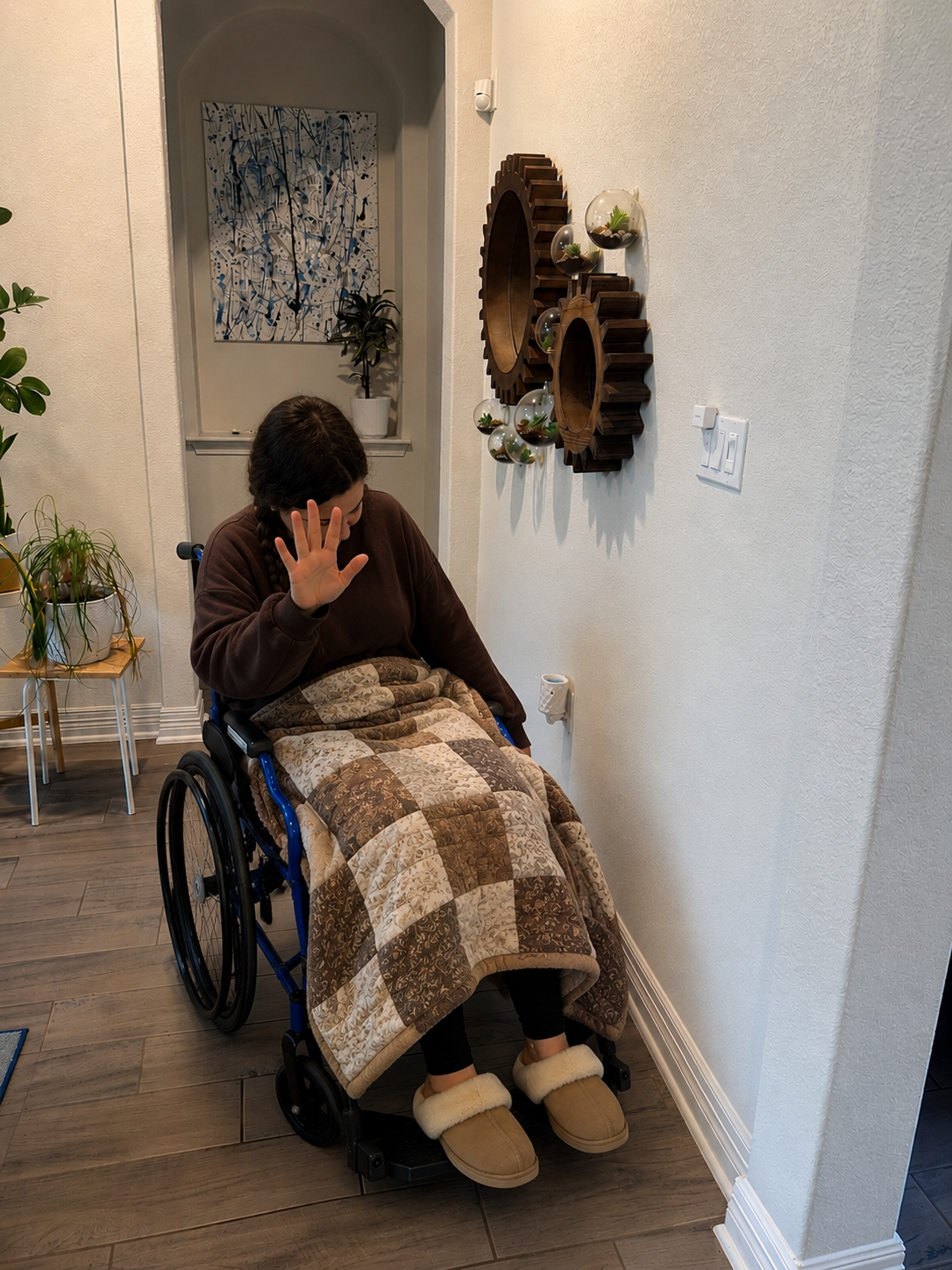
Carrying massive fluid accumulation in the abdomen (ascites) or heavy fluid retention in the lower extremities (edema) drastically shifts your physical posture and center of gravity.
My Experience: A swollen abdomen completely changes your balance, posture, breathing, stamina, and the mechanics of movement itself. On top of that, fluid-filled legs feel heavy, tight, painful, and significantly harder to move or lift over simple steps.
3. Medication Side Effects (Diuretics & Beta Blockers)
Managing advanced liver disease often requires taking strong medications to prevent life-threatening complications, but these essential prescriptions come with heavy exertional and physical side effects.
My Experience: High-dose diuretics are necessary and helpful, but they are also sometimes brutal. They can contribute heavily to sudden dizziness, dehydration, weakness, and unstable blood pressure. Furthermore, nonselective beta blockers used to reduce portal hypertension and variceal bleeding risks can absolutely affect your stamina and exertional tolerance. For some people, lowering your blood pressure and heart rate means constant fatigue or lightheadedness when you stand up.
4. Hepatic Encephalopathy & Spatial Awareness Shifts
When the liver cannot properly filter metabolic waste products like ammonia, those toxins cross into the central nervous system.
My Experience: Hepatic Encephalopathy (HE) changes your thinking, reaction time, coordination, balance, and spatial confidence moving through space in ways that are difficult to explain unless you have personally lived it.
The Grocery Store Calculus: Navigating the Invisible
Even after I transitioned out of the wheelchair, the calculations stayed. That is something I do not think people understand about chronic illness and mobility changes—the wheelchair was not the entire story, it was just the beginning of understanding that every outing now involved strategy.
I started mentally categorizing stores based on resting opportunities:
World Market? Lots of couches. Good option.
Certain grocery stores? Not enough seating.
Target? Depends how dizzy I am that day.
Even when I regained enough strength not to need the wheelchair constantly, I still carried the mobility mindset with me everywhere. Because the issue was never just: "Can I technically walk?" The issue was the daily calculation:
Every Single Outing Requires Strategic Calculus:
• How much energy will this walk cost my body?
• What happens afterward? Will I crash later tonight? •
Is there somewhere to sit if my blood pressure tanks?
• How far away is the parking lot from the front door?
• What if the dizziness hits me suddenly in the aisle? •
How many upright hours do I realistically have today?
Once chronic illness teaches you those calculations, they never fully leaves.
The Strange Visibility of Illness
One of the hardest emotional realizations was understanding that the wheelchair became visual proof of illness in a way my other symptoms had not. People had seen the jaundice, the ascites, the weight changes, the procedures, and the mountain of medications. But the wheelchair changed something psychologically. It translated the severity to the outside world instantly.
That experience made me think a lot about invisible illness and the arbitrary ways society decides what “counts” as visibly sick. Because the truth is, I was catastrophically ill long before the wheelchair entered the picture. The wheelchair was simply the first symptom other people emotionally understood immediately.
Mobility aids are not moral failures. They are not exclusively about inability. Sometimes they are about conserving energy, preventing falls, reducing risk, extending independence, participating in life longer, and surviving the outing without destroying yourself afterward. Honestly, I think more chronically ill people deserve freedom from the shame around that reality.
What to Ask Your Healthcare Team: Specialist Questions
Navigating a sudden drop in your physical independence requires active, coordinated communication across your medical network. Take these specific questions to your next care team appointments:
Questions for Your Hepatologist or Transplant Team
"Could my recent leg weakness, balance changes, or dizziness when standing up be driven by my portal hypertension medications or fluctuating ammonia levels?"
"Given my current ascites and edema tracking, am I at an elevated risk for clinical frailty, and should I officially be labeled a fall risk at home?"
"Are my diuretic dosages contributing to orthostatic hypotension (blood pressure drops when standing), and how should we monitor my baseline hydration?"
Questions for Your Physical Therapist and/or Neurologist
"How can I strategically incorporate mobility aids like a wheelchair, walker, or cane to conserve energy without causing full muscular deconditioning?"
"Are there specific low-impact, seated, or supported exercises I can perform to safely protect my remaining muscle mass while managing severe fatigue?"
"What specific physical safety thresholds or neurological coordination flags should prompt me to transition from a walker to a wheelchair for long-term safety?"
Summary: Mobility is Negotiated, Not Binary
I do not live in the wheelchair now. I use a cane sometimes, especially when dizziness flares or my blood pressure is unstable. Working tightly with physical therapy helped tremendously, and regaining muscle strength became one of the most important parts of rebuilding my life after decompensation.
But even now, the awareness never completely leaves. I still notice chairs. I still mentally track exits. I still calculate energy. Chronic illness taught me that mobility is far more nuanced than "can walk" versus "cannot walk." Mobility is not binary. It is negotiated. Constantly.
Peer-Reviewed Sources and References
American Journal of Gastroenterology: Review the research outlining the high prevalence of physical falls in liver disease, its link to blood sodium levels, and predictive algorithm testing on the ACG Clinical Guideline Repository.
National Institutes of Health (NIH): Read the clinical data tracking how structural muscle loss, systemic undernutrition, and physical frailty independently impact liver transplant candidacy via the PubMed Central Sarcopenia Study.
World Journal of Hepatology: Explore how minimal cognitive shifts, elevated blood ammonia, and nervous system toxicity directly cause measurable changes to a patient's balance and walk speed in the PMC Motor Performance Analysis.
MDPI Medical Journals: Learn about how common liver prescriptions—specifically diuretics and non-selective beta blockers—alter systemic blood pressure dynamics and cause orthostatic hypotension via the Systematic Review on Drug-Induced Dizziness.
Journal of Clinical Medicine: Examine the medical data detailing how advanced liver fibrosis directly causes decreased gait speed and overall physical deconditioning in chronic patients on the NLM Hepatic Clearance Repository.
