

Understanding Brain Fog, Sleep Changes & Hepatic Encephalopathy
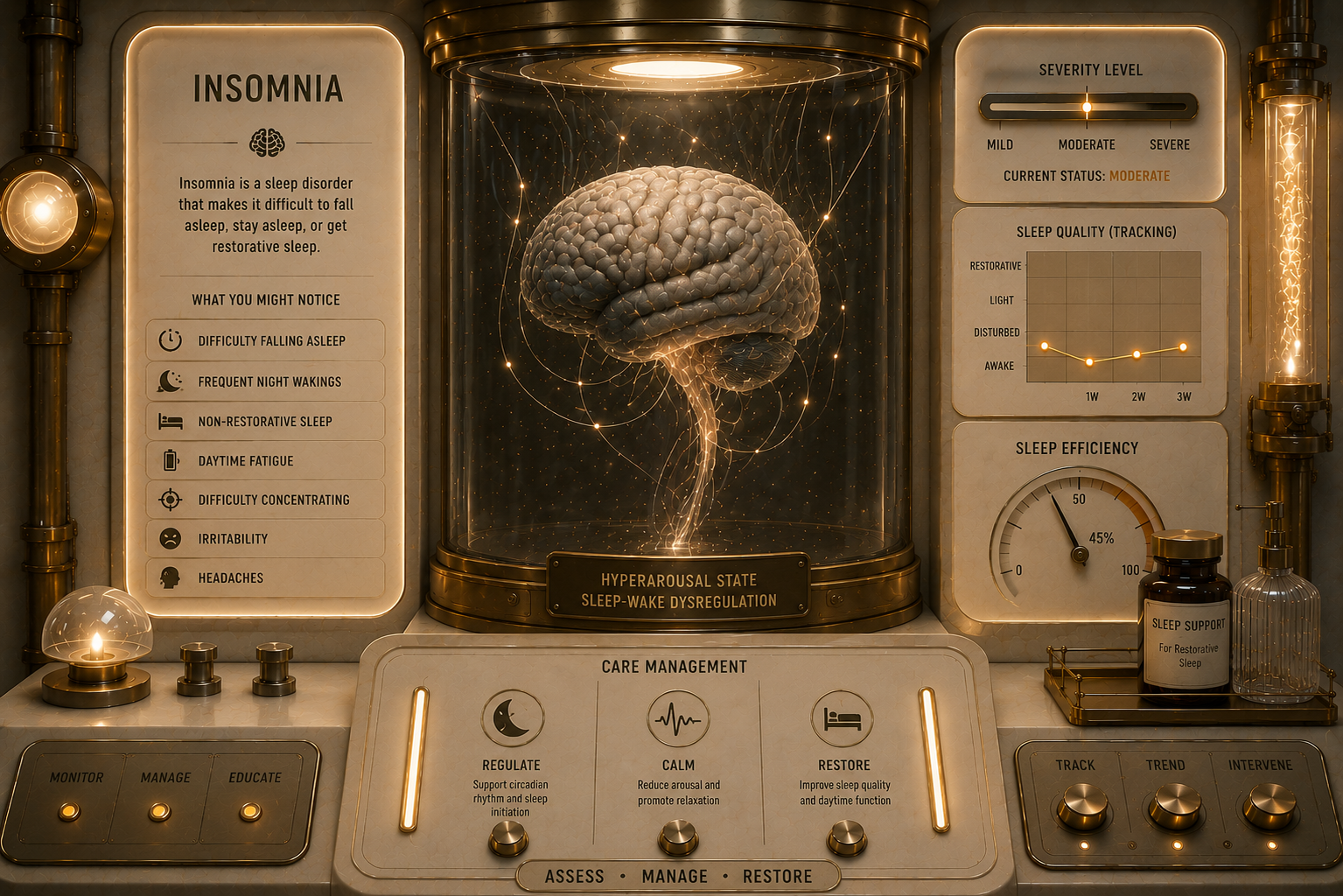
How does a disease famous for making you tired also make it impossible to sleep?
For many people, hepatic encephalopathy doesn't begin with dramatic confusion or forgetting who they are. It starts with smaller, stranger things. You're exhausted all day but wide awake all night. You walk into a room and forget why. You lose your train of thought mid-sentence. You read the same paragraph three times. Something feels off, but it's difficult to explain exactly what.
People often imagine hepatic encephalopathy as a severe complication that only appears in hospitals. In reality, it exists on a spectrum. Long before obvious confusion develops, subtle changes in memory, concentration, reaction time, sleep patterns, and mental clarity can begin appearing. Sometimes the first sign isn't confusion at all. Sometimes it's the clock.
What It Is
Your brain depends on a constant supply of clean, filtered blood.
One of the liver's many jobs is removing waste products created by normal metabolism, including ammonia.
A healthy liver filters these substances before they can circulate through the body.
As cirrhosis progresses, that filtration system becomes less effective.
Ammonia Buildup
When ammonia levels rise, toxins can travel through the bloodstream and reach the brain.
This interferes with normal communication between brain cells.
Neuroinflammation
The brain responds to these toxins with inflammation and altered signaling pathways.
Messages still travel.
They just don't travel as efficiently.
Circadian Disruption
The same processes affecting concentration and memory can also disrupt the body's sleep-wake cycle.
Daytime becomes sleepy.
Nighttime becomes alert.
The schedule starts drifting.
Late Nights à la Liver
What It Feels Like
Hepatic encephalopathy can feel different for everyone.
Common experiences include:
🧠 Brain fog
🧠 Forgetfulness
🧠 Difficulty concentrating
🧠 Slower thinking
🧠 Word-finding problems
🧠 Mental fatigue
🧠 Mood changes
🧠 Feeling "off"
Sleep-related symptoms often include:
🌙 Wide awake at 2:00 AM
☀️ Exhausted during the day
😴 Unplanned naps
⏰ Sleep-wake reversal
📅 Feeling disconnected from normal schedules
The Crossover Point
Think of your brain like a switchboard.
At first, a few signals arrive late.
A connection flickers.
A message gets rerouted.
Everything still works.
Then more signals begin crossing wires.
Some messages arrive slowly.
Others never arrive at all.
The switchboard becomes increasingly difficult to manage.
Hepatic encephalopathy is what happens when the brain is forced to work through static.
Things Nobody Explains
1. It Isn't Just Confusion
Many people expect hepatic encephalopathy to look dramatic.
Often it begins with subtle changes that are easy to dismiss.
2. Sleep Problems Can Be an Early Clue
For some patients, a reversed sleep schedule appears long before obvious cognitive symptoms.
3. You May Notice It Last
Friends and family sometimes recognize changes before the patient does.
4. It Can Fluctuate
A person may feel completely normal one day and noticeably foggy the next.
Infections, dehydration, constipation, medications, and other stressors can all contribute.
What Helps
✅ Lactulose when prescribed
✅ Rifaximin when prescribed
✅ Preventing constipation
✅ Staying hydrated when appropriate
✅ Managing infections quickly
✅ Maintaining nutrition and muscle mass
✅ Regular follow-up with your healthcare team
The Bottom Line
Hepatic encephalopathy is not a character flaw, a lack of effort, or a failure to pay attention.
It's a complication of liver disease that affects the brain's ability to process information efficiently.
Sometimes it looks like confusion.
Sometimes it looks like forgetfulness.
And sometimes it looks like lying awake at 3:00 AM wondering why a disease built around fatigue won't let you sleep.

What It Feels Like
Hepatic encephalopathy can feel different for everyone.
Common experiences include:
🧠 Brain fog
🧠 Forgetfulness
🧠 Difficulty concentrating
🧠 Slower thinking
🧠 Word-finding problems
🧠 Mental fatigue
🧠 Mood changes
🧠 Feeling "off"
Sleep-related symptoms often include:
🌙 Wide awake at 2:00 AM
☀️ Exhausted during the day
😴 Unplanned naps
⏰ Sleep-wake reversal
📅 Feeling disconnected from normal schedules
The Crossover Point
Think of your brain like a switchboard.
At first, a few signals arrive late.
A connection flickers.
A message gets rerouted.
Everything still works.
Then more signals begin crossing wires.
Some messages arrive slowly.
Others never arrive at all.
The switchboard becomes increasingly difficult to manage.
Hepatic encephalopathy is what happens when the brain is forced to work through static.
Things Nobody Explains
1. It Isn't Just Confusion
Many people expect hepatic encephalopathy to look dramatic.
Often it begins with subtle changes that are easy to dismiss.
2. Sleep Problems Can Be an Early Clue
For some patients, a reversed sleep schedule appears long before obvious cognitive symptoms.
3. You May Notice It Last
Friends and family sometimes recognize changes before the patient does.
4. It Can Fluctuate
A person may feel completely normal one day and noticeably foggy the next.
Infections, dehydration, constipation, medications, and other stressors can all contribute.
What Helps
✅ Lactulose when prescribed
✅ Rifaximin when prescribed
✅ Preventing constipation
✅ Staying hydrated when appropriate
✅ Managing infections quickly
✅ Maintaining nutrition and muscle mass
✅ Regular follow-up with your healthcare team
The Bottom Line
Hepatic encephalopathy is not a character flaw, a lack of effort, or a failure to pay attention.
It's a complication of liver disease that affects the brain's ability to process information efficiently.
Sometimes it looks like confusion.
Sometimes it looks like forgetfulness.
And sometimes it looks like lying awake at 3:00 AM wondering why a disease built around fatigue won't let you sleep.
Read More








Within a few months, my vision changed so dramatically that I ended up in an expensive, deeply annoying optometrist spiral: three separate visits, three new prescriptions, three different pairs of glasses.
I thought I was aging.
I thought my eyes were just being dramatic.
I thought I had an eye problem.
Turns out, I may have been optimizing for the wrong organ.
Because advanced liver disease does not politely stay in the liver lane. It affects metabolism, inflammation, hormones, nutrition, fluid balance, blood vessels, and sometimes, apparently, your ability to see the world clearly.