
ALT
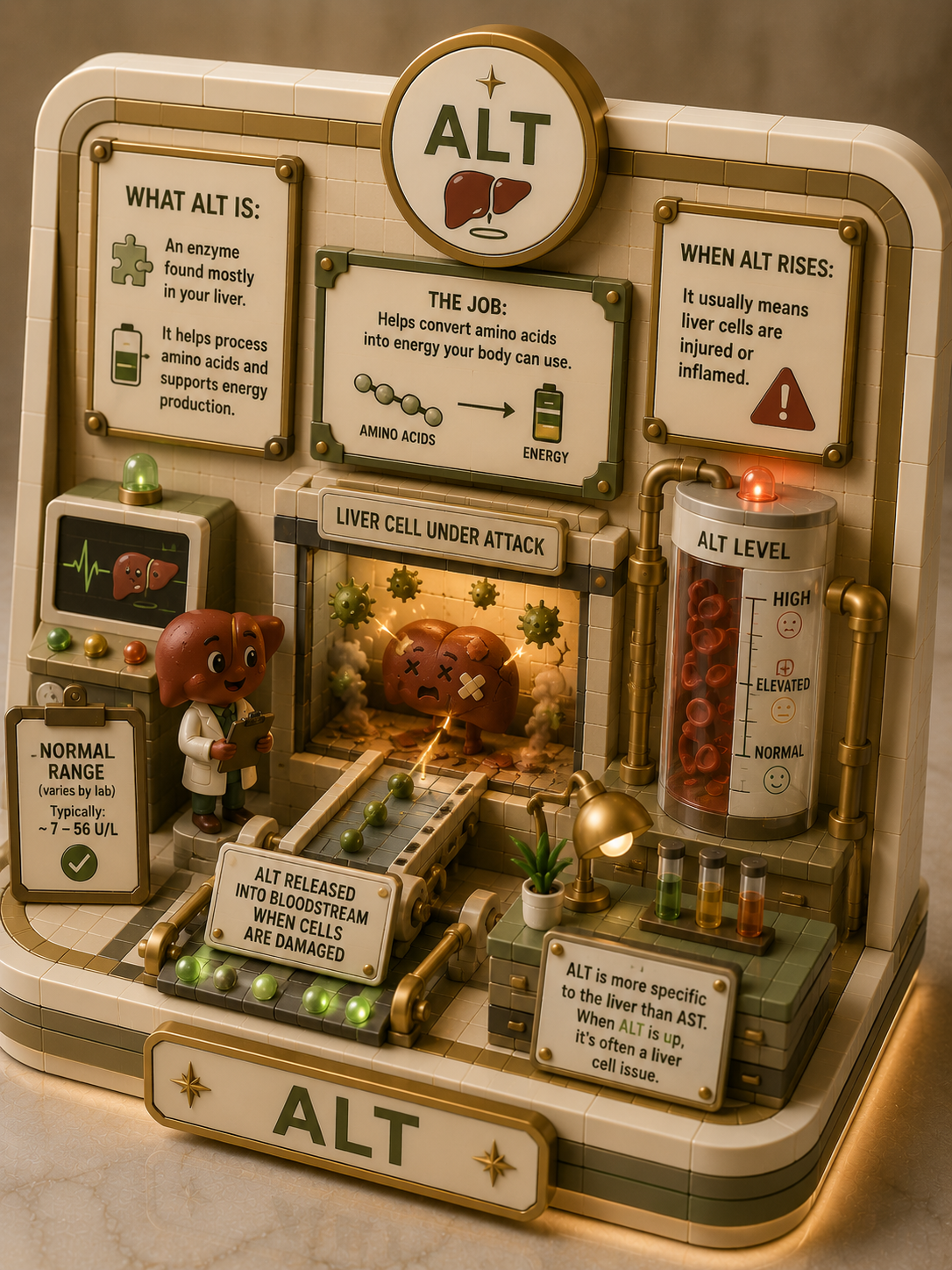
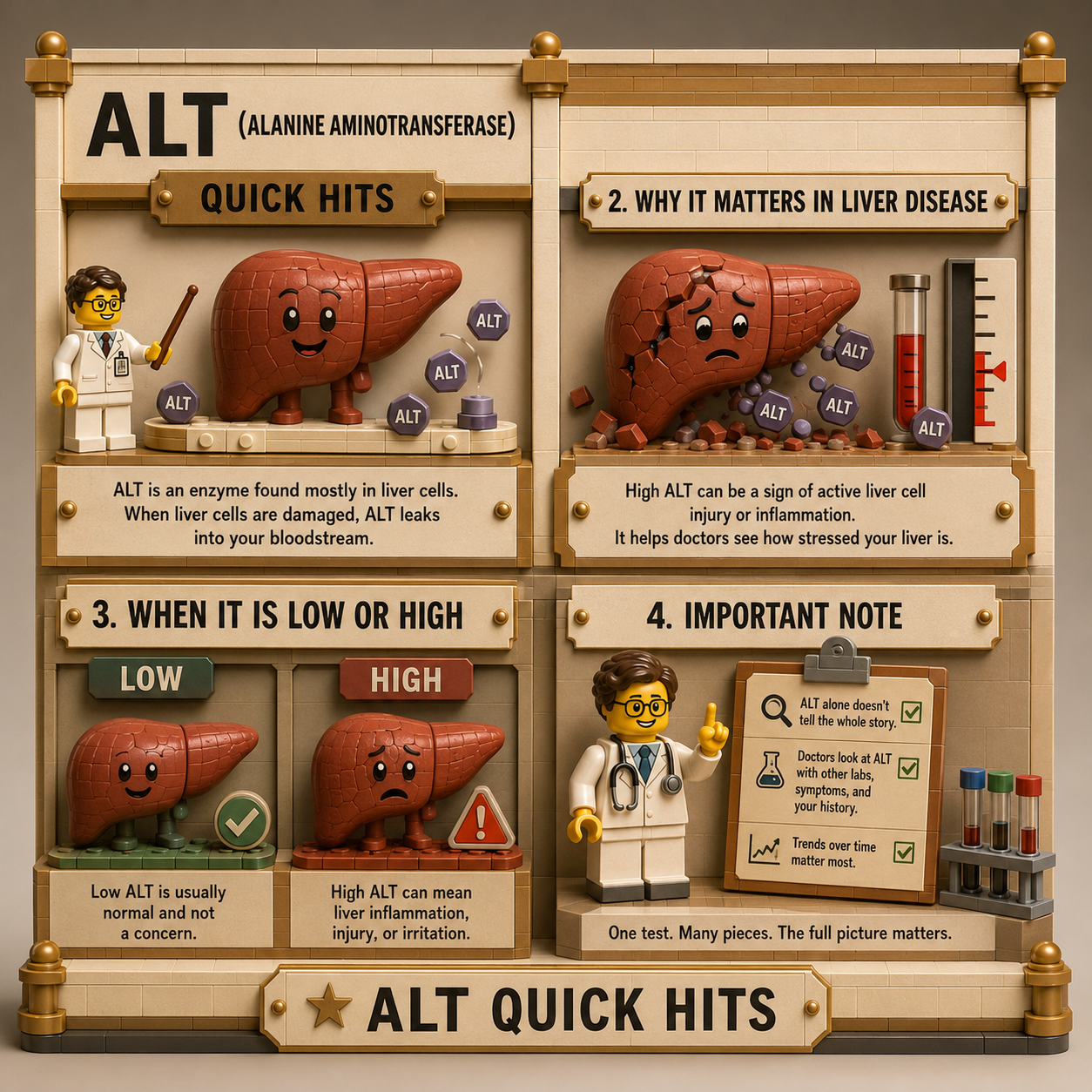
@diagnosis_cirrhosis 🧪🩸ALT explained: the liver lab that says “this is me” 👀💥 why is my doctor checking ALT? 🤔 what does a high ALT mean? 📈 is ALT liver damage? 💥 why is ALT high with fatty liver? 🍩 can alcohol raise ALT? 🍷 can meds raise ALT? 💊 why isn’t ALT in MELD? 🧮 ALT lives inside liver cells 🧬 so when it goes up ⬆️ 👉 it usually means liver cells are being injured and leaking it out 🩸🧪 not maybe ❌ not somewhere else ❌ 👉 this one is me 🫀 — 💥 what it means ALT goes up when liver cells are actively getting hurt 🍩 fatty liver (MASLD / NAFLD / MASH / NASH) 🍷 alcohol-related liver disease 💊 medication or supplement-related injury 🦠 hepatitis B or C 🔥 autoimmune hepatitis 🧬 bile duct and metabolic conditions 👉 different causes… same signal: cell injury 💥 — 📈 why ALT can move a lot ALT is an injury marker 🚨 so it can: ⬆️ spike when something is actively irritating the liver ⬇️ come down when that stress improves 👉 it reflects what’s happening right now, not the full long-term picture 👀 — 🧮 why it’s not in MELD MELD is about: 👉 overall liver function + survival risk ALT is about: 👉 active injury so even very high ALT 📈 doesn’t always mean the liver is failing — 💚 why this matters if ALT is elevated… 👉 something is actively affecting your liver but the real question is always: 👉 what is causing the injury? — 🧬 causes of liver damage (big picture) autoimmune hepatitis 🔥 fatty liver disease (MASLD / NAFLD / MASH / NASH) 🍩 alcohol-related liver disease 🚫🍷 hepatitis B 🦠 hepatitis C 🦠 primary biliary cholangitis (PBC) 🧬 primary sclerosing cholangitis (PSC) 🧬 hemochromatosis ⚙️ Wilson’s disease 🪙 alpha-1 antitrypsin deficiency 🧩 drug-induced liver injury 💊 👉 many different causes… but ALT rises when liver cells are taking a hit 💥🫀 — 👩⚕️🩺 talk to your doctor if ALT is elevated or changing 📈📉 👉 don’t guess the cause 👉 don’t assume it’s one thing your doctor will look at: 🧪 other labs (AST, bilirubin, ALP, GGT) 📊 trends over time 🧬 your history + medications because ALT is a clue… not the full answer 🧩 — ✨ real talk ALT can look scary because it moves 📈📉 but it’s your liver saying: 👉 “I’m the one getting hurt right now.” 💥 and that’s always worth paying attention to 👀 💚 #bloodwork #phlebotomist #liverhealth #patienteducation #medicaltiktok ♬ original sound - diagnosis cirrhosis
Top 4 ALT Need to Knows
Important Medical Disclaimer: I am Angie, a cirrhosis patient sharing my personal lifestyle, nutrition, and mindset journey. I am a data aggregator and community builder, not a licensed medical professional, doctor, or dietitian. Content on diagnosiscirrhosis.com is based solely on my personal experience living with advanced liver disease and is intended for informational and educational purposes only. It does not constitute medical advice or a substitute for professional medical care. Always follow the recommendations of your own healthcare team and consult your hepatologist or physician before changing your diet, medication, or lifestyle routine.
My Experience with It
By Angie from @Diagnosis_Cirrhosis on TikTok
Once I figured out my little trick — AST means “Always Sometimes Liver” vs “ALT is Always Liver”— I became convinced this number was going to be my gateway lab.
The one.
The number that would pull back the curtain and tell me exactly what was happening inside my body.
And then, because cirrhosis loves nothing more than ruining a clean theory, ALT did not behave quite how I expected.
For me, ALT has not been wildly dramatic. It has not been this flaming emergency flare shooting across my lab portal every other week. A lot of the time, I found myself staring at it, waiting for some massive spike or obvious explanation that never really arrived.
And to be clear, I am not giving a medical appraisal here. I am telling you how confusing it felt as a patient.
Because when you first start learning labs, you want one number to be the Rosetta Stone. You want one enzyme to say:
Here.
This is what is happening.
This is why you feel this way.
This is whether you are getting better or worse.
But ALT does not always give you that kind of theatrical performance.
At least mine did not.
Personally, ALT and AST often move in the same general direction, but I did not have the huge dramatic enzyme spikes I had read about online. And that was its own kind of confusing, especially while I was stabilizing and trying to understand what mattered.
So yes, ALT is a major clue.
But it has not been the singular secret decoder ring I expected it to be.
The other piece I have learned is that there is a balance between medical expertise and knowing your own body.
For example, a “spike” for me is to 80. Not the triple digit theatrics most expect. but for me, that’s “alarming”.
It’s important to have your own sense of a relative range. Whether your ALT tends to live around 15, 35, 65, or somewhere else entirely, it helps to know what your “normal for me” looks like.
Not because you are replacing your doctor. Absolutely not.
But because trends need context.
Your doctor knows medicine. You live in your body. Both pieces matter.
At the end of the day, ALT carries a lot of emotional weight for a tiny little enzyme.
It’s easy to look at ALT like it is supposed to walk into the room carrying the whole answer. And sometimes it brings something useful.
But sometimes it is just one flickering light on a very large dashboard.
So yes, respect it. Watch the trend. Ask your doctor what movement actually matters for your body. But do not make one tiny enzyme become the courtroom, the witness, the verdict, and the sentence.
Why Isn't in the MELD ?
@diagnosis_cirrhosis 🧪📊 Why aren’t AST and ALT part of the MELD score? One of the most frustrating things about liver disease is looking at your labs and feeling like the numbers are arguing with each other. Maybe your AST and ALT are sky-high, but your MELD barely moves. Maybe your enzymes improved, but you still feel awful. Maybe you’re wondering why your doctor doesn’t care about ALT and AST for transplant the way you do, or why a MELD score can affect transplant priority while liver enzymes are not even in the calculation. If you’ve ever felt like the numbers are speaking two different languages, you’re not alone. Because they are. — 🚗 Think of AST and ALT as a hail storm. Think of MELD as whether the car still runs. AST and ALT tell you: 🌩️ How hard is the car getting hit right now? MELD tells you: 🚗 Does the engine still work? Those are different questions. — When liver cells are injured, they leak AST and ALT into the bloodstream. That can happen with viral hepatitis, autoimmune hepatitis, medication injury, alcohol-related hepatitis, or fatty liver inflammation. The hail storm can be enormous. A massive hail storm can crack the windshield, dent every panel, destroy the paint, and make the car look terrible… while the engine still starts perfectly. That’s why people ask: 👉 Why are my ALT and AST high but my MELD score is low? 👉 Why doesn’t a high ALT and AST make my MELD score high? Because injury and function are not the same thing. The liver may be taking a beating, but it may still be functioning. — This is also why transplant teams don’t prioritize based on AST and ALT. It feels strange because higher enzymes seem like they should mean a sicker liver. But transplant is not asking: ❌ How much damage is happening today? It is asking: ⚠️ How likely is this person to die if nothing changes? That is the purpose of MELD. So when people ask: 👉 Why doesn’t my doctor care about ALT and AST for transplant? 👉 Why aren’t enzymes important for mortality risk? The answer is that AST and ALT are good at detecting injury, but much weaker at predicting survival. Someone can have AST and ALT in the thousands from acetaminophen overdose, hepatitis A, acute viral hepatitis, or drug-induced liver injury and still recover completely if the liver keeps functioning. — So why aren’t AST and ALT included in the MELD score? Because MELD was built around mortality risk. It uses: 🟡 bilirubin — can the liver clear waste? 🩸 INR — can the liver make clotting proteins? 🫘 creatinine — are the kidneys still working? 🧂 sodium — how disrupted has circulation become? Those predict survival better than enzymes. — Now flip it around. If my liver is failing, why are my enzymes normal? Because AST and ALT measure active destruction, not remaining capacity. In advanced cirrhosis, there may not be many healthy liver cells left to leak enzymes. So AST and ALT can look normal while bilirubin rises, INR rises, kidney function worsens, sodium falls, and the “engine” is failing. That is what MELD is watching. — And this is why MELD can feel disconnected from real life. If you have a MELD of 9 or 10 and still feel terrible, you are not crazy. MELD does not directly measure ascites, edema, fatigue, weakness, hepatic encephalopathy, or how much cirrhosis has taken over your daily life. So when people ask: 👉 Why doesn’t MELD capture how I actually feel? 👉 Why do I feel terrible if my MELD is low? The answer is that MELD measures mortality risk. Not quality of life. — AST & ALT: 🌩️ How bad is the hail storm? MELD: 🚗 Does the car still run? One measures active injury. One measures remaining function. One measures damage. The other mortality risk. And that’s why they don’t always agree. 👩⚕️👨⚕️🩺 Always talk to your doctor or hepatologist about AST, ALT, bilirubin, INR, creatinine, sodium, MELD score, Child-Pugh score, transplant eligibility, and what those numbers mean in your specific situation. #liverhealth #livertransplant #hepatitis #fattyliver #bloodwork ♬ The Mountain - FASSounds
While ALT is the single most famous biomarker for tracking acute liver cell inflammation, it is completely locked out of the MELD score calculation [4, 5]. This feels like an absolute clinical contradiction—how can a model designed to predict liver disease mortality ignore the most famous liver enzyme? Yet, transplant committees exclude ALT because high numbers measure a temporary cellular cellular spill, not a patient's proximity to death [Source 2, 4].
True Signal vs. Actual Severity
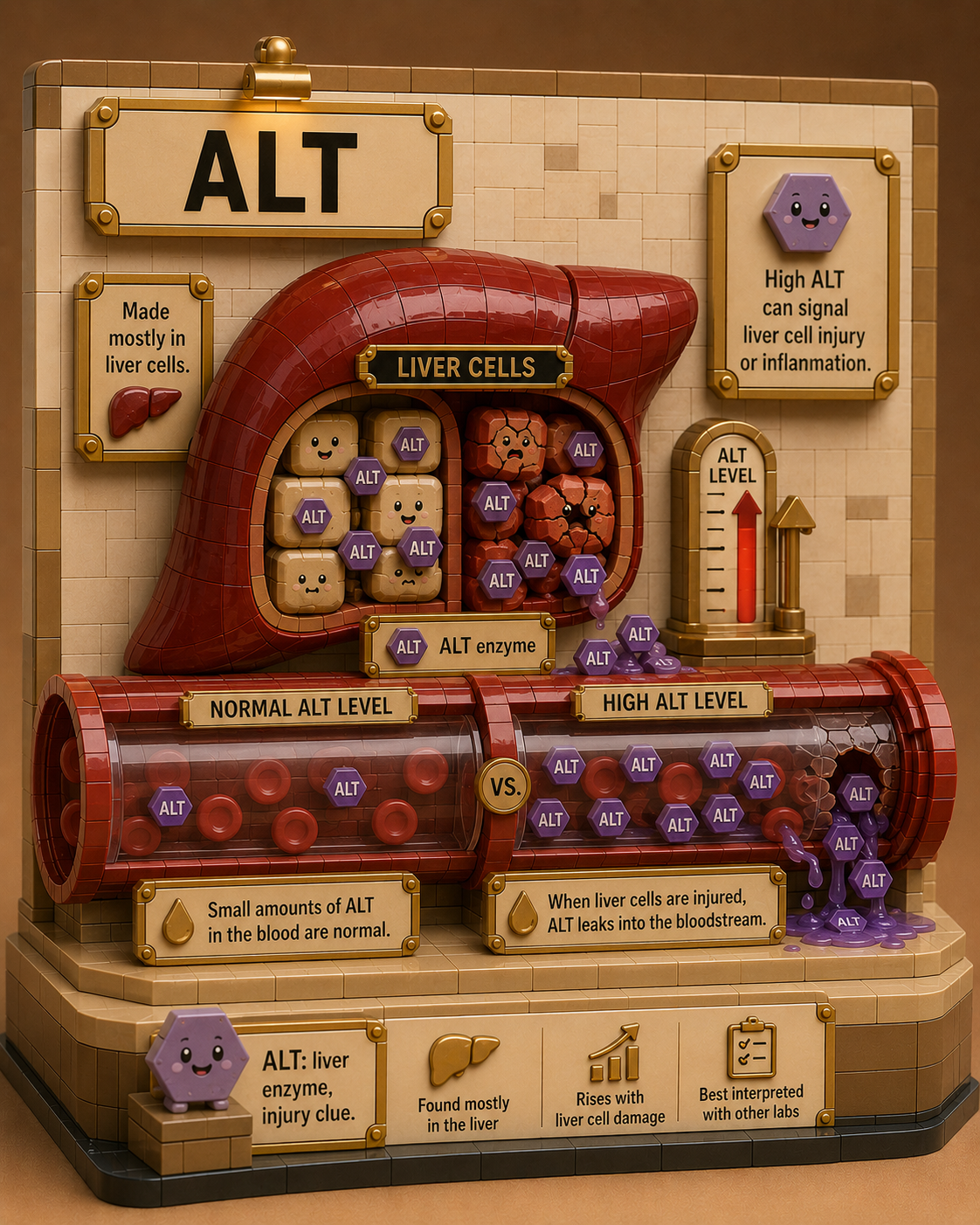
The Burst Balloon Analogy: ALT lives inside your liver cells [Source 3]. When a cell faces friction or an immune attack, it pops and leaks this enzyme directly into your blood, causing a massive lab spike [3].
False Terminal Urgency: A patient with a structurally healthy liver who experiences a sudden, acute reaction to a new medication, or contracts a temporary bout of viral hepatitis, can see their ALT shoot up into the thousands [2]. If ALT were included in the MELD score, this patient would instantly jump to the absolute top of the national transplant list, deeply misrepresenting their condition and stealing a priority organ from someone whose liver is genuinely shutting down [4, 5].
The Cirrhosis Paradox
Running Out of Cells: In advanced cirrhosis, healthy liver tissue has been heavily replaced by inactive scar tissue [Source 2, 5]. Because there are simply fewer functioning liver cells left to get injured, a patient can run out of cells capable of leaking enzymes altogether [2].
Deceptively Low Baselines: A patient actively dying of liver failure can show a completely normal, pristine ALT level [Source 2]. If the MELD score counted enzymes, these critically ill patients would have their priority points stripped away simply because their liver had already "burned out" its enzyme supply [2, 4]. Because a transplant model cannot use a metric that drops lower the sicker a patient becomes, ALT remains a daily tracking tool for inflammation rather than a variable inside allocation math [4].
Check out each of the 5 MELD score components: BISCA
Key Takeaways:
What the Procedure Is
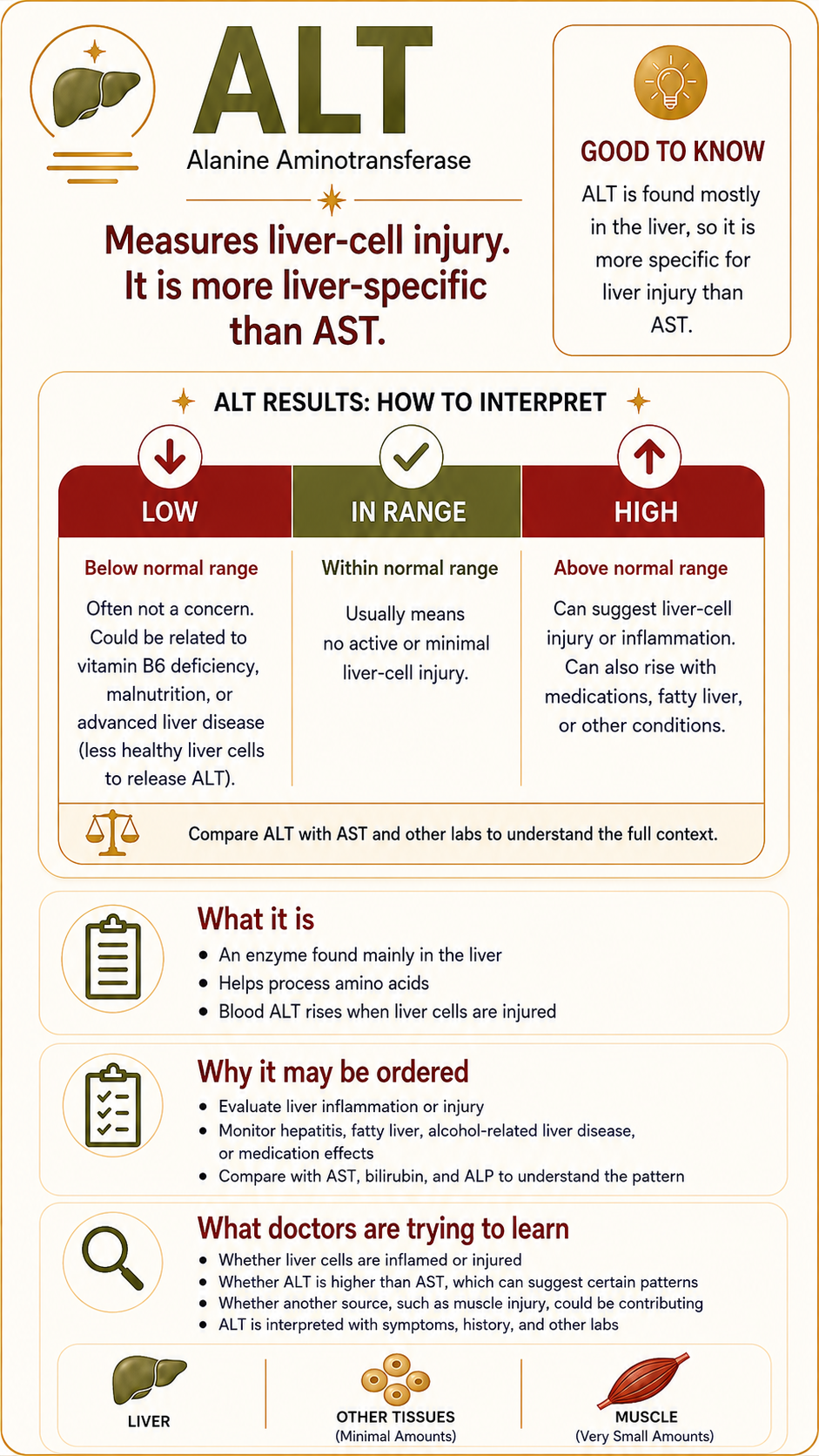
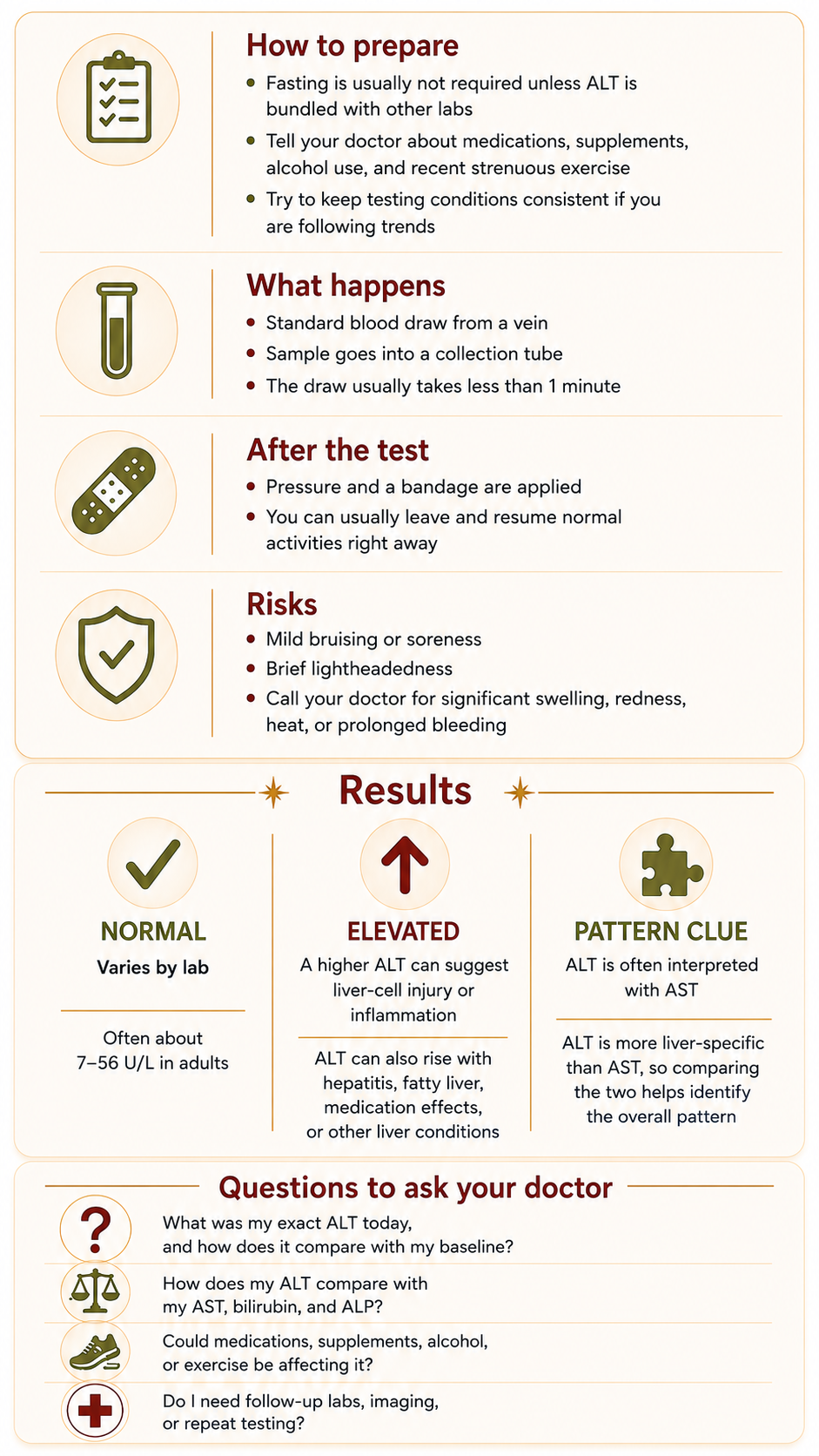
The Alanine Aminotransferase (ALT) test is a routine venipuncture blood draw that measures the exact concentration of the ALT enzyme circulating in your blood plasma [3]. In clinical biochemistry, ALT is a foundational metabolic protein:
The Primary Home: While trace amounts of ALT can be found in your kidneys and muscles, it is heavily concentrated inside the cytoplasm of your liver cells, or hepatocytes [1, 3].
The Chemical Catalyst: Its physiological purpose is to act as a catalyst, helping your liver cells convert proteins into daily cellular energy [3].
Why This Procedure May Be Recommended
Hepatologists and clinical teams order and track ALT levels with intense frequency to monitor the real-time activity of your liver disease [2, 4]. A physician will utilize this marker to:
Monitor Autoimmune Hepatitis Activity: In conditions like autoimmune hepatitis, tracking ALT tells doctors exactly how aggressively your immune system is attacking your liver cells [2].
Assess Response to Immunosuppressants: If you are taking maintenance medications like prednisone or CellCept, a dropping ALT confirms that your therapies are successfully calming the inflammation [2, 5].
Screen for Drug-Induced Liver Injury, or DILI: Cirrhosis patients take complex medication regimens; tracking ALT ensures that a new water pill or prescription isn't accidentally toxic to your cells [4, 5].
Evaluate Inflammatory Flares: Sudden spikes in ALT act as an early clinical warning system that your liver is facing a fresh wave of cellular stress long before you develop visible symptoms like jaundice [2].
What Doctors Are Trying to Learn
When interpreting your ALT levels, a physician is looking past basic numbers to evaluate Hepatocellular Necroinflammation and Transaminase Kinetics [2, 5]. This solves the exact mystery of why this mecca marker can be so unreliable [1].
ALT is a highly sensitive smoke alarm, but it has no idea how much structural fire damage has already happened [2]. A spiking ALT tells a doctor that cells are actively popping right now, but it cannot tell them if your liver is mildly irritated or severely scarred [2, 5].
To get the full picture, doctors cross-reference your ALT with your AST twin to calculate the De Ritis ratio [1]. If both are elevated but your ALT is higher than your AST , it typically points to an active autoimmune or viral attack on the liver cells [1, 2]. However, if your liver advances to deep cirrhosis, that ratio flips—your AST becomes higher than your ALT because chronic structural damage alters how the enzymes clear from your system [2, 5]. Doctors analyze these enzyme movements to ensure they are treating active inflammation rather than chasing a temporary, non-fatal fluctuation [2].
How to Prepare
Ensuring an accurate diagnostic baseline for your ALT test requires following standard laboratory preparation guidelines:
Confirm Fasting Panel Layouts: While a standalone ALT test does not strictly require an empty stomach, it is almost always bundled into blood draws alongside a fasting Comprehensive Metabolic Panel, or CMP, or Liver Function Test, or LFT, requiring zero calories for 8 to 12 hours before entering the lab [1].
Avoid Rigorous Workouts: Do not engage in heavy, exhausting weight lifting or intense exercise within 24 to 48 hours of the test, as severe muscle breakdown can release extra transaminase enzymes into your blood and falsely inflate your liver metrics [1, 3].
Document Supplement Intake: Inform your care team of any over-the-counter herbal supplements or vitamins you take, as common alternative remedies can cause hidden cell irritation that skews your baseline results [4, 5].
What Happens During and After It
The blood collection follows standard, low-risk laboratory venipuncture protocols [3]. A phlebotomist applies a flexible tourniquet to your upper arm, thoroughly treats the skin surface with an antiseptic wipe, and inserts a small needle into a vein near the bend of your elbow to collect a single vial of blood in under a minute [3].
Once the collection is finished, a small gauze pad is pressed firmly over the puncture site and sealed with a standard adhesive bandage [3]. You can leave the laboratory facility immediately, drive yourself home, eat a normal meal, and go about your daily routine without any required downtime [3].
Risks and What to Watch For
The physical risks of a standard liver panel draw are exceptionally minor and resolve quickly on their own [3]. You may experience a brief pinch from the needle, notice a tiny pinpoint bruise at the draw site, or feel a temporary wave of lightheadedness from morning fasting [3].
However, because a cirrhotic liver struggles to manufacture the essential proteins required for blood clotting—a vulnerability heavily compounded if your spleen is trapping your platelets—careful post-care is mandatory [2, 5]. Ensure you apply firm, continuous manual pressure to the gauze pad for several minutes after the needle is removed to effectively prevent prolonged bleeding, localized hematomas, or deep bruising under the skin [2, 5].
What Results May Mean
While exact reference ranges depend slightly on the specific laboratory analyzing the blood, normal ALT levels generally fall between 7 and 56 units per liter (U/L) [2].
Normal Levels: Indicate that there is no widespread, acute liver cell destruction or major active inflammation occurring right now [1].
Mild to Moderate Elevations: Frequently signal ongoing, manageable liver stress from conditions like a fatty liver, localized inflammation, or a mild reaction to a medication [2].
Severe Elevations (10x normal or more): Usually point to a sudden, acute liver emergency, such as an active viral hepatitis infection or acute liver poisoning (like an acetaminophen overdose) [1].
The Cirrhosis Flatline: Just like my personal experience, in advanced cirrhosis, your ALT numbers might not show huge, dramatic spikes [3]. Consensus guidelines point out that because chronic cirrhosis replaces healthy liver cells with permanent scar tissue, there are simply fewer active liver cells left to leak enzymes [3]. This is why a flat or near-normal number can sometimes mask advanced structural changes in the liver [4].
Questions to Ask Your Doctor
To take an active role in your care and confidently navigate your next clinical check-up, consider discussing these targeted questions with your medical team:
What was my exact ALT level on this latest panel, and is it trending upward or downward compared to our last check [1, 3]?
Since ALT can be a little bit unreliable, how does this number balance against my AST twin and total bilirubin to show our true liver health [1, 2]?
Does this current enzyme reading suggest that my autoimmune hepatitis is fully stable on my current doses of medications [2]?
Could any of my recent physical changes or a new prescription be causing my ALT to bounce around on my chart [4, 5]?
If my ALT experiences a sudden, massive spike, what specific physical warning signs, like yellowing of the eyes or deep abdominal pain, require an immediate call to the clinic [2, 4]?
Sources
[1] View the baseline diagnostic details and technical values via the Mayo Clinic Laboratories ALT Testing Catalog.
[2] Review the clinical mechanics of enzyme surges, cellular necroinflammation, and liver stress indexed on the National Institutes of Health PMC Database.
[3] Read about transaminase leakage dynamics, laboratory values, and drawing preparation at the Mayo Clinic Alanine Aminotransferase Guide.
[4] Access liver panel interpretations, non-invasive risk stratification guidelines, and formula omissions through the Journal of Hepatology EASL Clinical Guidelines. [1]ACG Clinical Guideline: Evaluation of Abnormal Liver Chemistries and Enzyme Fluctuations
[5] Study the official diagnostic standards for monitoring drug-induced liver injury (DILI) and autoimmune profiles at the American College of Gastroenterology (ACG) Guidelines on PubMed.
