
Bilirbuin
@diagnosis_cirrhosis 🟡 Why are my eyes yellow? Why is my skin turning yellow? 👀🪞 If you’ve ever stared in the mirror at 2 AM thinking, “can liver disease make your eyes yellow?” or “does yellow eyes mean liver failure?” you are not alone 😵💫 Yellow eyes or yellow skin can happen when a waste compound called bilirubin builds up in your body 🧪🟡 That yellowing is called jaundice — but most people do not search “jaundice” first. They search: “why are my eyes yellow?” “why is my skin turning yellow?” “what should I do if my eyes turn yellow?” Because that is what they can actually see 👀 — 🩸 Where does bilirubin come from? Every day, your body breaks down old red blood cells 🩸♻️ That creates bilirubin. Normally, your liver acts like a filtration plant 🏭 It collects bilirubin, processes it, packages it into bile, and helps move it out of your body 🚽🧪 — 🌊 The lake analogy Think of bilirubin like water flowing into a lake 🌊 💧 Healthy liver: Water flows in, gets processed, and flows out. The lake level stays normal. ⚠️ Damaged liver: Water keeps rushing in… but processing slows down 🐌 or the exit pipes get blocked 🚧 The lake starts rising. And rising. And rising. 🌊 Eventually, it spills over. Except instead of flooding a field… it shows up as yellow eyes and yellow skin 🟡👀 — 🍷 Can alcohol cause yellow eyes? Yes. Alcohol-related liver disease can cause bilirubin to build up, especially when alcohol injures the liver enough that it cannot process bilirubin normally 🚫🍷 Yellow eyes can happen with alcohol-related hepatitis, cirrhosis, or severe liver inflammation. So if you are searching “can alcohol cause yellow eyes?” or “why are my eyes yellow after drinking?” please do not ignore it 🩺 — 👀 Does blurry vision mean yellow eyes? Not exactly. Blurry vision usually does not cause yellow eyes. But vision changes, fatigue, lighting, or staring in the mirror can make you suddenly notice something looks off 👀🪞 So if you are wondering “does blurry vision mean yellow eyes?” or “can vision changes make yellow eyes noticeable?” the key is this: yellowing is about a color change in the whites of the eyes, not just needing new glasses. — 🚨 Why doctors care Yellow eyes are not the diagnosis. They are the warning light. They can mean bilirubin is building up because something is disrupting the system. That could be: 🫀 cirrhosis 🔥 hepatitis 🍩 fatty liver disease / MASLD / MASH 🚫🍷 alcohol-related liver disease 🚧 bile duct blockage 💊 drug-induced liver injury 🩸 red blood cell breakdown ❓ or other causes So yes, if you are searching “can fatty liver disease cause yellow eyes?” or “can fibrosis cause yellow eyes?” the answer is: it depends on severity and what else is happening, but yellow eyes should always be taken seriously. — 👩⚕️👨⚕️🩺 Talk to a doctor or hepatologist immediately if you notice yellowing eyes or yellowing skin. Especially with: 🟡 dark urine ⚪ pale stool 🔥 fever 🤢 nausea/vomiting 😵 confusion 💧 swelling 🩸 bleeding/bruising 😴 extreme fatigue 🍷 alcohol use 📈 known liver disease The cause matters more than the color 💚 #symptoms #yelloweyes #liverhealth #alcoholism #fattyliver ♬ Palm Haze - Dust and Whisper
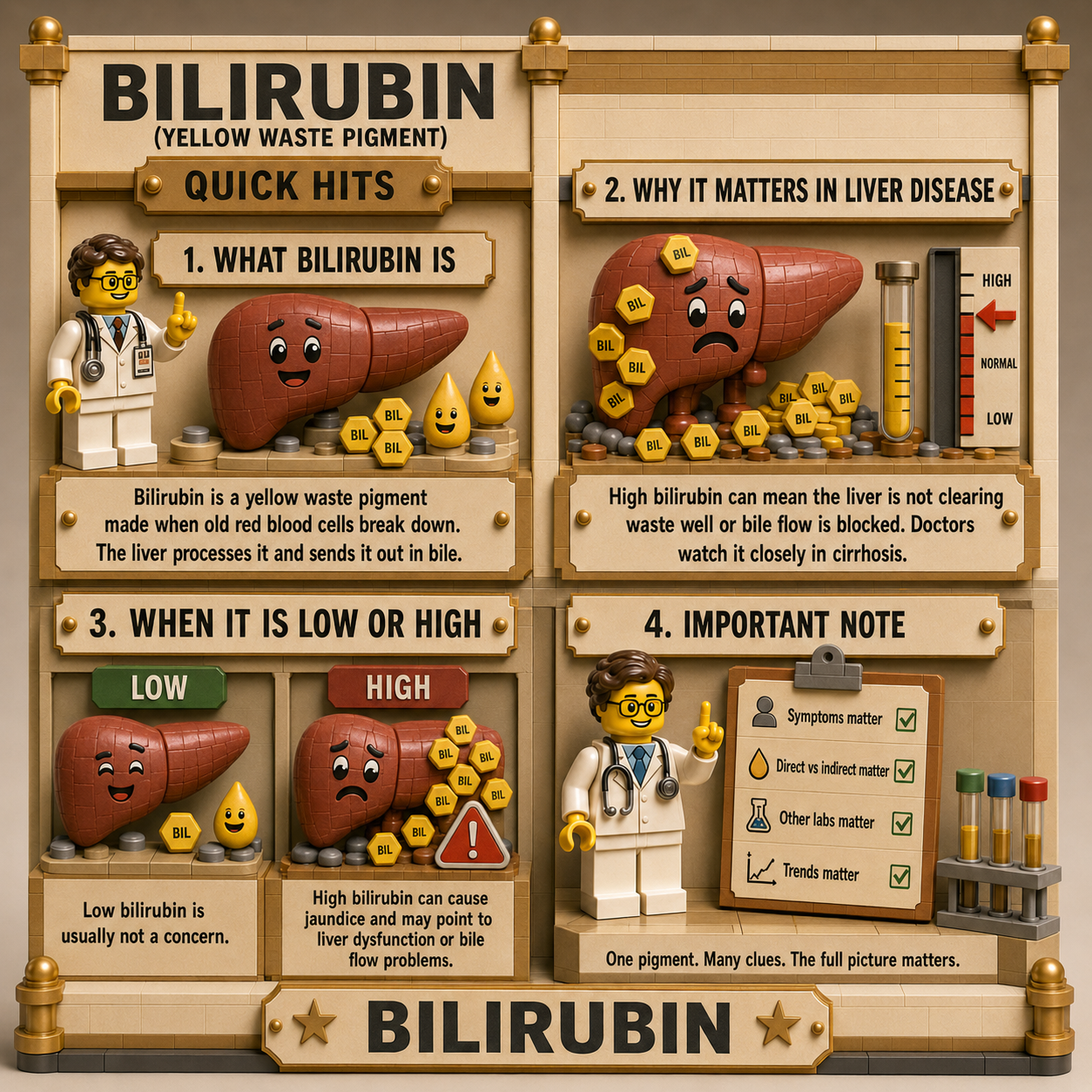
Top 4 Need to Knows:
Important Medical Disclaimer: I am Angie, a cirrhosis patient sharing my personal lifestyle, nutrition, and mindset journey. I am a data aggregator and community builder, not a licensed medical professional, doctor, or dietitian. Content on diagnosiscirrhosis.com is based solely on my personal experience living with advanced liver disease and is intended for informational and educational purposes only. It does not constitute medical advice or a substitute for professional medical care. Always follow the recommendations of your own healthcare team and consult your hepatologist or physician before changing your diet, medication, or lifestyle routine.
My Experience with It
By Angie from @Diagnosis_Cirrhosis on TikTok
Bilirubin is the headliner.
If liver disease had a concert poster, bilirubin would be the name in the biggest font, dramatically backlit in yellow, probably wearing sunglasses indoors.
ASTand ALTare famous too, of course. They are the enzymes people vaguely know to side-eye on bloodwork, especially if they have ever had a relationship with Captain Jack, Tito’s, or whatever charming little bottle convinced them it was a personality.
But bilirubin? Bilirubin has branding.
It has a color.
It has a symptom people recognize before they even know the word for it. Jaundice.
Yellow eyes. Yellow skin. Dark urine. Pale stool. The whole body suddenly entering its legal-pad era.
And honestly, one of the funniest things about bilirubin is that voice-to-text refuses to respect it. Half the time, it turns into some imaginary man named Billy Rubin, which is so perfect I have basically accepted him as a character in the liver disease cinematic universe.
The little yellow menace. The pigment with a publicist.
••• Jump to Key Takeaways •••

The Lab That Came Outside
Bilirubin.AST.ALT. The podium. The big three. The numbers you Google after bloodwork because they sound important and vaguely accusatory.
But bilirubin is different because it does not stay politely trapped in the portal.
When bilirubin is high enough, it makes itself known.
It paints. That was my first real symptom.
Not subtle fatigue.
Not a whisper from my abdomen.
Not some delicate little clue tapping gently on the window.
••• Jump to Why Doctors Care •••
I turned yellow. Not “hmm, maybe the lighting is weird” yellow.
More like:
Why are my eyeballs the shade of canary feathers?
Why do my cheeks look like a legal pad?
Why is my skin suddenly auditioning for a banana double commercial nobody authorized?
Everyone else seemed to understand the plot faster than I did. The minute people saw yellow, their brains jumped to liver, jaundice, bilirubin.
Meanwhile, I was somehow the last person at the hepatic crime scene to realize the caution tape was for me.
Pantone. Palette. Pee. Poop. Pruritus
It is one of the most famous liver markers, and yet when it happens to you, it can still feel impossible to process.
Maybe because jaundice is something we mostly associate with babies. It does not feel like something that should suddenly be reflected back at you in your own bathroom mirror.
And the itching.
I have somehow sidestepped such a specific circle of hell (for now), but so many of my friends are miserable from it. Liver itch.
Between the toes. Deep in the ear like your brain has a rash. Waking up with bloody feet from scratching in your sleep. Feeling like the itch is inside your body and your nails are just useless little velvet pebbles.
It is abominable. Bilirubin may have branding, but itching is the deranged DJ.
My highest documented bilirubin was around 12, but that number came weeks after I had already turned dramatically yellow, so who knows what the actual peak was. By the time anyone started measuring the mess properly, Billy Rubin may have already finished his opening number and moved into the encore.
And even now, bilirubin is one of the numbers I watch closely because mine likes to bounce.
It flirts with improvement. It gets close. 1.2 is like an old groupie
It has been one of the last labs to approach the normal range for me, and it still has not fully crossed that line. Maybe it will. Bilirubin has taught me that stabilization does not always mean every number files neatly back into place like well-behaved office supplies.
Total, Direct, and Indirect Bilirubin
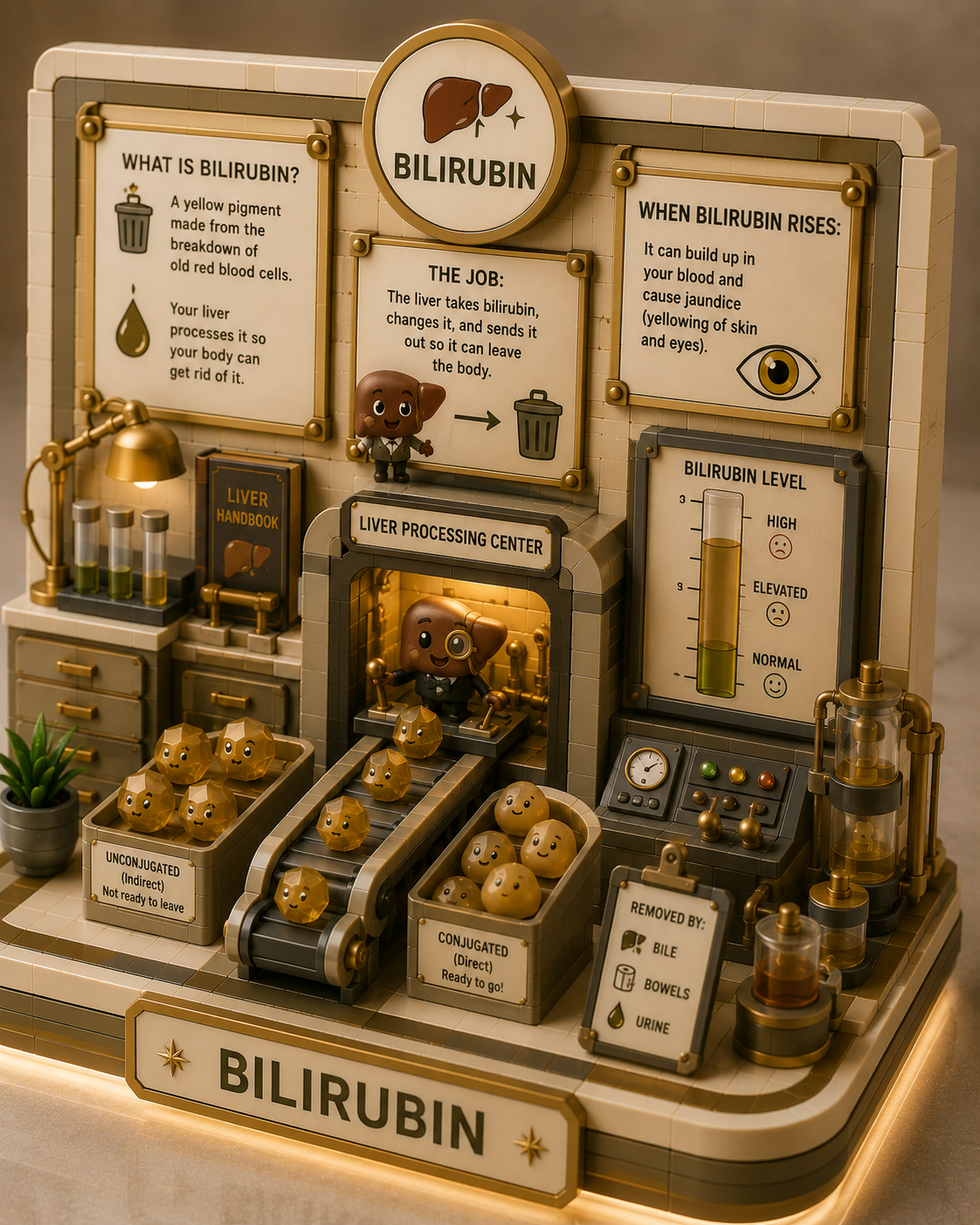
@diagnosis_cirrhosis 🟡🧪 Bilirubin (bill-ih-ROO-bin): the waste you can actually see 👀 why is my doctor checking bilirubin? 🤔 what does high bilirubin mean? 📈 why do eyes turn yellow? 🟡 what’s direct vs indirect bilirubin? 🧪 is this from my liver… or something else? ❓ — 🧪 what is bilirubin? bilirubin is waste from old red blood cells 🩸 your body is constantly recycling them… so there’s always some being made 👉 your liver’s job is to: - take that waste - process it - and move it out of your body — 🔁 the key concept (this is everything) same waste… two forms: 🟡 indirect bilirubin = unprocessed, not ready to leave 🟡 direct bilirubin = processed, ready to leave 👉 the liver converts indirect → direct 👉 then sends it out through bile — 🚪 what’s supposed to happen direct bilirubin → flows out through bile → leaves your body — ⚠️ what happens when it doesn’t bilirubin builds up in your blood 👉 and this is one of the few labs where… you can actually see it 👀 - yellowing of the eyes (scleral icterus) - yellowing of the skin (jaundice) — 💥 why this happens it’s usually one of three buckets: 🧠 1. too much being made - red blood cells breaking down faster than normal (hemolysis) 🏭 2. the liver can’t process it well - cirrhosis 🫀 - hepatitis 🦠 - liver injury 💊 - or other causes 🚧 3. it can’t flow out (blockage) - bile duct issues - gallstones - inflammation - or other causes — 🔬 why doctors care about direct vs indirect 👉 indirect high → think production or processing problem 👉 direct high → think flow or blockage problem this is how they figure out where the issue is — 🫀 cirrhosis connection with fibrosis → cirrhosis: - the liver struggles to process bilirubin - flow through the system becomes impaired 👉 so bilirubin rises as the system gets overwhelmed — 🧬 causes of cirrhosis autoimmune hepatitis 🔥 fatty liver disease (MASLD / NAFLD / MASH / NASH) 🍩 alcohol-related liver disease 🚫🍷 hepatitis B 🦠 hepatitis C 🦠 primary biliary cholangitis (PBC) 🧬 primary sclerosing cholangitis (PSC) 🧬 hemochromatosis ⚙️ Wilson’s disease 🪙 alpha-1 antitrypsin deficiency 🧩 drug-induced liver injury 💊 cryptogenic cirrhosis ❓ or other causes 🫀 — 🫀🫘 real talk bilirubin isn’t just a number 👉 it’s a signal that: - waste is building up - and the system isn’t clearing it properly — 👩⚕️👨⚕️🩺 always talk to your doctor hepatologist 🫀 kidney doctor / nephrologist 🫘 or general doctor 👉 don’t guess if it’s a symptom 👉 don’t assume the cause your doctor will look at: - direct vs indirect bilirubin - AST / ALT - ALP / GGT - symptoms + trends because the cause matters more than the number 🧩 — #bloodwork #symptoms #liverhealth #fattyliver #medicalhumor ♬ original sound - diagnosis cirrhosis
The other thing that confused me early on was the whole total bilirubin, direct bilirubin, indirect bilirubin situation.
Because when you are new to liver disease, seeing a brand new word show up in multiple forms feels sloppy,
Total sounds like the whole thing. Direct also sounds like it should be the main thing, because direct feels very official. Very decisive. Very “I brought the answer.”
Then indirect shows up like a mysterious cousin nobody mentioned.
And suddenly you are comparing numbers that are not meant to be compared the way you are comparing them.
I absolutely did that.
I would look at one result, then another, then wonder why my bilirubin seemed so much better or worse, only to realize later that I was not always looking at the same version of the number.
Total bilirubin is the overall amount.
Direct bilirubin is the portion that has been processed by the liver and made water-soluble.
Indirect bilirubin is the portion that has not gone through that processing yet.
So no, you do not need to become a bilirubin mathematician.
This is not a fractions unit with malice.
The Paintbrush Lab
For me, bilirubin became memorable because it was the first lab that did not just live on paper.
It showed up on my face. It changed my eyes. It was the literal poster child of my disease..
It made liver disease visible before I had language for what was happening.
AST and ALT may whisper injury.
INR may ask whether the liver is still manufacturing what the body needs.
Albumin may show the factory slowing down.
Creatinine & Sodium are looking out for the kidneys.
But bilirubin? Bilirubin walks in with a highlighter. Commanding: Look here
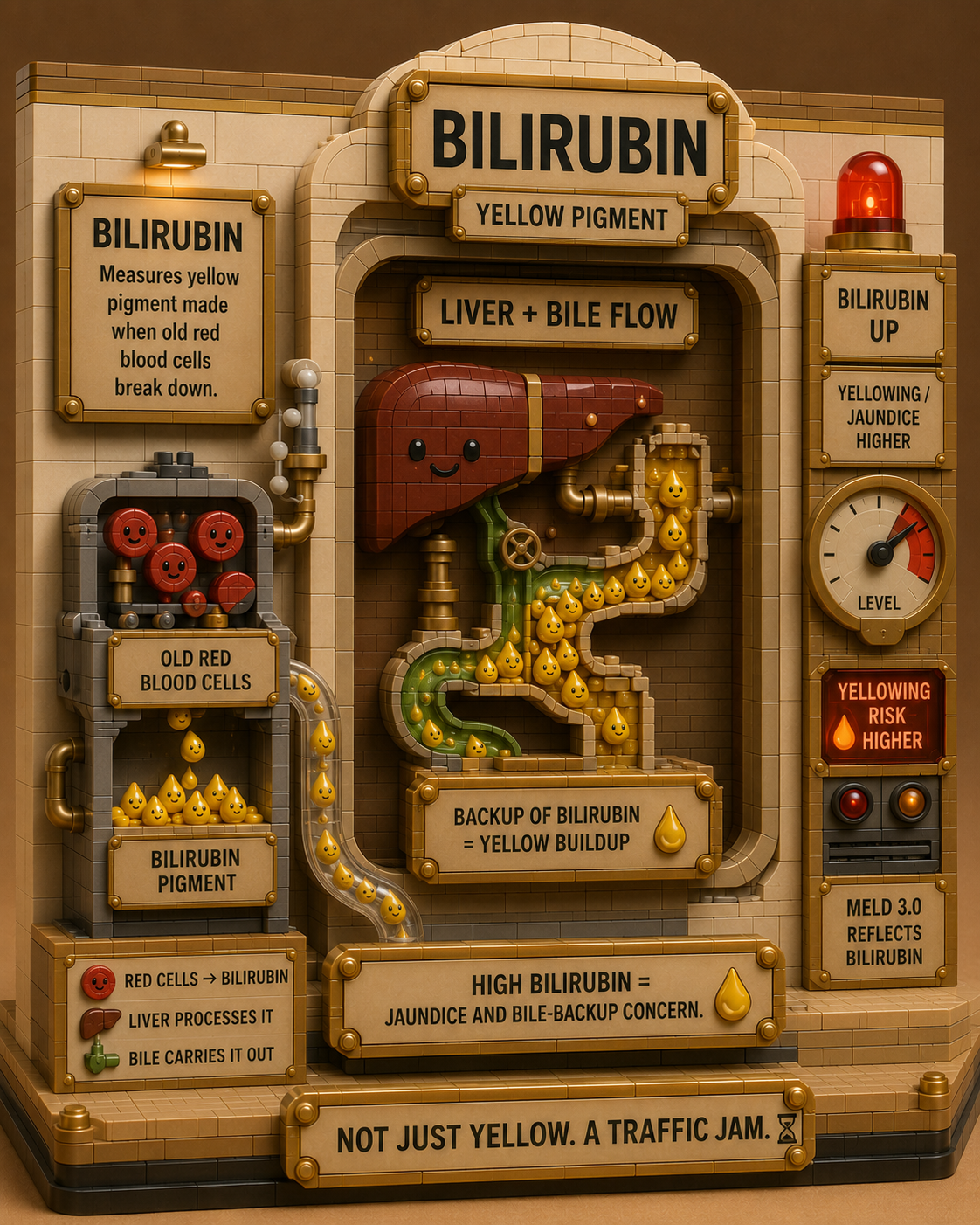
Why It Matters in MELD 3.0
Bilirubin s a founding, non-negotiable cornerstone of the Model for End-Stage Liver Disease, or MELD, score calculation [4]. While enzymes like ALT and AST measure active, temporary cell injury, bilirubin is a specific, un-fakable metric of your liver’s remaining functional survival capacity [2, 4].
The Pure Signature of Liver Failure
The primary reason bilirubin is cemented into the MELD formula is that its accumulation in the blood represents a true, systemic filtration collapse [4].
An Objective Predictive Metric: When a liver is atrophying, it loses its physical capability to clear bilirubin from the bloodstream [2]. Unlike other blood values that can bounce around based on a simple muscle ache or yesterday's workout, a climbing bilirubin score is a pure, objective mathematical indicator of progressive organ failure [4].
Calculating the Transplant Priority: Because international clinical data proves that a patient's short-term mortality risk scales exponentially higher the more bilirubin stacks up in their plasma, your exact bilirubin number is a primary driver that dictates your ranking position on the national liver transplant waitlist [4].
The True Siren of Disease Severity
Isolating the Excretory Reality: While sodium tracks circulatory fluid shifts and albumin reflects long-term protein synthesis, neither marker measures active hemoglobin recycling waste disposal [3, 4]. Omitting bilirubin strips the equation of its only direct metric for tracking real-time canalicular transport overloads and systemic filtration failure [2, 4]. Including bilirubin ensures that a complete shutdown of the liver's clearing engine is mathematically accounted for [1, 4, 5]
Read more about what else is included in the MELD 3.0:
Key Takeaways:
Find Out More
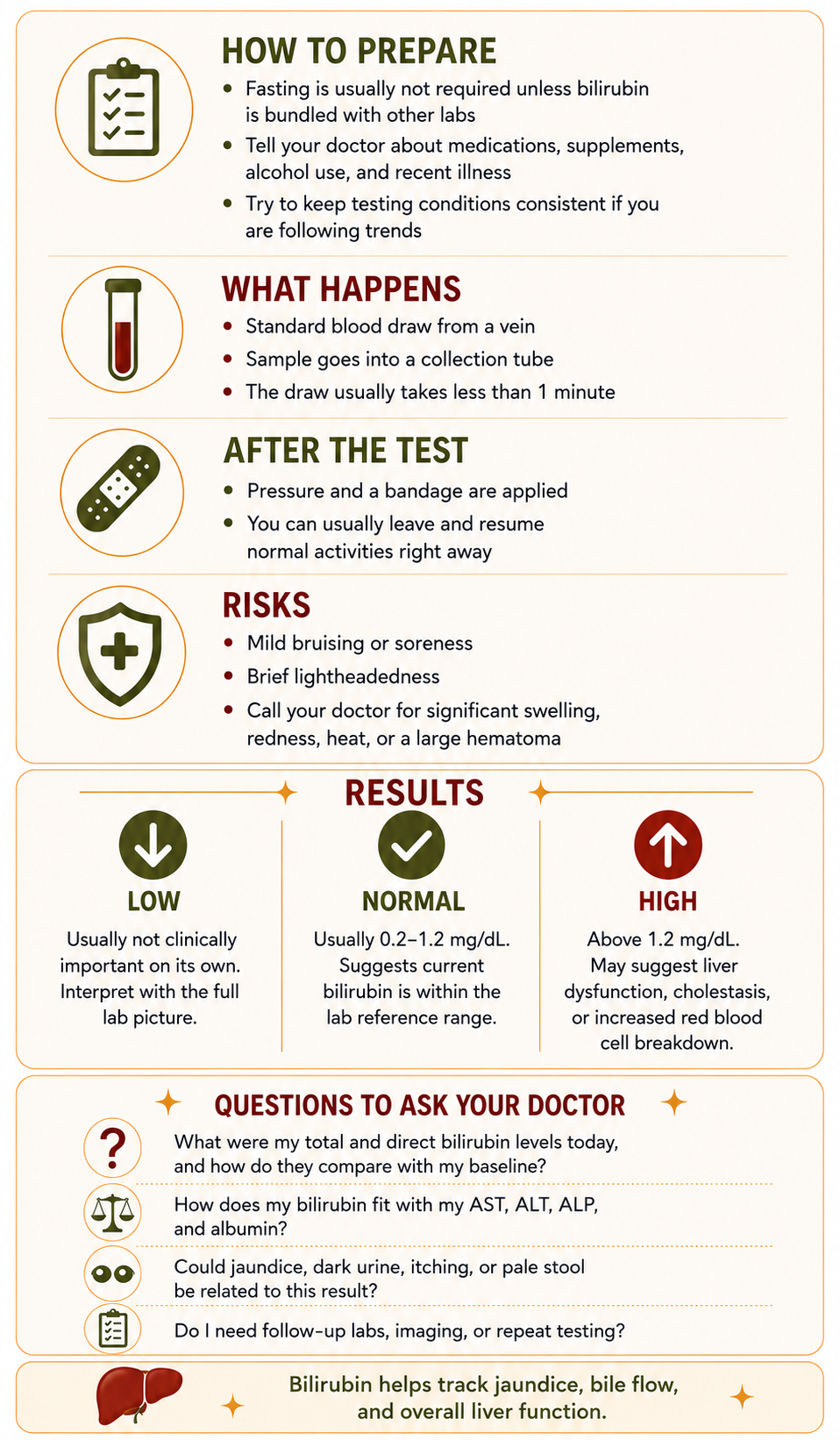
What the Procedure Is
The serum bilirubin test is a routine venipuncture blood draw that measures the exact concentration of this yellowish-orange pigment circulating in your blood plasma [3]. In human biology, bilirubin is an unavoidable byproduct of daily life and red blood cell degradation [3]:
The Recycling Plant: Your body constantly destroys old, worn-out red blood cells, breaking down their iron-rich hemoglobin [3]. This breakdown creates raw bilirubin, which travels through your blood directly to the liver to be processed, packaged, and excreted through your bile into your digestive tract [1, 3].
The Structural Breakdown: A standard lab panel tracks this pigment through three distinct metrics: Indirect, or Unconjugated, Bilirubin, which is the raw waste traveling to the liver; Direct, or Conjugated, Bilirubin, which is the processed waste traveling out of the liver; and Total Bilirubin, which is the combined sum of both lines [1].
Why This Procedure May Be Recommended
Hepatologists and medical teams order and monitor bilirubin levels with absolute, intense frequency to evaluate the functional health and plumbing of your liver [2, 4]. A physician will utilize this marker to:
Assess the True Excretory Function: Bilirubin is the ultimate test of your liver's clearing power; a climbing number tells doctors that your liver's internal filtration mechanics are actively falling behind [2].
Monitor the Onset of Jaundice: Tracking bilirubin allows doctors to catch a biochemical rise long before it manifests physically as visible yellowing of your sclera, or eyes, or skin [3, 4].
Screen for Biliary Plumbing Blockages: In cirrhosis, structural scarring or compressed bile ducts can physically trap processed bile; tracking direct bilirubin tells doctors if the liver's external plumbing is blocked [4, 5].
Calculate Daily MELD Priority Scores: Continuous tracking of total bilirubin is mandatory to run the mathematical formulas that determine your priority rank on the national organ list [4].
What Doctors Are Trying to Learn
When analyzing your bilirubin trends, a physician is investigating Hepatic Conjugation Efficiency and Canalicular Transport Mechanics [2, 5]. This solves the exact clinical mystery of why this "painter" marker has so much complexity to it [1].
By breaking down your total bilirubin into direct and indirect lines, doctors can run an instant microscopic audit on your liver's internal processing plant [1, 2].
If your overall number is high but your Indirect, or Unconjugated, Bilirubin makes up the majority of the spike, doctors learn that your liver cells are being completely overwhelmed by a massive wave of red blood cell destruction, or that your cells are too irritated to grab the raw waste out of your blood [1, 2].
However, if your Direct, or Conjugated, Bilirubin is the primary driver of the spike, it tells an entirely different story: your liver cells are still successfully performing the chemical work of packaging the waste, but your liver's internal transport channels or biliary plumbing are too compressed by scar tissue to flush that processed fluid out into your gut [2, 5]. This microscopic insight tells your care team exactly where the system is breaking down, helping them adapt your treatments to keep your internal pathways moving safely [5].
How to Prepare
Ensuring an accurate diagnostic baseline for your bilirubin test requires following standard laboratory preparation guidelines:
Strictly Maintain Fasting Demands: Bilirubin levels are exceptionally sensitive to digestion and metabolic shifts [1, 3]. You must fast with zero calories for 8 to 12 hours before entering the lab, consuming only plain water, as eating a meal can cause sudden waves of bile movement that distort your true baseline [1].
Avoid Strenuous Physical Exertion: Do not engage in exhausting weight lifting or extreme physical training within 24 to 48 hours of your draw, as intense muscle stress can accelerate red blood cell breakdown and artificially inflate your circulating pigment levels [1, 3].
Disclose Specialized Supplements: Inform your medical team of any over-the-counter vitamins or herbal remedies you take, as certain alternative therapies can directly interfere with how your liver cells process and conjugate pigments [4, 5].
What Happens During and After It
The blood collection follows standard, low-risk laboratory venipuncture protocols [3]. A phlebotomist applies a flexible tourniquet to your upper arm, thoroughly treats the skin surface with an antiseptic wipe, and inserts a small needle into a vein near the bend of your elbow to collect a single vial of blood in under a minute [3].
Once the collection is finished, a small gauze pad is pressed firmly over the puncture site and sealed with a standard adhesive bandage [3]. You can leave the laboratory facility immediately, drive yourself home, eat a normal meal to break your fast, and resume your daily routine without any required downtime [3].
Risks and What to Watch For
The physical risks of a standard liver panel draw are exceptionally minor and resolve quickly on their own [3]. You may experience a brief pinch from the needle, notice a tiny pinpoint bruise at the draw site, or feel a temporary wave of lightheadedness from morning fasting [3].
However, because a cirrhotic liver struggles to manufacture the essential proteins required for blood clotting—a structural vulnerability heavily compounded by the low platelet counts common in portal hypertension—careful post-care is mandatory [2, 5]. Ensure you apply firm, continuous manual pressure to the gauze pad for several minutes after the needle is removed to effectively prevent prolonged bleeding, localized hematomas, or deep bruising under the skin [2, 5].
What Results May Mean
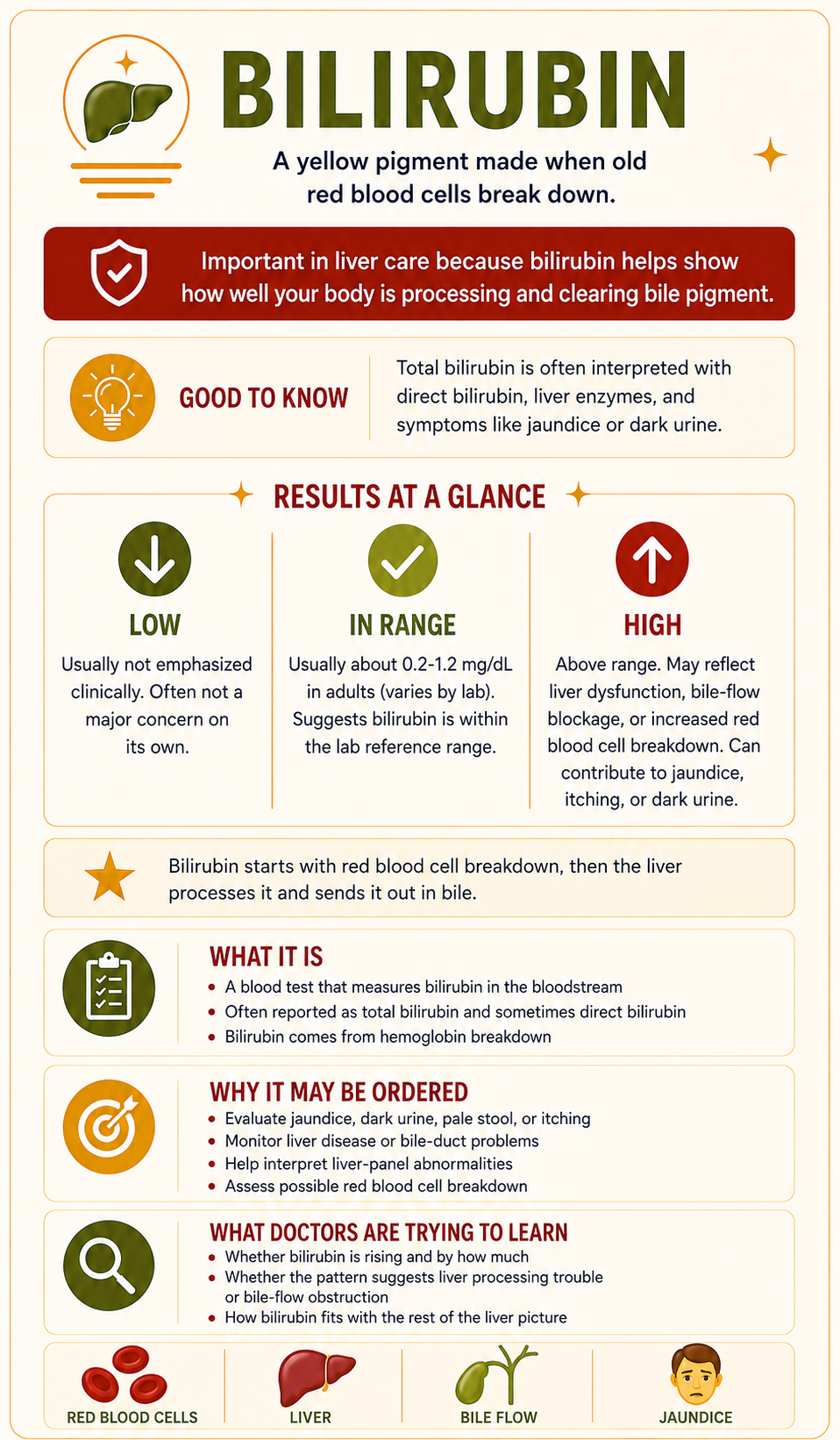
Standard reference ranges for adult total serum bilirubin typically range between 0.1 and 1.2 mg/dL, or milligrams per deciliter, with direct bilirubin staying strictly below 0.3 mg/dL [1]:
Stable Normal Baseline — 0.1 to 1.2 mg/dL: Falling neatly within this reference range is an incredibly reassuring sign, confirming that your liver's recycling machinery is fully functional, your bile channels are clear, and your body's waste processing is operating in a stable equilibrium [2, 4].
Mild to Moderate Elevation — 1.3 to 2.5 mg/dL: This is the early warning zone where Billy Ruben starts to act up [1]. In a cirrhosis patient, it signals that your liver's processing lines are beginning to fall behind due to an active autoimmune flare, medication stress, or advancing tissue scarring, prompting closer monitoring [2, 4].
Highly Elevated Bilirubin — >2.5 mg/dL to Double Digits: Severe spikes point to an advanced filtration crisis [1]. Once total bilirubin climbs past 2.5 or 3.0 mg/dL, it overflows into your tissues, causing physical jaundice, meaning yellowing of the eyes and skin, and severe skin itching [3, 4]. It serves as a major, high-stakes alarm telling your medical team that your liver's survival capacity is dropping, which will directly drive up your MELD priority points on the transplant waitlist [4, 5].
Questions to Ask Your Doctor
To take an active role in your care and confidently navigate your next clinical check-up, consider discussing these targeted questions with your medical team:
What was my exact Total Bilirubin number on this panel, and has it shown any unexpected climbs compared to our last check [1, 3]?
How does my total number break down between Direct and Indirect bilirubin, and what does that tell us about our internal plumbing [1, 2]?
Does my current bilirubin baseline show that my MELD score is holding stable, or are we creeping into a higher priority bracket [4]?
Could any of my current autoimmune or water pills be secretly impacting how my liver cells conjugate or flush out this pigment [4, 5]?
At what specific numerical spike in my bilirubin should we worry about physical jaundice or biliary blockages, and what steps will we take to manage it [2, 4]?
Sources
[1]: Mayo Clinic Laboratories: Total, Direct, and Indirect Serum Bilirubin Reference Standards, Conjugation Equations, and Fasting Interferences.
[2]: World Journal of Gastroenterology: Pathophysiology of Bilirubin Accumulation, Hepatic Excretory Failures, and Canalicular Transport Overloads in Cirrhosis.
[3]: National Institutes of Health (NIH) / MedlinePlus: Understanding Liver Function Panels, Hemoglobin Recycling Waste, and Jaundice Diagnostics.
[4]: Journal of Hepatology: Consensus Guidelines on Liver Allocation Formulas, MELD Scoring Non-Negotiables, and Survival Predictors in End-Stage Hepatology.
[5]: The American Journal of Gastroenterology: Clinical Guidance on Biliary Plumbing Compression, Chronic Jaundice Dynamics, and Longitudinal Bilirubin Tracking.
